The Map That Builds Itself
Soren had a theory, and the theory was wrong, and he was discovering this one lap at a time.
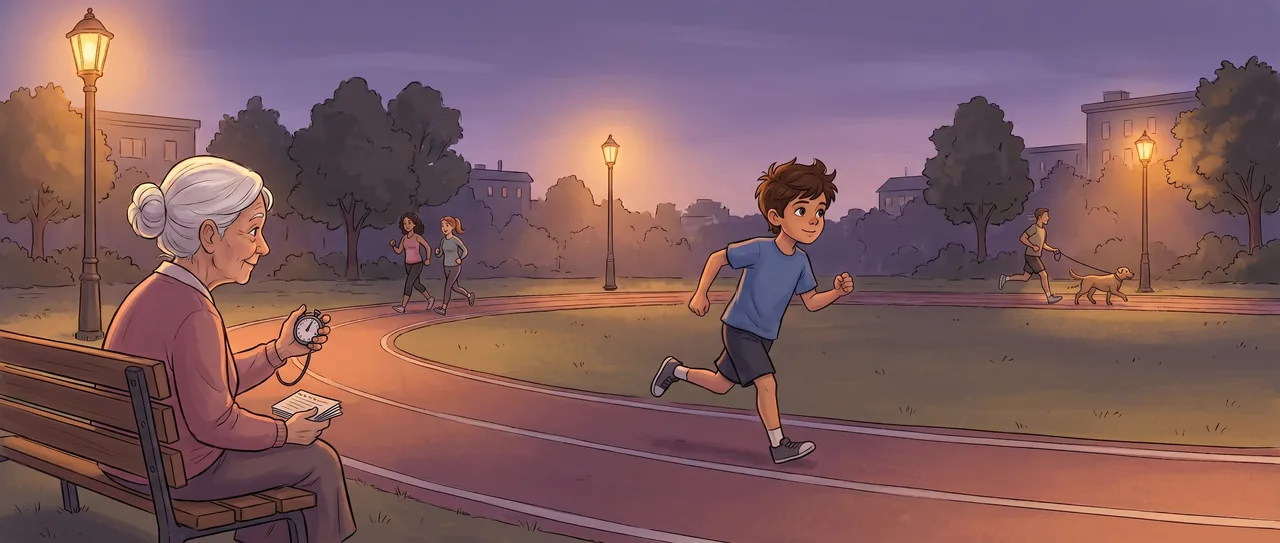
The project was supposed to be simple. Memorize a list of fifty words while sitting still. Memorize a second list while walking. Compare. He had read that exercise helped the brain, and he wanted to prove it cleanly, the way a good experiment should prove things. His grandmother sat on the bench at the edge of the track with the index cards and a stopwatch, because she had insisted on coming and she had insisted on being useful.
The trouble was the numbers refused to behave.
Walking, he remembered thirty-one words. Sitting, he remembered thirty. One word. That was nothing. That was noise. He had wanted a mountain and gotten a pebble.
"It's not working," he said, dropping onto the bench beside her.
"What were you expecting?" Grandma asked. She was eighty-one and had taken up the violin two years ago, badly, loudly, every single morning. Nobody in the family understood why.
"A big difference. The website said exercise grows new brain cells. New neurons. In the hippocampus, which is where you make memories." He flipped his notebook shut. "So walking should have helped a lot. It barely helped at all."
Grandma considered this. "How long did you walk for?"
"Like, eleven minutes."
"And you expected to grow new brain cells in eleven minutes."
Soren opened his mouth and then closed it.
He had not actually thought about the timing. He had treated the brain like a light switch. Walk, switch on, remember better. But neurons were not switches. Cells took time. Days. Weeks. Whatever was growing in there was not going to show up on a stopwatch tonight.
"So my whole experiment is measuring the wrong thing," he said slowly. "I'm measuring tonight. But the thing I care about happens over weeks."
"Mm," said Grandma, which was the sound she made when she agreed but wanted you to keep going.
He stared at the track. The lamps had come on, pale orange against a sky going purple. A few other people were out. A man jogging with a dog. Two women walking fast and talking faster, never pausing, building some enormous shared story between them.
Soren watched the two women loop the track. He thought about what the article had actually said, the parts he had skimmed past because they did not fit his clean little plan. New neurons in the hippocampus. Born in adults. Not just children. Adults. Old adults. The supply did not shut off at a certain birthday and coast on whatever was left.
And the things that fed it were a strange list. Exercise. Yes. But also learning something genuinely new. And other people. Conversation. The hard work of paying attention to another mind.
The things that starved it were on a list too. Mostly one big thing, repeated. Long stretches of stress with no relief. The brain, under siege, slowed its own construction.
"Grandma," he said. "Why did you start the violin?"
She laughed, a short bark. "Everyone asks like I committed a crime. Your aunt thinks I've lost my mind."
"I don't think that. I'm asking why."
She was quiet for a moment, turning the stopwatch over in her hand. "After your grandfather died, the days got very flat. Same chair. Same window. I could feel myself getting smaller. Narrower. Like a path getting overgrown." She shrugged. "The violin was the hardest thing I could think of. I'm terrible at it. Every morning I am completely terrible at something new. And I noticed, after a few months, that I didn't feel narrow anymore."
Soren sat very still. She had been doing the experiment for two years. He had been trying to do it in eleven minutes.
"You can't measure it on a stopwatch," he said. "That's not the experiment failing. That's the experiment being too short."
"So what's the right length?"
He looked at her. Eighty-one. Sawing away at a violin in the kitchen at six in the morning, growing something nobody could see.
"Years," he said. "Maybe the right length is years."
The two fast-walking women passed the bench again, mid-sentence, building their story. The jogger and his dog cut across the infield. Soren watched all of them moving through the orange light and understood that every one of them was, right now, in the dark inside their skulls, manufacturing brand new pieces of brain. Not replacing old ones. Adding. The map was not finished and handed to you at birth. The map kept drawing itself. Walking drew it. Talking drew it. Being terrible at the violin every morning drew it.
And the most ordinary part of it was the strangest. You could not feel it happening. There were no nerves in there to report it. His grandmother had grown two years of new cells and the only evidence she had was that one morning the days stopped feeling flat.
"My project is wrong," Soren said, and he was almost happy about it. "I was trying to prove walking makes you smart by tonight. But the real thing is so much bigger. The brain is building itself the whole time you're alive. As long as you keep giving it hard things."
"Is that a worse project or a better one?"
He didn't answer right away. He picked up his pen. Then he set it back down, because writing it felt too small for the size of the thing.
He got up from the bench instead.
"Time me again," he said. "Not for the word list. I just want to run."
Grandma raised the stopwatch. "Why?"
"Because I can't feel it," he said, "and I want to know it's happening anyway."
She pressed the button. Soren ran out into the orange light, past the jogger, past the two women still talking, his feet hitting the track in the dark, somewhere far below his thoughts where a curl of cells was quietly drawing one more line on a map that would never be finished.
Read the interactive version, listen to the narration, and earn a gold star →
A science-verified short story for curious kids · Curiosity Land