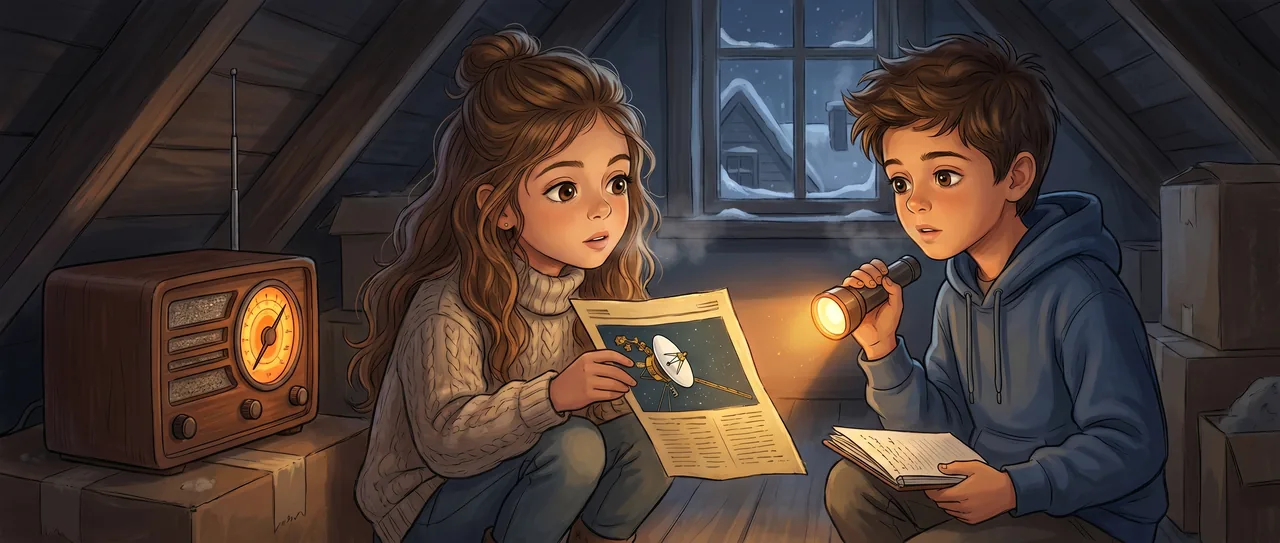
The Long Hello
The radio in Grandma Lin's attic was older than both of them put together, and it hissed like the sea.
Maya turned the dial slowly. Soren held the flashlight and his notebook, which he had brought up the ladder under his chin because his hands were full.
"There," Maya said. A voice swam up out of the static, a man reading numbers in another language, then sank again. "Where is that from?"
"Could be anywhere," Soren said. "Shortwave bounces off the sky. The signal goes up, hits a layer in the air, comes back down a thousand miles away. Grandma said she used to hear ships."
"A thousand miles," Maya said. She kept turning. The hiss returned, soft and endless, like something breathing very far off.
Soren wrote down nine forty-one PM and a thousand miles, then stopped, because the hiss was bothering him in a way he couldn't name.
"That sound," he said. "The static. Some of that isn't from Earth."
Maya took her hand off the dial. "What do you mean."
"Grandma told me once. A little bit of the hiss every radio makes is from space. Old light. Stuff left over from the start of everything." He frowned at his own sentence. "I don't fully get it. But she said no radio is ever truly quiet."
Maya leaned back against a box of Christmas ornaments and looked at the slanted ceiling like she could see through it.
"So if you can hear a ship a thousand miles away," she said slowly, "and you can hear leftover space in the quiet parts, then how far away is the farthest thing we've ever talked to?"
Soren opened his mouth to guess and found he didn't have a number. "The Moon?"
"People walked on the Moon. That's close." Maya was sitting up now. "Farther."
"Mars, then. We have robots on Mars. We talk to them."
"How long does that take? The talking?"
Soren did the kind of arithmetic he did in his head, the slow careful kind. "Light goes really fast. But Mars is far. Minutes, maybe. Like, ten or twenty minutes for a message to get there."
Maya stared at him. "You send a message and wait twenty minutes for it to even arrive."
"And twenty more for the answer." Soren felt the size of that settle onto him. He wrote forty minutes round trip, Mars. Then he sat with the pencil not moving.
Because Mars wasn't the farthest. He knew it wasn't. There was something out past everything, something his grandmother had a clipping about, taped inside the cabinet of this exact radio, yellow at the edges.
He shone the flashlight on the little door. The clipping was still there. A photograph of a spacecraft with a big white dish, gold foil, an antenna like an open hand.
"Voyager," he read. "Launched nineteen seventy-seven."
Maya counted on her fingers and gave up. "That's older than Grandma's radio acting old. That's almost fifty years ago."
"It never stopped," Soren said. "It's still going. It's still on." He read the small print, holding the light close. "It left the solar system. In twenty twelve. The first thing people ever made that got all the way out. Past the planets. Past where the Sun's wind stops pushing."
"Out into the actual space between the stars," Maya said. She said it quietly, the way you say something you don't want to scare off.
"And." Soren stopped. He read the line three times to be sure he was reading it right. "And we can still hear it."
The attic was very quiet except for the breathing hiss.
"How long," Maya said. "For its message. To get here."
Soren had the Mars number. Forty minutes round trip. He looked at the word interstellar and he thought about the ship a thousand miles away, and the leftover light in the static, and he understood that he was about to say a number that didn't belong in an attic.
"More than twenty-two hours," he said. "One way."
Maya didn't say anything.
"You send it hello," Soren went on, because now he had to, "and the hello travels all day and all night, basically a whole day, going as fast as anything can possibly go, and that's just to arrive. And if it answers, that's another whole day coming back."
"Two days," Maya whispered, "for one hello and one answer."
"It's so far that the fastest thing in the universe takes a day to cross it." Soren put the pencil down. His hand wasn't steady enough to write.
Maya was up on her knees now, both palms flat on the floorboards. "Soren. The hello we hear today. We didn't send it today."
He looked at her.
"We sent it yesterday," she said. "Whatever it's telling us right now, right this second, it's the answer to a question somebody asked yesterday. The Voyager that's talking to us tonight, the real one, it's already a whole day farther away than the voice we're hearing."
Soren felt the floor of the attic stretch, in his mind, out through the wall, past the snow, past the air where shortwave bounced, past the Moon, past Mars and its forty patient minutes, out past the edge where the Sun stops pushing, to a thing the size of a car, alone in the dark, still holding up its one open antenna hand toward a planet it left when his grandmother was young.
"It can't see us," he said. "It doesn't know if anyone's still listening. It just keeps sending."
"And we keep answering," Maya said. "Even though it takes two days. Even though it's that far. Somebody, right now, is keeping the line open."
She turned and looked at him, and her face had the look it got when an idea was too big to stay inside one person.
"That's the longest conversation anyone has ever had," she said. "And it's still going. Right now. Tonight."
Soren reached over and turned the volume up on the old radio, all the way, until the hiss filled the whole attic, the breathing sound, the ships and the sky and the leftover beginning of everything.
Somewhere inside it, twenty-two hours out and climbing, was a voice they would not hear until tomorrow.
They sat in the dark and listened to all of it at once.
Read the interactive version, listen to the narration, and earn a gold star →
A science-verified short story for curious kids · Curiosity Land