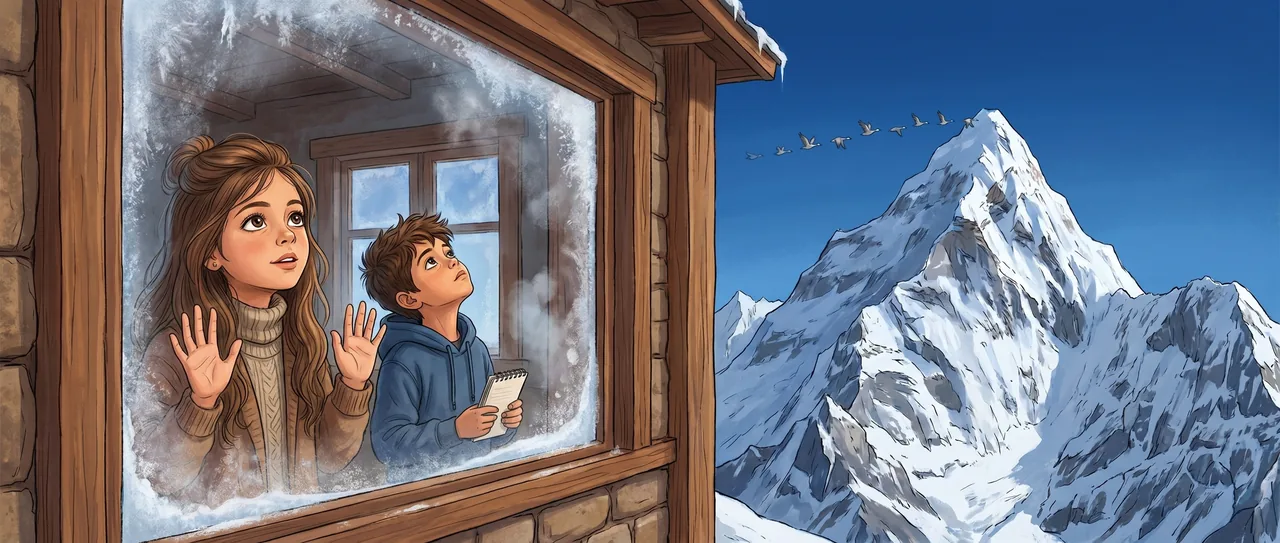
The Geese That Went Over
The window of the rest house had frost on the inside. Maya breathed on it and watched her own breath disappear, then come back. Outside, the snow had stopped, and the sky over the pass had gone the deep hard blue you only get when the air is too thin to hold much of anything.
Maya's father was packing his camera bag with the careful slowness of a man who had been cold for three days. "There," he said, pointing his chin at the sky. "Listen."
They heard it before they saw it. A high two-note honking, far up, much farther than birds should be.
Soren went to the window. He had to tilt his head all the way back. "How high is that?"
"Higher than us," said Maya's father. "Bar-headed geese. They ride the wind that pours over the pass. The wind lifts them. That's the trick. They wait for the right air and let it carry them across."
Maya watched the line of dots beat across the blue. She said nothing, but her face did the thing it did when something did not fit.
Soren noticed. "What," he said.
"They're flapping," Maya said.
"So?"
"If the wind was carrying them, they wouldn't have to." She pressed her finger against the cold glass and tracked one dot. "Look. They're working. Hard. The whole way."
Her father laughed, the easy laugh of someone who had photographed these birds for twenty years. "They glide on the updrafts, sweetheart. I've watched them do it a hundred times."
But Soren was already counting wingbeats under his breath, and they were not the slow strokes of a bird coasting on a free ride. They were fast. Steady. Furious, almost.
"Dad," Maya said. "How high can you go? Up the mountain. Before you need the oxygen bottles."
"Me?" He zipped the bag. "Above five thousand meters I get headaches. Above six, nobody goes far without a tank. The air's got barely a third of the oxygen down here." He tapped the window. "That's why the climbers carry bottles up Everest."
Maya turned around. "And how high are the geese?"
Her father paused. "Some have been tracked at seven thousand."
The room got quiet. Soren stopped counting.
"Seven thousand," Maya said. "Higher than where a person dies without a bottle."
"Riding the wind," her father said again, but slower this time.
Soren had his notebook out. He drew a fast bird with fast wings. "If they were just riding wind, they could coast. But they're flapping the whole way. Flapping burns oxygen. A lot of it." He looked up. "So they need more oxygen than a coasting bird. And they're getting it. Up there. Where you'd pass out."
"That's backwards," Maya said, and she was almost smiling, the way she did when a thing was wrong in an interesting direction. "They're doing the hardest possible thing in the worst possible place. On purpose."
Her father sat down on the edge of the cot. He had the look of a man rearranging twenty years inside his head. "Then how," he said. He was asking them. That was new.
Maya closed her eyes. She did this when she was working backward from a feeling to a reason. "It's not about the wind," she said. "It can't be. The wind doesn't help them breathe. So it has to be them. Something about the goose."
"Their blood," Soren said suddenly. He was writing fast now. "It has to be the blood. Think about it. Same thin air goes into a person and into a goose. The person can't grab enough. The goose can. So the goose's blood must grab oxygen harder. Tighter." He underlined it. "Like a hand that closes faster on less."
"And the lungs," Maya said. She had her eyes open again. "Ours are bags. We pull air in, push the old air out. There's a moment in between where we're holding stale air, getting nothing. A pause."
"A goose can't afford a pause," Soren said.
They looked at each other. Neither of them knew the answer. They were standing in the exact place where you can feel an answer in the room before you can say it.
"What if they don't have the pause," Maya said. "What if the air just keeps moving through. One direction. So even when they breathe out, fresh air is still passing the part that grabs the oxygen."
"Breathing in and breathing out," Soren said. "Both pulling oxygen." He stopped writing. "That's not a better version of our lungs. That's a different machine."
Maya's father stood up and went to the window and looked up for a long time at the disappearing line of dots. "I always told people it was the wind," he said quietly. "It made a good caption."
"It's better than the wind," Maya said. "The wind would be lucky. This isn't luck. This is built."
Soren went back to the glass. The geese were almost gone now, a faint stitching at the top of the sky, going over a wall of rock and ice that would kill an unprepared man in a single night. They were not coasting. They were beating their wings the whole way, eight hours sometimes, all the way across the roof of the world, breathing air that human lungs would gasp and fail in, and their strange blood was holding that thin air tight and their strange lungs were sipping it on the way in and on the way out, and they were not even slowing down.
Maya pressed both palms flat against the freezing window. The cold went straight through. Somewhere above the glass, somewhere in the killing blue, a body smaller than her own was doing the impossible thing easily, because it was made for exactly there, the one place she could not follow.
"I want to know what else does this," she whispered. "What else is up there. What else is somewhere we can't go, just living, not even trying."
Her father had no caption for that.
Soren tilted his head back as far as it would go, watching the last dot cross the rim of the mountain and vanish into air that had no room left for him.
Read the interactive version, listen to the narration, and earn a gold star →
A science-verified short story for curious kids · Curiosity Land