The Bees That Remember
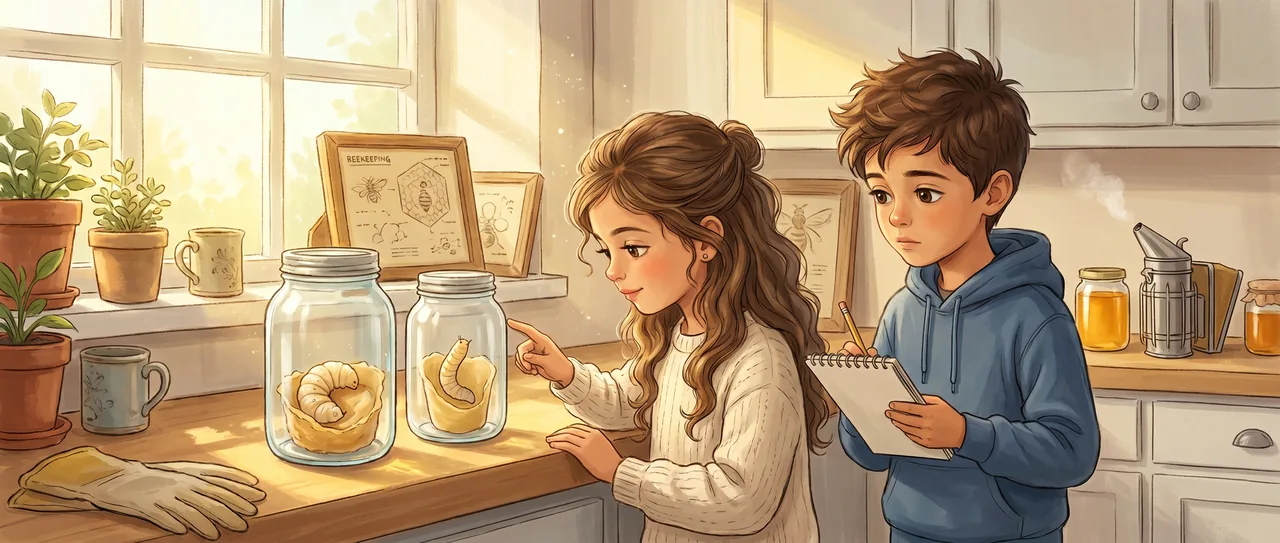
Soren's grandmother kept her bees in white boxes at the back of the garden, and she had one rule. You do not open the hive without me. So when Maya found the two jars on the kitchen windowsill, she did not touch them. She just stared.
Two larvae. Each in its own little wax cup. One was fat and pale and curled like a comma. The other was smaller, thinner, a different shape entirely.
"These came from the same frame," Soren said, reading the masking tape on the jars. His grandmother labeled everything. "Same day. She wrote it twice to be sure."
"Same mother?" Maya asked.
"Same everything. Gran says all the eggs the queen lays are basically copies."
Maya picked up the fat one and held it to the light. "Then why is this one wrong."
"It's not wrong. Gran says that one's going to be a queen."
"From the same egg as a worker."
"From the same kind of egg, yeah."
Maya set the jar down very carefully. She had a list in her head of things that did not make sense yet, and this had just jumped to the top of it. Two eggs. Identical instructions. One becomes a worker who lives six weeks and never lays an egg. One becomes a queen who lives five years and lays a thousand eggs a day.
"What's different about them," she said. It was not really a question.
Gran came in then, wiping her hands, smelling of smoke and sugar water. She was certain about her bees the way she was certain about weather, which was to say completely, and sometimes wrong.
"That one gets royal jelly," she said, nodding at the fat larva. "The whole time. The workers only get it for a few days, then they're switched to bread and honey. Feed a larva royal jelly long enough and you grow a queen. Simple."
"But the instructions are the same," Maya said. "The egg already says what it is."
Gran shrugged. "The food decides. That's all there is to it." And she went back out to the boxes, certain.
Soren had his notebook open. "That can't be all there is to it," he said quietly. "Food doesn't rewrite instructions. If the queen and the worker have the same instructions, the instructions don't change. So something else has to."
"Something has to turn parts off," Maya said. She was pacing the kitchen now. "In the worker. Whole pages of her get switched off. The egg-laying pages. The live-five-years pages. They're still in her. They just don't get read."
Soren stopped writing. "Switched off how."
They looked at the jars. The larvae told them nothing. Larvae never do.
That night Soren's mother, who taught biology and was tired and only half listening, said the word for it from the couch without looking up. "Methylation. That's what you're describing. Little chemical tags. They sit on the DNA and pin certain genes shut. The letters underneath don't change. The tag just covers them so they can't be read."
Maya sat up. "So the instructions stay the same."
"Letter for letter. Same in the queen, same in the worker."
"But the tags are different."
"The tags are different. The royal jelly changes which tags go on. Pin a different set of genes shut, you get a different bee." Soren's mother yawned. "It's why a caterpillar and a butterfly can be the same animal with the same DNA. Different things switched on, different things switched off." Then her phone buzzed and she was gone into it.
Maya and Soren sat with that.
"It's the same book," Soren said slowly. "The queen and the worker. Same book, every word. Somebody just taped some pages shut in one of them."
"And once they're taped," Maya said, "do they stay taped? Her whole life?"
Soren wrote the question down because he did not know the answer and the not knowing felt enormous. "I think mostly yes. That's the strange part. The tags can stick. A choice gets made early, about food, about a few days of jelly, and the bee carries it for her whole life. The worker never gets those pages back."
Maya went very still.
"Soren," she said. "We have the same kind of tags."
"Everything does. All of us. Every cell in you has the same DNA. Your eye cells and your bone cells have the exact same book. They're just reading different pages, because different ones are taped shut."
"So the difference between an eye and a bone"
"Is which pages are open. Same instructions. Different tags."
They both looked at their own hands then, in the yellow kitchen light, and the hands looked suddenly impossible. Every cell in there carrying the entire instructions for a whole person. A whole eye, a whole heart, a whole queen, taped shut and quiet, present in a fingertip.
Maya thought about the kid she had been in second grade, the one who asked so many questions the teacher moved her desk to the back. She had felt for a long time like there was a version of her that got taped over somewhere. She did not say this out loud. But she looked at the fat larva in the jar, the one with all its pages still open, the one that got to become a queen because somebody kept feeding it, and something in her chest pulled tight.
"The worker isn't a broken queen," she said. "She's a whole queen with the queen part covered."
"It's still in there," Soren said. "It's just not being read."
Maya picked up both jars and carried them to the window, where Gran liked them, in the morning light. She set the worker beside the queen. From the outside, in the wax, you could tell them apart by shape now. But she knew that if you opened them up, all the way down, past the shape, into the letters, you would not be able to tell at all. The same book in both. The same thousand pages. One read aloud, one read silent.
She pressed her finger to the cool glass beside the smaller larva, the worker, the one whose queen was still folded up inside her, taped shut, never to be opened, fully there.
Read the interactive version, listen to the narration, and earn a gold star →
A science-verified short story for curious kids · Curiosity Land