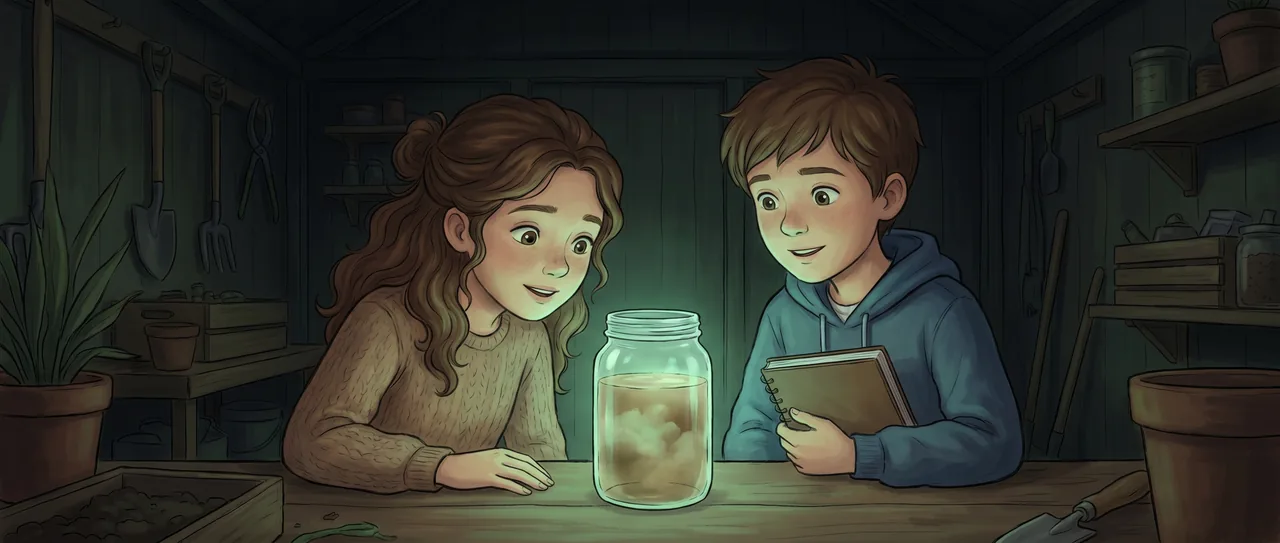
The Yeast That Could Count
The note taped to the jar said: Feed twice a day. Sugar packet in the blue tin. DO NOT let it glow.
Maya read it twice. "Do not let it glow," she said. "That's a weird thing to forbid."
Soren turned the jar in the light from the shed window. The liquid inside was the color of weak tea, faintly cloudy. Living, in the way pond water is living. A second note underneath the first, in the same handwriting, said the yeast had been given new instructions. Not bred. Built. Somebody had added pieces of DNA the way you add parts to a circuit.
"Priya did this for the regional fair," Soren said. He had her lab sheet, three pages, smudged. "She put two switches inside them. One switch turns on if there's sugar. The other switch turns on if there's no salt. The glow only happens when both are true at the same time."
"Sugar and no salt," Maya said.
"Both. Not one. Both." Soren tapped the page. "She calls it an AND gate. Like in electronics. The light comes on only when this and that agree."
Maya looked at the jar. Then at the blue tin of sugar packets. Then back at the jar.
"So she's telling us not to feed them sugar," she said slowly, "in a shed with no salt anywhere. Because if we feed them, both switches go true, and they glow, and she doesn't want them glowing while she's gone."
"Probably wastes them," Soren said. "Making the glow protein costs the cells energy. She wants them rested for the judges."
They fed them anyway. Not on purpose. That was the thing about the weekend that Maya kept turning over afterward.
It was Sunday morning. The jar looked thin and tired, the cloudiness settling to the bottom. Hungry. Maya hated watching something be hungry. She tipped in half a sugar packet before Soren could finish saying wait.
They waited for the glow. They turned off the shed light and pulled the door shut and sat in the dark with the jar between them.
Nothing.
"Maybe it's slow," Soren said.
They waited twenty minutes. Forty. Maya's eyes adjusted until she could see the grain of the wood. The yeast did not glow. It just sat there being tea-colored in the dark.
"The salt," Soren said suddenly. "There's no salt. Sugar yes, salt no. Both switches should be true. It should be on."
"Unless one switch is broken."
"Or unless," Soren said, and stopped, and got out his notebook, which was the thing he did when the inside of his head got crowded. "Maya. What did we wash the jar feeder with on Friday."
They had rinsed the little glass dropper in the garden sink. The garden sink, where everybody washed everything. Where last week somebody had soaked clay pots in salt water to kill the moss.
Maya was already moving. She wet a fingertip from the rim of the dropper and touched it to her tongue.
Salt.
"We salted them," she said. "We gave them sugar and salt. Both. So the no-salt switch reads false. So the AND gate says no."
Soren wrote it down, fast, the pen scratching. "It's not broken. It's working. It checked both conditions and decided no. It said no to us."
They sat with that.
The yeast in the jar were not thinking. Maya knew that. They had no brains, no eyes, nothing that wanted anything. But somebody had laid two questions inside them, written in the same four letters that wrote everything alive, and the cells were answering those questions over and over, every one of them, millions, asking is there sugar, asking is there salt, combining the two answers into one decision the way a light switch combines a wire and a finger. A computation. Running wet and warm and silent in the bottom of a jar in a garden shed.
"It's a circuit," Maya said. "A real one. Out of meat."
"Out of yeast," Soren said, but he was grinning at his notebook.
Here was the part Maya needed to know. "Can we fix it? Can we make it say yes?"
Soren looked at the lab sheet. The no-salt switch turned off when salt was present. To get a yes, they had to make the salt go away. You could not pick salt out of water with tweezers.
But you could give the yeast more water.
"Dilute it," Maya said, the same instant Soren said "more clean water." They looked at each other. That happened sometimes, the two of them landing on the same stone in the same breath.
They did it carefully. Rinsed a clean jar with no salt, no soap, three times in plain bottled water from Soren's bag. Moved a few drops of the yeast over. Added a clean pinch of sugar from deep in the tin, the dropper now washed in bottled water and dried on a clean shirt.
Sugar, yes. Salt, gone.
They shut the door. They sat in the dark again. Maya counted her own breathing because counting gave her hands something to do.
It came up the way dawn comes up, not a flick but a swell. A green so faint that Soren said he was imagining it, and Maya said no, look away from it, look at the wall, and out of the corner of her eye it was unmistakable, a cool green breathing out of the liquid where a moment ago there had been only dark.
Millions of cells, each one having checked, having asked sugar yes, having asked salt no, having combined the two into a single small yes, and that yes was a color now, pooled in a jar, bright enough to see.
"They said yes," Soren whispered. He did not write it down. He just watched.
"We asked them right," Maya said. "That's all. We asked them in their own language and they answered." Maya leaned close to the jar until the green light lay across her face.
"What else can we ask it," she said.
Read the interactive version, listen to the narration, and earn a gold star →
A science-verified short story for curious kids · Curiosity Land