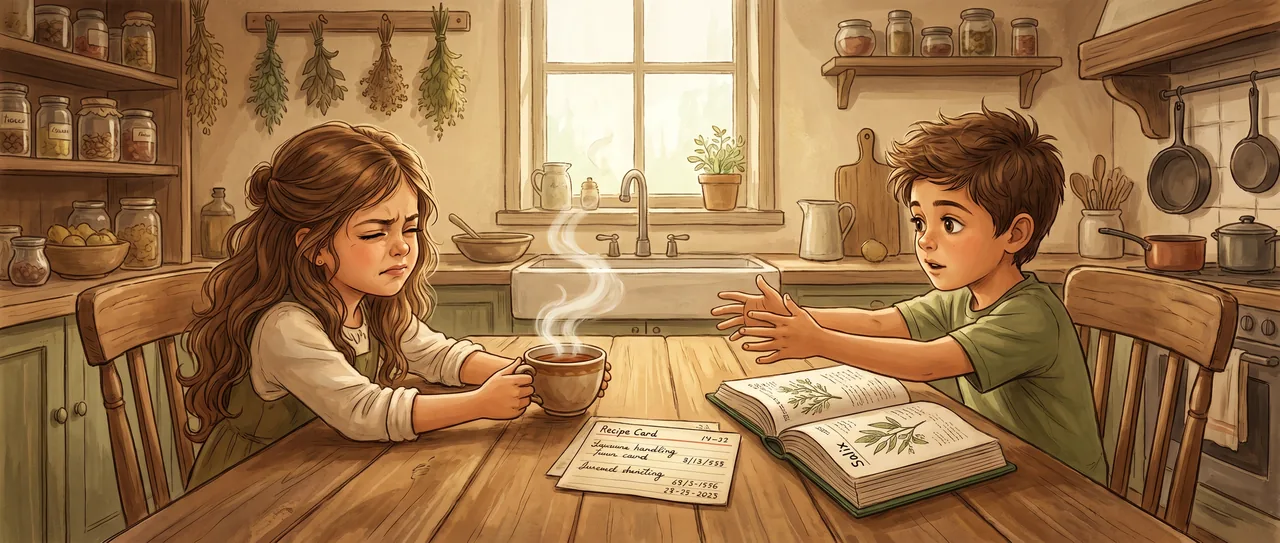
The Tea That Was Always Right
The recipe card was older than Maya's grandmother, who was older than almost everything.
Strip the bark from the young willow. Steep in hot water until bitter. Drink for the aching head, the aching joint, the fever that will not break.
"She used to make this," Maya said. "Her mother made it. Her mother's mother made it." She held the card up to the window light. The ink had gone the color of weak tea itself.
Soren peeled a curl of bark off the twigs they had cut that morning. He smelled it. He winced. "It's so bitter it makes my teeth feel weird."
"That's how you know it's working," Maya said, because that was what her grandmother always said.
Soren wrote that down. Then he stopped writing and looked at the pen like it had said something rude. "But how would she know it's working? Nobody in this whole line of grandmothers had a chemistry set."
The kettle ticked toward a boil.
"They just knew," Maya said. "You drink the bitter tea, the headache goes. You teach your kid. Your kid teaches their kid."
"For how long, though?"
Maya turned the card over. On the back, in three different handwritings, were three different dates. The oldest one she could barely read.
They poured the water over the bark and watched it go amber.
"Okay," Soren said, settling in the way he did when a question had hooked him. "My uncle takes a little white pill for his back. Aspirin. It comes in a bottle with a child lock. There's a factory somewhere that makes millions of them, all exactly the same." He nodded at the murky cup. "And that is the same thing as this?"
"It can't be the same."
"Why not?"
Maya opened her mouth and found she didn't have the reason. She just had the feeling, sharp and certain, that the white pill and the bitter tea were two faces of one thing. She had felt it the second he said it.
"It is the same," she said. "Or it's the same idea. The pill is the tea with everything boiled away except the part that works."
Soren looked at the cup. "So which part works?"
They didn't have it. They went to the shelf where Maya's grandmother kept books for pressing flowers, and underneath those, a fat old medical encyclopedia with a cracked green spine. Soren read out loud, finger moving under the lines.
Willow. Salix. The bark contains a compound called salicin.
"Salicin," Maya said, tasting the word, bitter like the bark.
The chemists isolated it. Then they changed it, one piece at a time, to make it gentler on the stomach. In eighteen fifty-three a French scientist made the changed version in a flask. It sat in journals, ignored, for decades. Then a company made it by the ton and called it aspirin.
"Eighteen fifty-three," Soren repeated. He underlined it twice. "That's when the whole pill industry sort of starts. Factories. Bottles. Everything my uncle's medicine cabinet has in it. All of it. From willow."
Maya was somewhere else. She was looking at the dates on the recipe card.
"Read the next part," she said.
Soren read it. Then he read it again, quieter.
Willow bark had been used for pain and fever for at least three thousand five hundred years. The Egyptians wrote it on papyrus. The Greeks chewed it. Healers across the world reached for the same tree without ever meeting, without ever knowing why it worked.
The kitchen was very still. The tea steamed.
"Three thousand five hundred years," Maya said.
"That's before glass," Soren said. "Before chemistry was a word. They had the answer the whole time. They had it in a cup. They just didn't have the why."
Maya picked up the recipe card again and suddenly it weighed more in her hand. The three dates in three handwritings. And behind those, dates with no card at all, hands that never learned to write, passing the bitter tea forward, grandmother to grandmother, all the way back to people who watched the same willows bend over the same rivers.
"They knew it worked," she said slowly, "for longer than they knew why. Way longer. The knowing-why is the new part. The new part is tiny."
Soren stopped writing.
"Everyone who drank this," Maya said, "for three and a half thousand years, was right. They were completely right. They just couldn't say the reason yet."
Soren set the pen down. "My teacher always says if you can't explain it, you don't really know it."
"Your teacher is wrong," Maya said, not meanly. "Or, not wrong. Just late. Knowing comes way before explaining. Sometimes by thousands of years."
Soren sat with that. All the answers sitting in cups and stories and hands, waiting, patient, for the why to finally arrive.
"There's stuff like that now," he said. "Has to be. Things people do that work, and nobody knows the salicin in it yet."
"Tons of it," Maya said. Her eyes had gone bright. "Somewhere there's a tea right now. Some old thing somebody's grandmother does. And it works. And the why is still hiding in it."
"And someday someone boils it down."
"And finds the one part."
They looked at the cup between them, amber and bitter, three thousand five hundred years old and brand new at the same time.
Maya picked it up. She blew across the surface. She took a sip, and made the face everyone in her family had always made, the wince, the shudder, the same expression on faces going back past every date on the card and past all the cards there had never been.
She slid the cup across the table to Soren.
He wrapped both hands around it, lifted it, and drank.
Read the interactive version, listen to the narration, and earn a gold star →
A science-verified short story for curious kids · Curiosity Land