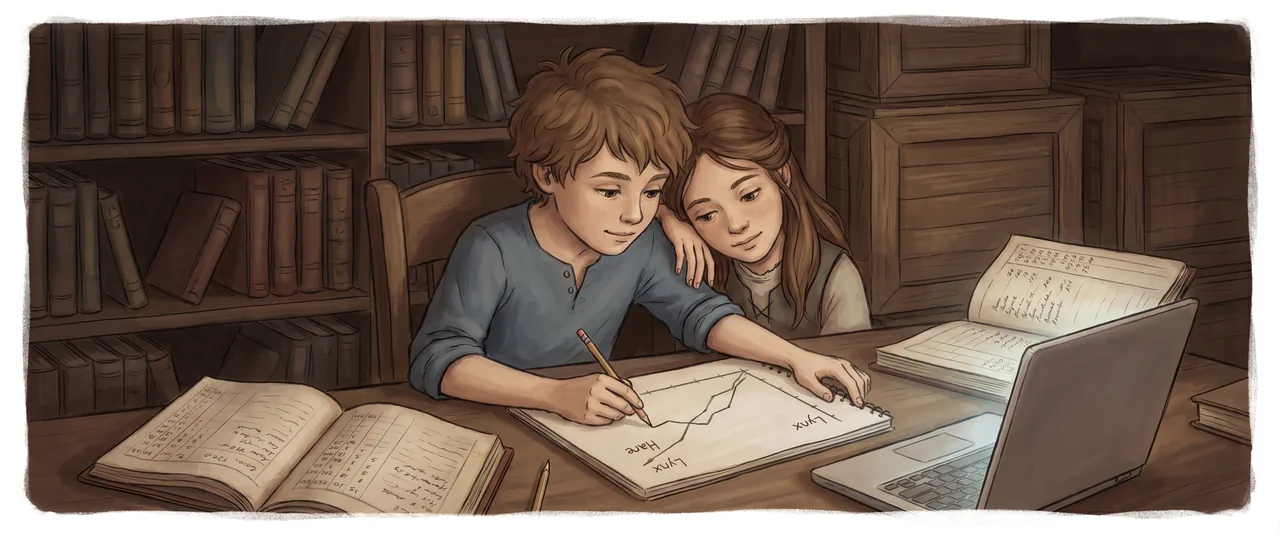
The Stack of Dead Years
The ledgers smelled like a basement that had been a basement for two hundred years.
Maya had a stack of them at her elbow, each one a fat book of numbers written by hand. Hares bought. Lynx bought. Marten, fox, beaver. The museum wanted everything typed into the computer before the paper crumbled, and they had handed the boring job to two eleven-year-olds because two eleven-year-olds had volunteered.
Soren was typing carefully. Maya was not typing at all. She was flipping.
"Stop flipping," Soren said. "We're supposed to go in order."
"The hares go up and down," Maya said.
"Everything goes up and down."
"No. They go up and down on purpose." She slid a ledger across the table. "Look. Eighteen forty-five, tons of hares. Then less. Then almost none. Then back. Count the years between the big ones."
Soren counted. He hated counting things he hadn't decided to count. He did it anyway.
"About ten," he said.
"Every time?"
He pulled the next ledger. Then the one after. He was the kind of person who needed to see a thing happen more than once before it was allowed to be true. He found the hare peaks. Eighteen forty-five. Eighteen fifty-five-ish. Mid-sixties. The gaps wobbled, nine years, eleven, ten, but they kept coming back to ten like a dropped ball coming back to the floor.
"Okay," he said slowly. "That's real. But why?"
Maya was already three pages ahead. "The lynx do it too."
"Lynx eat hares."
"I know. That's why it's weird." She put her finger on the lynx column. "The lynx don't peak at the same time. They peak after. Like they're chasing."
Soren stopped typing entirely.
He got two sheets of his notebook paper and a pencil and started making dots, hares on one line, lynx on another, year by year, the way you'd plot a fever. It took a long time. Maya read him numbers and he placed dots and neither of them said much, which is how you could tell they were both completely happy.
When it was done the two lines climbed and fell across the page like two waves that didn't quite hold hands. The lynx wave rose a little behind the hare wave every single time. Up, then up. Down, then down. Always trailing.
"Why would the lynx wait?" Soren said. "If there's a ton of hares, eat them now."
"They can't make babies instantly," Maya said. "Lots of hares means lots of food means more lynx, but the more-lynx part takes a while. The lynx are answering a question the hares already asked."
Soren looked at her. That was the thing about Maya. She got to the shape of it before she could explain it, and then her mouth caught up.
"And then there's too many lynx," he said, picking it up, "so the hares get eaten down, so there's not enough food, so the lynx crash, so the hares come back." He tapped the trough in his own drawing. "It feeds itself. It never stops because it can't stop."
"It's a loop you can't get out of," Maya said. "The hares cause the lynx and the lynx cause the hares."
They sat with that. A loop drawn in pencil out of numbers a dead trapper wrote down because he was getting paid, not because he was curious. He had no idea he was recording a wave.
Mr. Adeyemi, the archivist, drifted over with his coffee. He was the sort of adult who loved old paper for being old, not for what it said.
"Lovely, isn't it," he said, looking at the drawing. "The romance of the historical record. All those trappers, all those winters, and you can see their whole world in the ink."
"It's not the trappers," Maya said. "It's the hares."
"Mm," said Mr. Adeyemi, who had already decided what was interesting about the room and wasn't going to update. "The penmanship really is extraordinary." He wandered back to his shelves.
Soren waited until he was gone. "He thinks the wave is about people."
"The wave doesn't care about people," Maya said.
That sentence sat in the cold air of the records room and got bigger the longer it sat.
Soren turned to a clean page. He wrote down what they'd figured: hares feed lynx, lynx eat hares, the rise of one becomes the fall of the other, around and around, about ten years a turn. Then he stopped, pencil up.
"Maya. If it's just hares plus lynx plus food, that's only a couple of rules. You could write it down. Like, actually write it as a rule. Then you wouldn't need the ledgers at all. You could guess what a year was without anyone ever counting it."
"You could guess a year nobody wrote down," Maya said.
"You could guess next year," Soren said.
They looked at the two waves. The thought arrived in both of them at the same speed, which almost never happened.
"Somebody already did," Maya said. "Didn't they. Somebody wrote the rule."
Soren pulled the laptop over and searched while Maya leaned into his shoulder reading too fast. Two names. A chemist and a mathematician, working separately, almost a hundred years ago. Equations. Two lines, predator and prey, chasing each other around a loop. The math had come first. People had written the rule for the wave before anyone had stacked up enough real animals to check it. And then someone found these exact ledgers, the lynx and the hares, the boring fur receipts, and laid the real numbers over the math.
The real numbers fit the rule.
"Wait," Soren said. "They drew our drawing. Before they had our numbers."
"They drew it out of nothing," Maya said. "Out of two rules. And then reality showed up and did what they said."
Soren sat very still. He had tested a lot of things in his life. He had never run into the idea that you could write down how the world worked on a piece of paper and the world would obey a math problem it had never read.
"That means the wave is older than the trappers," he said. "It was happening before anyone counted. It's happening right now. In the woods. Tonight. Somewhere there are exactly the right number of hares for the math."
"And next peak," Maya said, "we could mark on a calendar. The lynx don't know what year it is. But we could."
Soren turned back to his two pencil waves. He pressed the point down past the last real year, into the blank part of the page where no trapper had ever written anything, and drew the curve forward into a winter that had not happened yet.
Read the interactive version, listen to the narration, and earn a gold star →
A science-verified short story for curious kids · Curiosity Land