The Sound of Air Getting Out of the Way
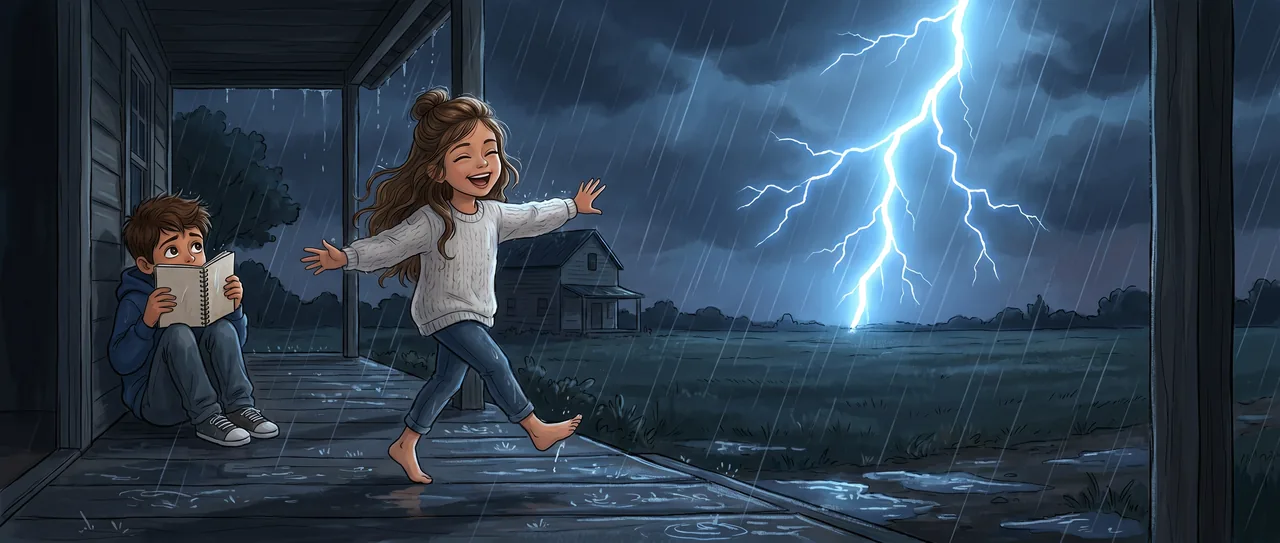
The power had been out for an hour, and Soren's grandmother had gone inside to find candles, so it was just the two of them on the porch with the rain coming down like the sky had a hole in it.
"Count," Maya said.
A blue-white crack split the field. Soren started counting under his breath. He got to six before the thunder rolled in, low and long, like furniture being dragged across the sky.
"Six," he said. "So about two kilometers. Sound travels about a third of a kilometer a second."
"I don't care how far," Maya said. "I care why it sounds wrong."
Soren looked at her. "Wrong how?"
She didn't answer right away. That was the thing about Maya. She felt the wrongness before she could say it. He waited.
"The close ones," she said finally. "They crack. The far ones rumble. Same lightning. Why two different sounds?"
Another flash. This one closer. The thunder came fast and sharp, a single enormous snap, and they both flinched.
"That," Maya said. "That was a crack. Not a rumble."
Soren had his notebook out, holding it close to his chest to keep the rain off. "Maybe the rumble is echoes," he said. "Off the hills, off the clouds. The far ones have more stuff to bounce off before they reach us."
"Maybe." Maya chewed her lip. "But the crack. Where does the crack come from in the first place? What makes the noise at all?"
They sat with it. The rain hissed on the gravel.
"It's the air," Soren said slowly. "It has to be the air. The lightning doesn't make a sound by itself. It's a spark. Sparks are tiny clicks." He held up two fingers and snapped them apart like he was pulling a thread. "So if a little spark makes a little click, a huge spark makes a huge click."
"But why does electricity make any sound," Maya pushed. "A flashlight doesn't make a sound. A wire doesn't."
Soren stopped writing.
"Heat," he said. "It has to be heat. The bolt heats the air. Hot air gets bigger. It pushes out."
Maya turned to him, and even in the dark he could see her eyes had gone wide and still, the way they did when something was about to connect.
"How fast," she said. "How fast does it push out."
"I don't know."
"Guess."
Soren never minded guessing. "Fast," he said. "Really fast. Because the air doesn't get warm. It gets warm like a stove. The bolt is" he searched for the number his teacher had said once and not explained, "hotter than the sun. The surface of the sun. Way hotter. Like five times."
Maya stood up. She walked to the edge of the porch where the rain almost reached her and she put her hand out flat into the cold spray.
"Five times the sun," she said. "In the air. Right there in the field. For a tiny piece of a second."
"Then it's gone," Soren said. "It cools off instantly. So the air gets shoved out as hard as a thing can be shoved and then there's a hole where it was and the air slams back in."
"That's the crack," Maya said. She wasn't asking now.
Lightning flashed again, far off this time, near the edge of the world, and they both went silent waiting. One. Two. Three. Four. Five. Six. Seven. Eight. The rumble came, soft and broken, tumbling over itself.
"Okay," Soren said. "So why does the close one crack and the far one rumble. Same explosion. You're right, it's the same kind of bolt."
Maya was quiet. Then she said, "The bolt is long."
"What?"
"The bolt isn't a dot. It's a line. It goes all the way from the cloud to the ground. That's like a kilometer of air all exploding at once." She drew a jagged line in the air with her finger, top to bottom. "When it's close, the whole line is about the same distance from us. So the whole bang arrives together. Crack."
Soren felt it land. "And when it's far," he said, picking it up, writing fast now, not caring about the rain, "the top of the bolt is way farther from us than the bottom. So the sound from the top arrives later than the sound from the bottom. It gets smeared out. Spread thin."
"Rumble," Maya said.
"The rumble is the same crack," Soren said. "Stretched. Because the bolt is long and we're hearing it at an angle." He stared at the line he'd drawn. "It's not echoes at all. Well. Maybe a little echoes. But mostly it's just that the sound has different distances to travel from one single bolt."
They both looked out at the dark field. Somewhere a long way off, a flash lit the underside of the clouds without any thunder reaching them at all.
"There's one," Maya said softly. "Too far to hear."
"And another one somewhere," Soren said. He was doing a different kind of math now, the kind that made the porch feel small. "It happens about a hundred times a second. Somewhere on Earth. Right now. A hundred bolts a second, every one of them five times hotter than the sun, every one of them a kilometer of air getting shoved out of the way faster than the sound can keep up with."
Maya didn't say anything. She was counting under her breath. Not seconds this time. He could hear her.
"One," she whispered. "Two. Three."
By four she had stopped, because there was no way to count that high, no way to count a hundred a second for every second that had ever happened, and she knew it.
The field lit up white. The crack arrived almost on top of it, so close it shook the floorboards under their feet, and Maya laughed out loud and stepped one foot off the porch into the rain with her arms spread wide.
Read the interactive version, listen to the narration, and earn a gold star →
A science-verified short story for curious kids · Curiosity Land