The Letters Bones Send
The waiting room at the clinic had a skeleton in the corner, the cheap plastic kind, and Soren had been staring at its femur for ten minutes.
"My grandmother says her bone feels lonely," Maya said. She was sitting upside down on the chair, knees over the back, hair pooled on the floor. "That's a weird thing for a bone to feel."
"Bones don't feel anything," Soren said. "They're scaffolding. They hold you up and that's it."
"Then why does she say her appetite changed after she broke it? And her mood?"
Soren paused. That was the kind of thing he hated, a fact that didn't fit the scaffolding. He picked up the fat anatomy textbook from the side table, the one with coffee rings on the cover, and opened it because the inside of his head felt too small to hold the question.
The physical therapist, a woman named Priya with chalk on her sleeves from the climbing gym, came out to grab a clipboard. "She's doing great in there. Weight-bearing already."
"Why weight-bearing so soon?" Soren asked. "Wouldn't resting heal it faster?"
Priya laughed. "Opposite. Bone needs load. You stop pressing on it, it gives up. Use it or lose it." She was already walking back. "Astronauts lose bone in space. No gravity pressing down, nothing to push against."
Then she was gone, and Soren was left holding the gives up part like a stone in his hand.
"Gives up," he repeated. "Scaffolding doesn't give up. Scaffolding doesn't care if you stand on it."
Maya flipped right side up so fast her hair flew. "So it's listening. It knows when you push on it."
"Listening isn't the word."
"Then find a better one."
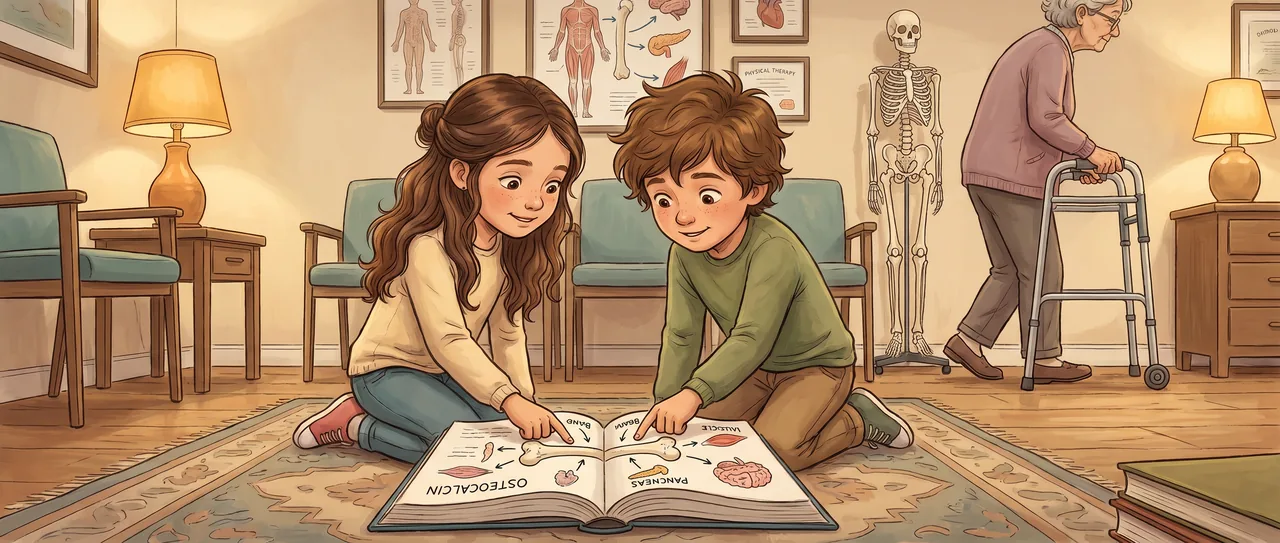
Soren turned pages. He found the chapter on the skeleton, expecting calcium and joints. Instead there was a diagram with arrows going out from a bone, little arrows reaching toward a brain, a pancreas, a muscle, like the bone was mailing letters.
"Look at this," he said.
Maya slid off the chair and onto the floor next to him. The word under the arrows was osteocalcin. A hormone. Released by bone.
"Bones make hormones," Maya said slowly. "Hormones are messages. So the skeleton is sending messages." She put her finger on the arrow pointing at the pancreas. "What's it telling the pancreas?"
Soren read, then read it twice because he did not believe it the first time. "It helps manage blood sugar. The bone talks to the pancreas about sugar."
"My bone," Maya said. "Right now. My leg bone is in a conversation with my pancreas that I am not invited to."
Soren almost laughed but the next arrow stopped him. It pointed at the brain. He read the caption out loud, careful, the way he read things he wanted to get exactly right. "In studies, osteocalcin affects memory. And mood."
The waiting room went very quiet around them.
"That's why," Maya whispered. "That's why Grandma's mood changed. Her bone broke and the letters stopped coming."
"We don't know that," Soren said, because he was honest about what he didn't know. "The book says the research is still going. They're still figuring out how much, in people." He pressed his thumb against the page. "But they found it. It's real. The bone is an organ that sends mail to your memory."
Maya stood up and pressed both hands flat against her own thighs, against the long bones underneath.
"What are you doing?"
"I'm trying to feel it." Her eyes were enormous. "I won't. But it's happening. Every time I jump, every time I walk, my bones feel the push and they make more of the messenger, and the messenger goes to my brain and helps me remember things." She looked at Soren. "When I run, my skeleton is mailing my brain."
Soren looked back down at the diagram, at all those arrows. He had spent his whole life thinking of his skeleton as the most boring part of him. The part that was basically furniture. The part that would still be furniture after everything else was gone.
"I always thought I was a brain riding around on a skeleton," he said. "Like the skeleton was just the car."
"The car talks to the driver," Maya said. "The car has opinions about sugar."
This time he did laugh.
Priya came back through with Maya's grandmother walking beside her, slow, gripping a frame, but walking, one foot then the other foot, pressing down.
"There she is," the grandmother said. "My two scientists on the floor."
Maya scrambled up. "Grandma. Every time you put weight on it, you're making it strong, and it's sending messages to your brain. We read it. Your hip talks to your head."
Her grandmother smiled the slow smile of someone who had felt this before she had words for it. "I told you it felt lonely."
"It wasn't lonely," Maya said. "It was quiet. It couldn't send mail because nobody was pressing on it. Now you're pressing on it again."
The grandmother looked down at her own leg, at the place under the skin where the bone was knitting itself back into a sender of letters, and something moved across her face that none of them said out loud.
"Walk to the window with me," she said. "I want to press on it some more."
Soren stood, still holding the textbook open with his finger marking the page of arrows. He thought about the astronauts Priya had mentioned, floating with nothing to push against, their skeletons going quiet, the letters thinning out. He thought about how a person could be in a room full of other people and still have a whole correspondence happening inside them that no one would ever read.
Maya took her grandmother's arm. They went toward the window together, and at every step the grandmother's heel came down against the floor, press, press, press.
Soren watched the spot on her hip where he could not see anything happening.
"Soren," Maya called from the window. "Come press."
He set the book down open on the chair, the arrows still reaching out toward the brain, the pancreas, the muscle, and he crossed the room and stamped his own foot once, hard, against the floor, just to send something.
Read the interactive version, listen to the narration, and earn a gold star →
A science-verified short story for curious kids · Curiosity Land