The Eyes Are Closed
Aunt Ros said the platypus would come out at dusk if Soren sat still and stopped asking questions, which were two different things and she only meant the second one.
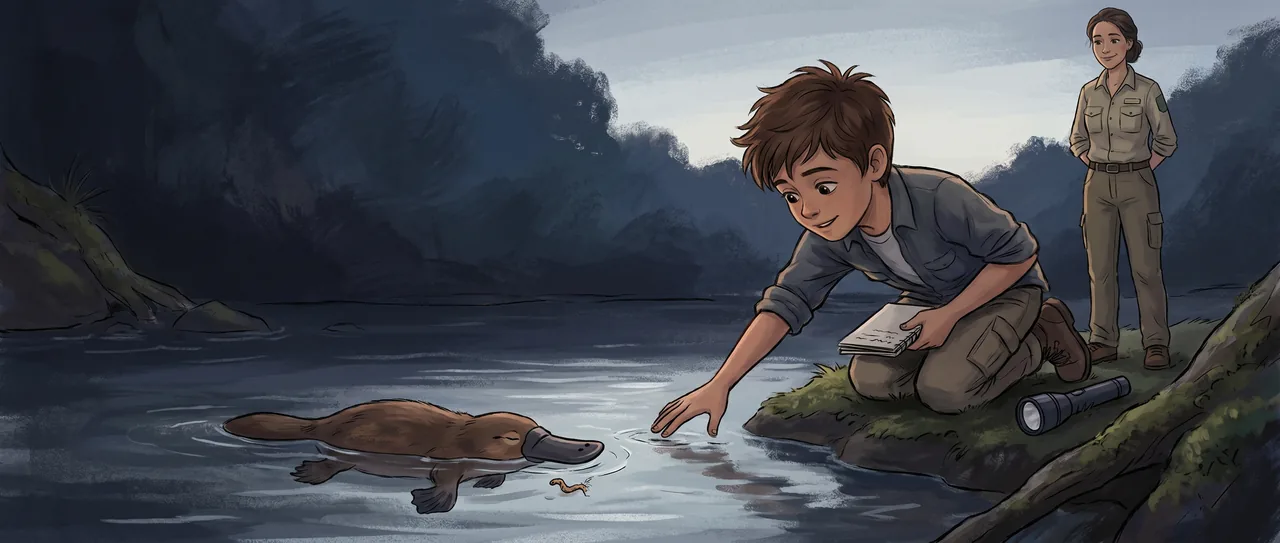
So Soren sat. He had a notebook on his knee and a torch he was not allowed to use yet, and the creek in front of him going dark and silver at the same time. Aunt Ros stood behind him with her arms crossed, a wildlife guide who had shown a hundred tourists this exact stretch of water and was, she had told him twice, very tired this week.
"There," she whispered.
Something surfaced. A brown lump, smaller than he expected, with a flat dark bill like a smudge of mud. It rolled once and dove.
Soren forgot the no-questions rule immediately.
"How does it see down there?" he said. "It's nearly black now."
"It doesn't, really," said Aunt Ros. "They hunt at night, in muddy water. Mostly closed eyes."
That did not fit. Soren wrote nearly black, closed eyes, and underneath it he wrote how, with a small angry line under the word.
The platypus came up again, further along. It was carrying something. It chewed without teeth, grinding with plates in its bill, and then it dove again, and this time Soren watched the exact spot where it went under.
He waited. He counted. At thirty seconds the platypus surfaced almost a body length to the left of where he was looking, which meant it had turned underwater, in the dark, and gone sideways toward something.
"It changed direction," Soren said. "Down there. Where it can't see."
"They're good swimmers," said Aunt Ros, which Soren felt was not an answer to the thing he had actually said.
He tried to picture it. Eyes closed. He shut his own and immediately understood how much he used them. He listened instead. He could hear the creek, frogs, Aunt Ros breathing, his own heart. But underwater your ears fill up. Aunt Ros had said closed ears too. Closed nose. He opened his eyes.
"If its eyes are closed," he said slowly, "and its ears are closed, and its nose is closed, then it's hunting with nothing."
"Mm," said Aunt Ros, checking her watch.
"You can't hunt with nothing," Soren said. He said it to the creek more than to her. "It found something down there. It turned toward it. So it's using something. Just not anything I'd use."
The platypus surfaced a third time. Soren watched the bill. It was sweeping. Not eating, not yet, just moving the bill side to side through the water, slow, like a man sweeping a torch beam across a dark room. Then it dove, sweeping, and came up with a wriggling larva pinched in the front of the bill.
Sweeping. The bill was the thing. Not the eyes. The bill.
"It's the bill," Soren said. "It's finding them with the bill."
"Feeling for them?" said Aunt Ros. "In the mud, sure."
But it wasn't touching the mud when it turned. It had turned in open water, before reaching anything, toward a thing it had not bumped into yet. You cannot feel something by touch before you touch it.
Soren thought about the larva. A shrimp, a worm, a soft small thing in the dark. What did a soft small thing in the dark do that another animal could find across open water without seeing or hearing or smelling it?
It moved. It twitched. Muscles.
He thought about the time his cousin's electric fence had buzzed his hand, and the way his science teacher had made everyone's arm jump by touching wires to the skin. Muscles moved by electricity. Every twitch of every muscle was a tiny pulse. His own arm, lifting the notebook, was little sparks firing in the dark of his body.
The larva down there, wriggling, was sparking too. Tiny. Constant. A living flicker in the black water.
And the platypus was sweeping its bill like it was listening for that.
"It's not feeling them," Soren said. His voice had gone quiet and fast. "It's not touching them. It's reading them. The bill reads the electricity. Every time the shrimp moves a muscle it makes a little spark, and the bill can feel the spark across the water, so it doesn't need its eyes, it doesn't need anything I'd need, it's got a whole sense I don't even have a word for."
Aunt Ros uncrossed her arms.
"Huh," she said. "They do have something in the bill. Electroreceptors. I read it once. Forty thousand of them or something stupid." She looked at the water differently than she had a minute ago. "I never thought about what that actually means."
Forty thousand. Soren wrote it down with his hand not quite steady. Forty thousand tiny ears for electricity, packed into a smudge of bill, in an animal that hunted with its face shut.
He looked at his own hands. Ten fingers that could feel cold and rough and wet and nothing else. He had been sitting here this whole time thinking the platypus was at a disadvantage, swimming blind in the dark. The platypus was not blind. The platypus was reading a world Soren could not even detect was there. Every fish, every shrimp, every beat of every heart in that creek was throwing off faint electrical light, and the whole creek was glowing with it, and the only one at this water who could not see the glow was Soren.
He was the one swimming blind.
"There's a whole layer," he said. "Over everything. All the time. Electricity coming off everything alive. And we just can't feel it."
"We can't," Aunt Ros agreed. She had stopped checking her watch.
The platypus surfaced one more time, close, and rolled, and Soren saw the bill clearly in the last grey light, sweeping the dark water side to side, reading something that was streaming out of him too. His heart. His moving hand. His leaning forward.
It was reading him.
Soren held very still and reached one hand down to the surface of the creek, fingers spread, and waited to be noticed by a sense he didn't have.
Read the interactive version, listen to the narration, and earn a gold star →
A science-verified short story for curious kids · Curiosity Land