The Edge of the Map
Maya had decided the app was lying about how smart it was.
Not lying exactly. Showing off. Every reaction she typed in, it answered before she finished. Vinegar and baking soda. Predicted, instantly, with a little curl of confidence at the bottom: ninety-nine percent. She fed it the red cabbage thing she was actually trying to do, the purple juice that turned pink in lemon and green in soap. Predicted. Ninety-eight. She fed it rust. Predicted. She fed it the burning of a candle. Predicted, predicted, predicted.
So she started trying to break it.
This was a thing she did. Her mother called it poking the bear. Maya called it finding the wall. Anything that always said yes had a wall somewhere, and she wanted to know where.
She typed in harder things. Reactions she found in her brother's old organic chemistry book, the one with the hexagons. Long ugly names. The app ate them. It told her which bonds broke, which formed, drew her the product in clean lines, and stamped its confidence at the bottom. Ninety-six. Ninety-four. Always high. Always sure.
Then she found a reaction with a little drawing next to it. Two molecules that looked exactly the same. Same atoms, same bonds, same everything. Except the book had drawn one with a wedge pointing up and one with a wedge pointing down, like a left hand and a right hand.
Maya typed it in. She picked the left-hand one.
The app paused.
It actually paused. The little thinking dots went around longer than they ever had. And then, instead of a clean answer with a number, it said something she had not seen it say all afternoon.
Confidence: low. I am not sure what this one does.
Maya sat up.
She leaned in close, like the phone might take it back. "Say that again," she said, which was silly, because it was a phone. But there was a button to ask why, so she pressed it.
The reason it does this, the app wrote, depends on the shape. These two molecules have the same parts arranged differently in space, like your two hands. A reaction can tell them apart even when the formula cannot. The way they approach each other in three dimensions decides what comes out.
Then it said the thing that made Maya forget about the cabbage entirely.
I have seen very few examples of this exact case. Most of what I learned came from reactions where the flat description was enough. When the answer hides in the geometry, I have less to go on. So I would rather tell you I am unsure than guess and be wrong.
Maya read it three times.
The app had answered ten thousand things without blinking. Acids, bases, fire, rust, the whole purple-pink-green dance of the cabbage. And here was one small thing, two molecules that were the same except for which way a wedge pointed, and the smartest thing in her kitchen had stopped and said, I don't know this one.
Not because it was broken. Because nobody had shown it enough. Because the part that mattered was not in the writing-down. It was in the standing-in-space. The handedness. The thing you could only feel if you built it with your fingers and turned it over.
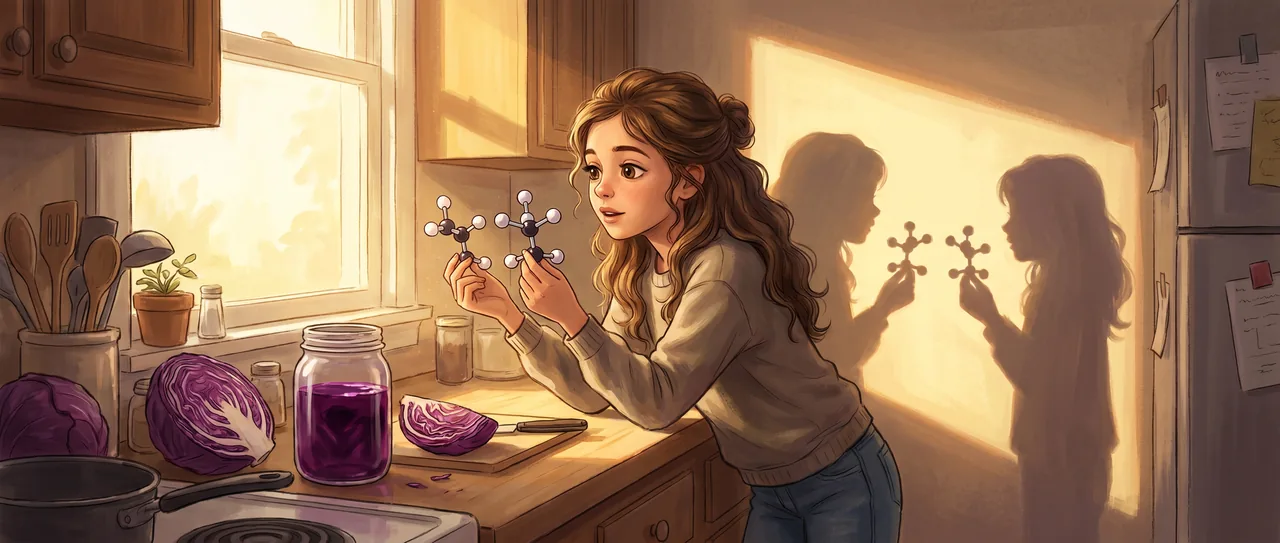
She got up and found her brother's molecular model kit in the closet, the bag of plastic balls and little gray sticks. She didn't ask him. He was at practice and the bag was just sitting there.
She built the left-hand molecule. Black ball, sticks, the colored balls in their places. Then she built another one exactly the same, checking each stick twice, and held them up side by side.
They were identical.
Then she tried to lay one on top of the other, the way you would check if two cut-out shapes matched. And they would not go. No matter how she turned them. One always had a piece sticking out where the other had a gap. Like trying to put a right glove on a left hand. Same glove. Wrong hand. It would not lie down flat onto its twin no matter what she did.
Maya stopped turning them.
The paper said they were the same. The app, reading the paper, mostly thought they were the same. But her two hands, holding the two little plastic shapes, knew they were not. The difference lived in a place that flat words could not reach. It lived in the turning.
And reactions, real ones, in real flasks, in real cells, could feel that difference. Your body could feel it. One hand of a molecule could be medicine and the other hand could do nothing at all, and the only thing separating them was a wedge pointing up instead of down.
The app knew this. That was the strangest part. It had told her. It knew there was a question here it could not answer yet, and it had handed her the question instead of pretending.
She picked the phone back up. She typed: how many reactions like this are there.
More than I have learned, it wrote. The shape problems are some of the hardest. People are still teaching machines to think in three dimensions the way you just did with your hands.
Maya looked at the two molecules. Identical and not. Same and mirrored. A wall, finally, the wall she had been poking for. Except it was not a wall. A wall meant the road stopped. This felt like the opposite. This felt like the road ran right off the edge of the map and kept going into country nobody had drawn yet, and the app had walked her to the edge and pointed and said, I can't tell you what's out there.
The cabbage juice had gone cold and dark on the counter. The lemon wedge had dried out. Maya did not notice.
She held the two molecules up to the window so the light came through them. She closed one eye. She turned the left one slowly, watching its shadow, waiting for it to match the right one's shadow, knowing now that it never would.
Then she turned the right one too, both of them spinning in the afternoon light, looking for the one position where the machine could not follow and only her own two hands could go.
Read the interactive version, listen to the narration, and earn a gold star →
A science-verified short story for curious kids · Curiosity Land