The Count That Got Larger
The poster said one hundred billion galaxies.
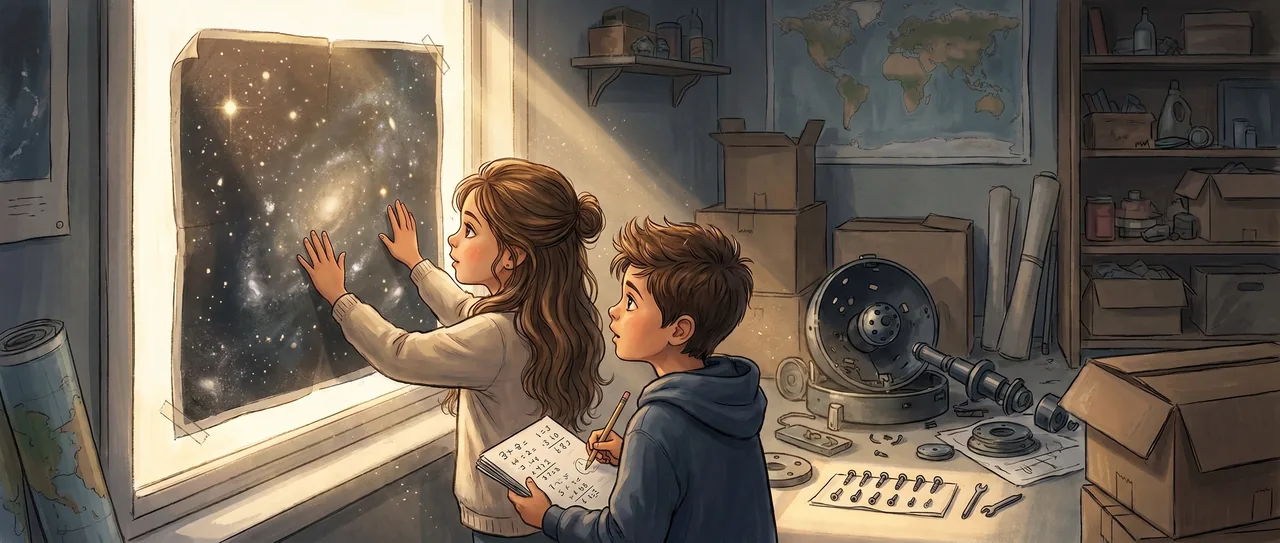
Maya found it rolled inside a cardboard tube, behind the broken projector the community center was finally throwing out. She unrolled it on the floor and weighed the corners down with paint cans. It showed a black square of sky with a date printed in the corner. Below the picture, big proud letters: ONE HUNDRED BILLION GALAXIES IN THE UNIVERSE.
"That's wrong," Maya said.
Soren looked up from the projector, which he had been quietly taking apart screw by screw, lining the screws up on the floor in the order he removed them. "How do you know it's wrong?"
"I just know the number's bigger. I read it somewhere." She frowned. "But I don't know why they put a wrong number on a poster. Somebody made this. Somebody who cared. Look how nice the letters are."
Soren came over. He looked at the date. "It's old. Maybe it was right when they printed it."
"Numbers like that don't change. A galaxy is a galaxy. You count them."
"So count them," Soren said, and pointed at the black square.
They both leaned in. The picture was a photograph of one tiny patch of sky, the kind of patch you could hide behind a grain of rice held at arm's length. The caption underneath said the telescope had stared at that one empty spot for days, with the shutter open the whole time, gathering whatever light arrived.
Maya put her finger near the picture and started counting the smudges of light. "One. Two. Those two are touching, are they one or two. Three." She stopped at around thirty and sat back. "There's hundreds in here. In this one tiny piece of nothing."
"And the sky is huge," Soren said slowly. "If this rice-grain spot has hundreds, then the whole sky has—" He stopped. He took out his notebook and did the arithmetic the long way, because doing it in his head felt like cheating. The number he got had so many zeros he counted them twice.
"That's how they get to a hundred billion," Maya said. "They count one spot and multiply by all the spots."
"Right." Soren tapped his pencil. "But here's the thing that's bothering me. Look at the faint ones."
Maya looked. Around the bright smudges, the clear obvious galaxies, there were dimmer ones. And around those, dimmer ones still, so faint you weren't sure if they were galaxies or just the picture being grainy.
"How do you count those?" Soren asked. "The ones you can barely see?"
"You don't," Maya said. "You can't count what you can't see."
They were both quiet. Outside, a man was loading the planetarium's old dome panels into a truck.
"So the people who made this poster," Maya said carefully, "they counted the ones they could see. The bright ones. And the faint ones they just—didn't count. Because how could they."
"But the faint ones are still there," Soren said.
"The faint ones are still there," Maya repeated.
She got up and walked to the window where the light was better and held the poster against the glass. With the daylight coming through the back of the paper, the faint smudges showed up more. There were more of them than she had thought. A lot more. The dim ones outnumbered the bright ones, easily.
"Soren. Come look. From the back the dim ones come out."
He came and looked. "That's just light through paper."
"I know it's just light through paper. But it's the same problem. They're faint because they're far, or because they're small, or because their light got stretched out on the way here. The poster only counted the loud ones." She lowered the paper. "The number isn't wrong because somebody made a mistake. The number's wrong because the universe was hiding most of itself in the faint part."
Soren went very still, the way he did when a thing was assembling itself in his head.
"So when they got better at seeing the faint ones," he said, "the count went up."
"By a lot," Maya said. "It has to be by a lot. Look how many dim ones there are for every bright one."
Soren did the arithmetic again, but this time he multiplied his first answer by the ratio of dim smudges to bright smudges that they could actually see through the window. His pencil stopped. He looked at the number. He turned the notebook so Maya could see it.
Two trillion.
"That's the number I read," Maya whispered. "That's the number that's right now. Two trillion."
"We didn't look it up," Soren said. "We just—got there. By noticing the part they left out."
Maya sat down on the floor next to the poster. She felt something open up under her, the way the floor of an elevator drops away for one second. A hundred billion had seemed like the biggest number a thing could be. And it had been wrong, not because anyone was foolish, but because for a long time the faintest galaxies had simply sat there in the dark, uncounted, waiting for eyes good enough.
"There were always two trillion," she said. "Even when the poster said a hundred billion. They were all already there. We just couldn't see them yet."
Soren wrote two trillion in his notebook and then drew a small arrow after it. He didn't write anything after the arrow.
"Why the arrow?" Maya asked.
"Because they got better at seeing and the number went up twenty times." He tapped the arrow. "What happens when they get better again?"
Maya looked at the poster on the floor, at the bright smudges with their crowd of dim companions, at the grainy edge where you couldn't tell galaxy from noise.
"The arrow doesn't have an end," she said.
The man from the truck leaned in the doorway. "That poster's garbage too, kids. Toss it in the bin on your way out."
"We're keeping it," Maya said.
She rolled it back up, carefully, the wrong number on the outside and the faint uncounted galaxies curled safe in the middle. Soren held the tube open. She slid the poster in and capped both ends, and they carried it out between them into the daylight, holding it level, the way you carry something that has more inside it than its size lets on.
Read the interactive version, listen to the narration, and earn a gold star →
A science-verified short story for curious kids · Curiosity Land