The Count Inside the Salamander
Soren found the salamander first, then the photograph, and it was the order that mattered.
The salamander was in the shallow part of the creek where the water went slow and warm. It was missing most of its left front leg. Not bleeding, not hurt. The stump was rounded and pale, like a thumb wearing a sock. Soren crouched on the rocks for a long time, and the salamander did not run.
When he came back the next afternoon, the leg was longer. Three days later there were buds where toes would be.
He wrote down the dates. He counted the toe buds. Two, then four. He held very still and let his shadow fall somewhere else so the water stayed bright, and he watched a leg build itself out of nothing the way you might watch the minute hand if you could only see it move.
His great-grandmother watched him from the porch. She was ninety-one and she said her eyes had gotten lazy, which was her word for almost blind. She liked Soren to read to her. She did not like questions before her second coffee.
"What are you staring at down there," she said.
"A salamander is growing its leg back," Soren said. "The whole thing. Skin and bone and toes."
"People used to think that meant they were magic," she said. "Now I suppose somebody knows."
Somebody did, partly. Soren had read about it. The salamander's cells could divide and divide and divide, building new tissue, and they did not seem to run out. That was the part he kept turning over. Run out. As if cells had a number in them.
Inside the house, on the wall by the clock, there was a photograph. A girl, maybe eleven, squinting into old sunlight, holding a fishing pole at this same creek. The edges of the photo were brown.
"That's me," his great-grandmother said when he asked. "Same age as you. Same rocks."
Soren looked at the girl in the picture and then out the window at the rocks, and the eighty years between them sat in the room like a third person.
"Your cells in that picture," he said slowly. "Are they the same cells you have now?"
"Goodness, no. I've worn through about a thousand of me by now."
That was the thing he couldn't put down. A salamander could rebuild a leg from scratch. A person rebuilt themselves constantly too, skin and blood and gut, cell dividing into two, two into four. So why did the girl in the photograph turn into a woman who said her eyes had gotten lazy? Why did people run out when salamanders didn't seem to?
He went to the library on Tuesday and asked, and the answer he found felt like reaching the bottom step in the dark and finding one more step than you expected.
Each time a cell divides, it copies all its instructions. But the copying machinery cannot quite reach the very ends of the strands. So on the tip of each chromosome there is a cap, a stretch of repeated code that doesn't spell anything important. A buffer. Every division, the cap gets a little shorter. The cell spends it like a roll of tickets. When the tickets run out, the cell stops dividing.
A clock. Not the kind on the wall. A clock made of how many times you have already become yourself again.
Soren sat with the book open and felt the floor of the world drop a level. The girl in the photograph and the woman on the porch were not the same cells, no. But every cell she had now had been copied from a cell that was copied from a cell, all the way back to that girl, and each copy had paid a ticket. The count in her cells was lower than the count in his. Not because of the calendar. Because of how many times she had already made herself.
He thought about the lazy eyes. About how two people could be the same age in years and not the same age in tickets, depending on how hard their cells had worked.
And the salamander. Soren read on, fast now. Some cells could rebuild their caps. They had a way to add the code back, to refill the roll. That was how a creature could grow a whole leg and not pay for it. That was how some cells in every person never seemed to run down at all.
So it wasn't a law. It was a setting. A thing biology already knew how to turn, in some cells, in some animals, all the time.
He walked home with the question buzzing in him too big for his skull, The salamander had five toe buds now. The leg was nearly a leg.
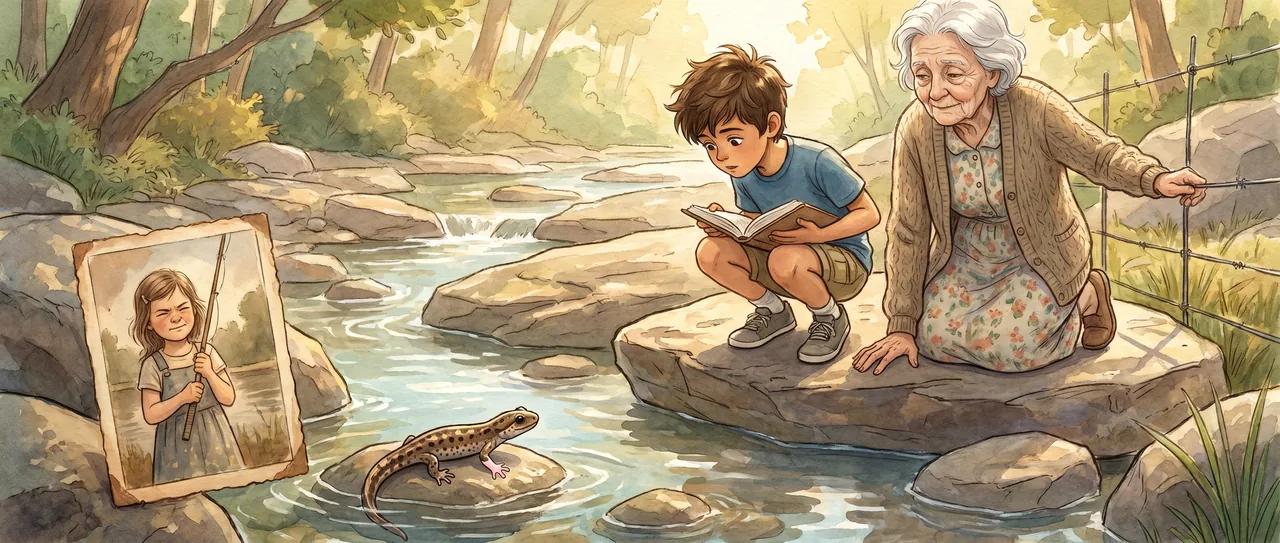
Soren put his great-grandmother's photograph on the rock beside the water. He had brought it without quite deciding to. The girl squinted up out of the brown paper at the same slow shallow water she had squinted at eighty years ago, and below her the salamander was building a new limb out of cells that refused to run their count down.
His great-grandmother came down the path, slow, one hand on the fence wire.
"You took my picture off the wall," she said.
"I wanted it to see the salamander," Soren said. "It can refill the clock. The thing that counts down in cells. The salamander can put the count back."
She was quiet. Then she lowered herself onto the rock beside the photograph, slow as the leg growing, and looked at the water with her lazy eyes.
"You're telling me," she said, "that somewhere in this little creature is the thing that's been ticking down in me since I was that girl."
"The same thing," Soren said. "Only it knows how to wind it back up."
She laughed, one short surprised breath.
"Read me the part about the tickets," she said.
Soren took the book out and found the page. The salamander lifted its new pale foot and set it down on the stone, testing it, five soft toes spreading against the rock, and held it there.
Read the interactive version, listen to the narration, and earn a gold star →
A science-verified short story for curious kids · Curiosity Land