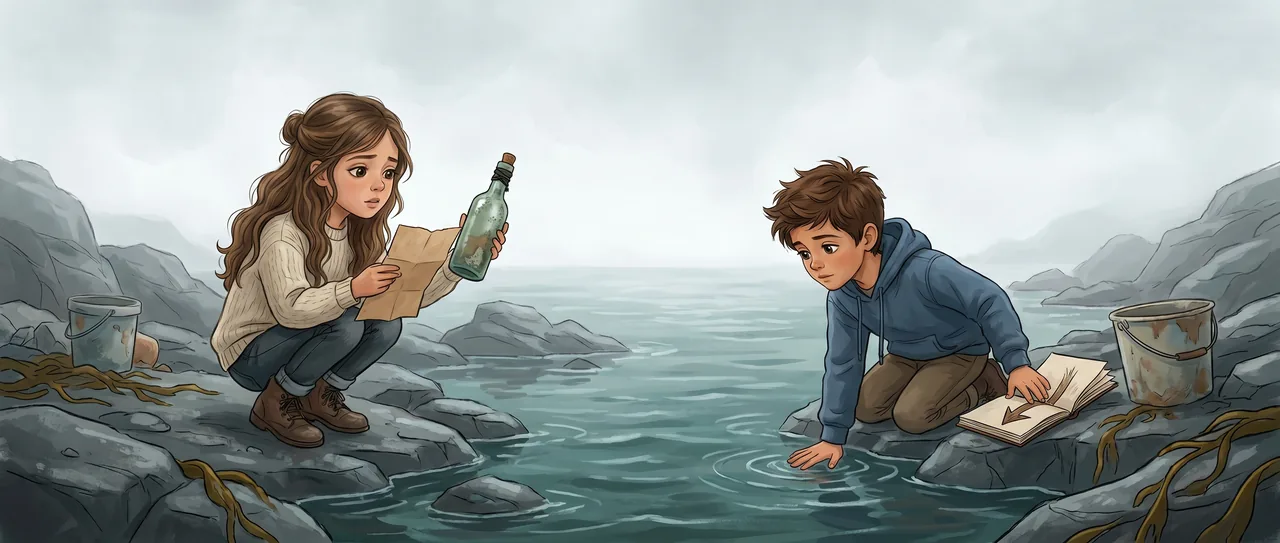
The Bottle That Was Older Than Anyone
The cleanup buckets were already heavy with the boring kind of trash. Fishing line. A flip-flop. Bottle caps that had given up their bottles long ago.
Maya was crouched at the waterline where the cold current came in close to the rocks. She had stopped picking things up. She was watching the water.
"This water is freezing," she said. "It's August."
"It's the deep current," Soren said. He had read the cove sign. "Cold water comes up against the headland here. Upwelling."
"Comes up from where?"
Soren opened his mouth, then closed it. He wrote upwelling from where in his notebook with a question mark, because he did not actually know.
That was when Maya found the bottle.
It was glass, thick and green, with a cork that had been wrapped in something black and tarry. It did not look like the plastic bottles. It looked like it had been somewhere. The glass was etched cloudy, like a bathroom window, sanded by a thousand miles of grit.
"There's paper inside," Maya said.
They worked the cork out on a flat rock. The paper inside was brown at the edges and soft, and the ink had bled, but the numbers held. A date. A latitude and longitude. And a line of careful handwriting: If found, please report. Released from a research vessel to study the deep current.
The date was the part that made Soren sit down.
"That can't be right," he said. "Read it again."
Maya read it again. The year on the paper was not from their lifetime. It was not from their parents' lifetime. The bottle was older than their grandparents.
"It's been floating for over a hundred years," Maya said.
"Floating things don't last that long." Soren turned the bottle over. "Storms smash them. Sun makes the glass brittle. A hundred years on the surface and it's gone. So." He stopped.
"So it wasn't on the surface," Maya said.
They looked at each other.
"Released to study the deep current," Soren read off the paper, slowly now. "What if it didn't float on top the whole time. What if it went down."
Maya picked up a strand of cold kelp and let the freezing water run off it onto her wrist. The same water Soren said came up from below.
"Where does the cold water go?" she asked. Not to Soren exactly. To the cove.
Soren started building it in his notebook, the way he built everything, one step that had to hold before the next one.
"Okay. Warm water on the surface near the equator. The sun heats it. It flows toward the poles, up north, and on the way it gives away its heat to the air." He drew an arrow curving north. "That's why up north isn't frozen solid. The ocean carries the warmth there."
"And then it's cold," Maya said. "Cold water is heavier."
"Heavier. And saltier, because ice forms up there and leaves the salt behind in the water that's left." Soren's pen pressed harder. "So the water gets heavy enough that it sinks. It sinks all the way to the bottom." He drew the arrow plunging down, off the edge of the page, and had to turn the page sideways to keep going. "And then it just. Crawls. Along the bottom of the whole ocean. Toward the tropics."
"How fast," Maya said.
"Slow. Slower than slow. Down there it isn't pushed by wind, there's no sun, nothing. It just oozes." He looked up. "It takes the deep water about a thousand years to make the whole loop. Sink at the poles, creep along the bottom, rise back up somewhere warm, ride the surface, sink again."
Maya was very still.
"A thousand years," she said.
"For the full circuit. Yeah."
Maya held the bottle up against the gray sky. The cloudy glass. The tar-wrapped cork that had held against pressure no swimmer could survive.
"Soren. The water touching my wrist right now." She pointed at the cold curl of the upwelling. "You said it came up from the deep. From the bottom."
"Right."
"So the last time this exact water saw the sky." She stopped. She made herself say it. "It could have been a thousand years ago. This water hasn't felt the sun since before anyone alive. It went down at the top of the world and it's been in the dark the whole time and it's coming up here, now, on my arm."
Soren did not say she was leaping ahead of the evidence. He looked at the cold water and then at his own arrow crawling sideways off the page, and something in his chest moved over to make room.
"That's what made it cold," he said quietly. "Not the weather. The journey. It's cold because of where it's been."
The bottle, Maya thought, had ridden some piece of that. Not the whole thousand years. But it had been down in the dark and slow part, somewhere a person would never go, riding a river under the ocean that no one ever sees, and it had surfaced here to be found by two kids with a bucket of bottle caps.
"We have to report it," Soren said. "It says to. There's an address." He stopped. "It's probably not even an address anymore."
"Someone wrote this," Maya said. "Someone leaned over a railing a hundred years ago and dropped this in and wanted to know where it would come up." She closed her hand around the cool glass. "They never found out. They couldn't have. They were gone before it got anywhere."
"And it kept going," Soren said.
The tide was turning. The cold tongue of water was pulling back from the rocks, sliding down to wherever it went next, the long dark loop it would not finish for centuries.
Maya crouched again at the waterline. She uncapped her own water bottle, the boring plastic one from her backpack, and tipped it out into the retreating cold.
"What are you doing?" Soren asked.
"Adding to it," she said.
Soren wrote down the latitude from the old paper. Then he knelt beside her and put his palm flat on the surface of the water, in the cold pull of the current, and held it there until he couldn't feel his fingers.
Read the interactive version, listen to the narration, and earn a gold star →
A science-verified short story for curious kids · Curiosity Land