Fainter Than It Should Be
The flashlight was supposed to prove something simple.
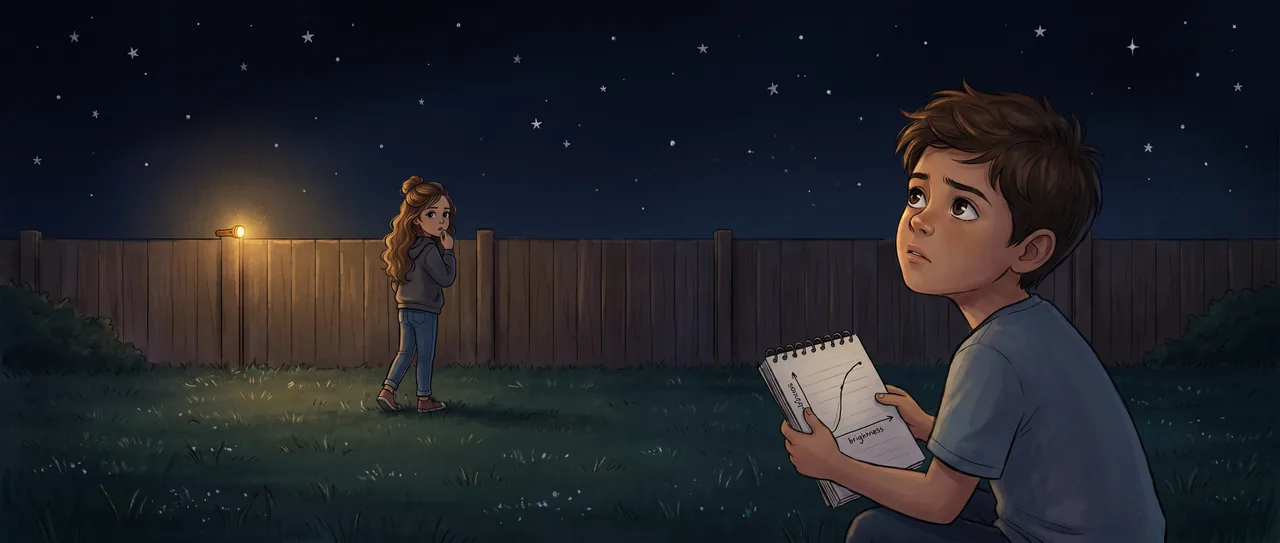
Maya had set it on the fence post at the far end of Soren's backyard. They had the same model in their hands. The idea was clean: a light four times farther away looks four times fainter, and twice as far looks four times dimmer than that, and if you knew the brightness up close you could work out the distance from how faint it looked. Soren had read about it. Standard candles, the book called them. You measure the dimness, you get the distance.
They paced it out. Ten steps. Twenty. Forty.
"Forty steps should be a quarter as bright as twenty," Soren said, squinting down the lawn. He had the math in his notebook, the little curve of brightness falling off as the square of the distance.
Maya stood at forty steps and looked back at the fence post. "It's dimmer than that."
"It can't be dimmer than that. The math says."
"I'm telling you what I see." She did not move. "It's too faint."
Soren walked out to her. He looked. He came back and checked his arithmetic by phone light. He walked out again. The flashlight on the post was definitely fainter than the curve predicted, and he could not find the mistake, and not finding the mistake bothered him more than being wrong.
"Battery," he said finally. "It's dying. That's why it's fainter."
Maya tilted her head. That was the first thing that had made sense all night. A standard candle that wasn't standard. A light you trusted to be a certain brightness, quietly fading while you measured it.
"So we can't trust it," she said.
"We can if we know how much it's fading." Soren swapped in a fresh battery, and they did the whole thing again, and this time the numbers behaved. Forty steps, a quarter as bright as twenty. The universe of the backyard made sense.
They lay back on the grass after, the way you do when a project is finished and the sky is right there.
"Stars are standard candles too," Soren said. "Some of them. There's a kind of exploding star that always blows up at the same brightness. Type one-A. Always the same. So you can tell how far away it is by how faint it looks. Same as the flashlight."
"Always the same brightness," Maya repeated. "Like the flashlight with a full battery."
"Right. A flashlight you can trust."
Maya watched a satellite slide between two stars. Something was turning over in her, the way it did before she had words.
"What if one was too faint," she said.
"Then it's farther away than you thought."
"No. I mean what if a whole bunch of them were too faint. The far ones. Fainter than they should be, even after you do all the math right and the battery's full."
Soren sat up. "Then your math is wrong somewhere."
"Or they're farther than they should be." She sat up too, faster than him. "Soren. What pushes a star farther than it should be?"
"Nothing pushes a star. The star just is where it is."
"The space pushes it." "The universe is getting bigger, you said that last week, everything moving apart. So the far ones got carried farther while the light was coming. The light took so long getting here that the whole way got longer behind it."
"That's just expansion. People knew that already." Soren had his notebook open without deciding to open it. "That wouldn't make them too faint. That would make them exactly as faint as expansion predicts."
"Unless," Maya said, and stopped.
Soren looked at her.
"Unless the pushing is getting harder," she said. "Not the same push the whole time. Speeding up."
Soren went very still. He was doing the flashlight again in his head, but backward and enormous. A standard candle, trustworthy, full battery, blowing up at the brightness it always blows up at. Arriving too faint anyway. Not because the candle was wrong. Because the room had been stretching faster and faster the entire time the light was crossing it.
"That would mean," he said slowly, "the farther ones are too faint by more than they should be. And the amount they're too faint by tells you how much the stretching sped up."
"Is it real?" Maya grabbed his arm. "Or did we just make it up because it's the only thing left?"
Soren did not answer right away, which was how she knew he was taking it seriously.
"I think," he said, "somebody would have noticed. If the far supernovae came in too faint. Somebody would have stood at forty steps and said it's dimmer than it should be, and checked the math, and not found the mistake."
"Like we did."
"Like we did." He wrote one line. Then he stopped writing and looked at the line.
The next afternoon they found out somebody had. Two teams, the back half of the nineteen nineties, measuring the faintest standard candles anyone had ever caught, exploding stars from before the dinosaurs, from before the Earth. The light came in too faint. The teams checked the dust. Checked the math. Checked whether the old stars were a different kind of candle. The faintness held. The far ones were too far. The universe was not just coasting outward. It was opening faster and faster, pushed by something nobody could see and nobody can name yet, something that fills the empty space and makes more of itself as the space grows.
They gave the prize for it in two thousand eleven. They still have no idea what the something is. They call it dark energy because that is what you call a thing when the only word you have is the size of the hole it makes.
Maya read that part twice. The smartest people alive, with the best telescopes ever built, and the answer was a faintness they could measure and a cause they could not name.
That night the flashlight was back on the fence post. Maya stood at forty steps with the fresh battery in it, full, trustworthy, exactly as bright as it was supposed to be.
She walked backward, one step, another, watching it shrink. She kept going until it was too faint, and then she took one more step.
Read the interactive version, listen to the narration, and earn a gold star →
A science-verified short story for curious kids · Curiosity Land