Worse Before Better
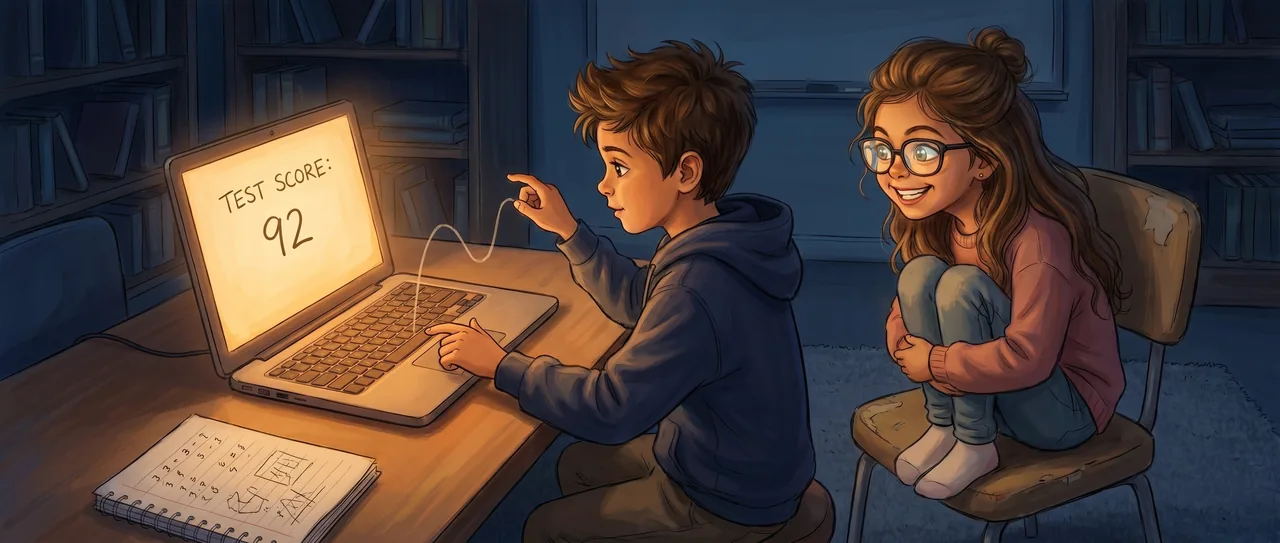
The club room smelled like warm laptops and old carpet. Everyone else had gone home. Maya had pulled her chair so close to the screen that the cursor reflected in her glasses.
"It got worse," she said.
Soren leaned in. On the screen, their little program tried to read handwritten numbers, threes and sevens and lopsided eights, and guess which was which. They had given it more to work with this time. More knobs. More room to think, was how Soren pictured it.
"That's backwards," he said. "We made it bigger. Bigger should be smarter."
"It's not smarter. Look." Maya tapped the number on the screen. The score for the practice digits, the ones it had studied, was almost perfect. But the score for the test digits, the new ones, the ones that actually counted on competition day, had dropped.
Soren opened his notebook. He had been writing down every version. Version one, small, a little clumsy. Version two, medium, much better. Version three, bigger, and now stupider than version two.
"Mrs. Adeyemi said this would happen," Soren said. "Sort of. She said if you give a program too many knobs it starts to memorize instead of learn. It just remembers the exact answers and falls apart on anything new."
"So we went too far."
"So we went too far." He underlined version two. "Two was the best. We should go back to two and stop."
Maya didn't answer right away. "Where exactly is it the dumbest?" she asked.
"What do you mean where."
"You said too many knobs makes it memorize. So somewhere there's a worst point. The exact size where it's memorizing the hardest." She turned to him. "What is that size?"
Soren thought. "Probably when it has just barely enough knobs to memorize every single practice digit perfectly. Right at the edge. It can fit every answer exactly but it's stretched so thin it has nothing left over. Like a kid who crammed all night and can only repeat the exact words on the study sheet."
"Right at the edge," Maya repeated. "Version three. We hit the edge."
"So back to two."
Maya pulled the laptop toward herself. "Or forward."
Soren put his pen down. "Forward is more knobs. Forward is worse. You just agreed it's worse."
"I agreed it's worst right at the edge. Worst isn't the same as gets worse forever." She was already typing. "If the worst part is the edge, what's on the other side of the edge?"
"Nobody goes to the other side of the edge," Soren said. "That's the whole point. Everybody stops at version two. Mrs. Adeyemi stops at version two. The whole internet stops at version two."
"Then nobody's looked." Maya hit enter. "Version four. Way bigger. Way past the edge. Tons more knobs than it needs."
The progress bar crawled. Soren watched it the way he watched a kettle, certain it would betray him. He half wanted Maya to be wrong, because if she was right it would mean the rule was wrong, and the rule was written in Mrs. Adeyemi's actual handwriting on the actual board.
The bar filled. The number appeared.
Soren stared at it.
"Read it again," he said.
Maya read it. The practice score was perfect, of course it was, it had so much room now it could memorize everything in its sleep. But the test score, the real one, the new digits it had never seen, had climbed back up. Higher than version three. Higher than the edge.
Higher than version two.
"That's not allowed," Soren said quietly. He flipped back through his notebook. Small clumsy. Medium good. Big stupid. Huge good again. He drew it with his finger in the air, a line going down, then up into a hump, then down again. "It's a hill. The error goes down, then up over the hump, then down again. There are two valleys."
"Everyone stops in the first valley," Maya said.
"Because they think the hump is a cliff." Soren's voice did something funny. "They think once it starts getting worse it keeps getting worse forever. So they turn around. Nobody walks over the hump."
"We walked over the hump."
They both looked at the screen like it might take it back.
"Why," Soren said. Not a complaint. A real question, the kind he wrote down. "Why does giving it way more room than it needs make it better. That's the opposite of cramming. It memorized everything and it still got smarter."
Maya pulled her knees up onto the chair. "Maybe when it only just barely fits, it grabs the answers any way it can. Ugly. Desperate. Whatever holds the study sheet together."
"And when it has way more room than it needs?"
"It has choices. It can fit everything a thousand different ways, so it picks a smooth one. A simple one." She frowned. "But I don't actually know that. I'm guessing. Nobody told us that. We just watched it happen."
That was the part that got Soren. Not that the program was clever. That it was clever in a way the rule on the board didn't know about. The rule wasn't lying. The rule just stopped looking too soon, right at the top of the first hill, and called the cliff the end of the world.
"Mrs. Adeyemi's going to say we did it wrong," he said.
"Then we show her version four." Maya was grinning now, the dangerous grin. "We show her the second valley."
Soren looked at the air where he'd drawn the line. Down, up, down. Two valleys with a hump between them, and almost everyone on Earth standing in the first one, sure the second one wasn't there.
"How far does it go," he said. "After the second valley. Does it keep going down. Are there three valleys. Are there ten."
Maya stopped grinning. She looked at him, then at the screen, then at the empty room around them, suddenly much bigger than a club room.
"We'd have to keep walking," she said.
Soren turned to a clean page and at the top, in careful letters, he wrote the size of version four. Then he typed the next number into the box, twice as big again, and put his finger over the enter key.
"Walk," Maya said.
He pressed it.
Read the interactive version, listen to the narration, and earn a gold star →
A science-verified short story for curious kids · Curiosity Land