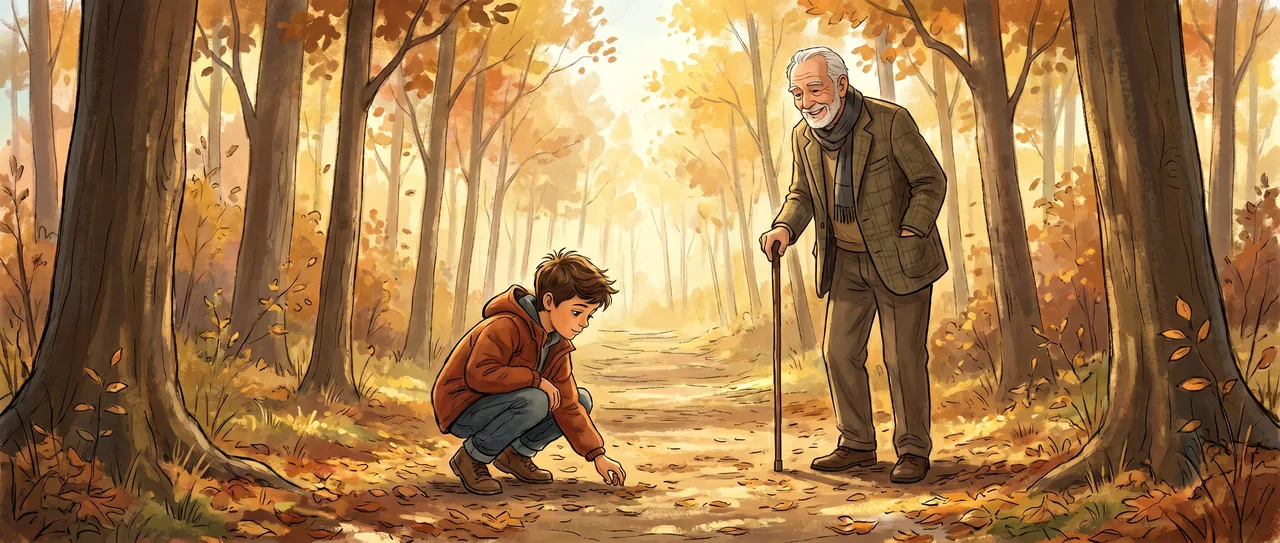
The Trail That Forgets
Soren's grandfather stopped at the edge of the woods and frowned at it like a crossword.
"There used to be a trail here," he said. "Right through. We took it every Sunday when your mother was small."
Soren looked. There was no trail. There was a wall of brambles and a thousand thin trees standing too close together, the kind of woods that did not want you in it.
"It was wide enough for a wagon," his grandfather said. "I'm not making it up."
"I believe you," Soren said, because he did. He pulled out his notebook and wrote down the date and the words trail that isn't there. Then they pushed in.
For a while it was just snagging and ducking. But Soren kept watching the ground, because the ground was behaving wrong. Under the leaves the dirt was harder than it should be in places, packed flat in a ribbon that wandered through the trees. And the trees were the strange part. Everywhere else they grew in a careless scatter. Along the ribbon they did not grow at all. They stood back from it on both sides, leaving a corridor of younger, thinner trunks that had crept in later and not quite filled the gap.
"Grandpa," Soren said. "Stand here. Look down the line of it."
His grandfather stood, and squinted, and his face changed. "That's it. That's the trail. You can see where it ran."
They followed the ghost of it. Wherever feet had once pressed the earth flat year after year, nothing big had managed to root. The old path survived as an absence, a thinning, a place the forest had not finished closing. Where no one had walked, the woods had filled in completely, dense and dark and sure of itself.
Soren crouched and put his hand flat on the packed strip. "It's like the woods kept the parts people used and got rid of the rest."
"Nature abhors a shortcut," his grandfather said, which was the kind of thing he said instead of an answer.
But Soren had stopped listening, because something had snagged in his head and would not come loose. He had read it on a Tuesday in a library book about the brain, and he had not believed it then, and he had written it down anyway. The book said that a small child's brain is not missing connections. It has too many. A two-year-old has wildly more connections between brain cells than a grown-up does, billions upon billions of extra ones, a whole forest of wiring grown thick and tangled and reaching everywhere at once.
And then, the book said, between two and twenty, the brain starts cutting. The circuits you use, again and again, the things you practice, the language you hear every day, the path home, those get kept. They get stronger, cleared, packed flat. The connections nothing ever crosses get pruned away until they are gone, and the woods of the brain closes over them as if they were never there.
Soren stood up very slowly.
"Grandpa," he said. "When Mom was little. Could she speak any other languages?"
His grandfather laughed, surprised. "Funny you ask. We had a Greek neighbor, Mrs. Pappas, your mother was over there every day. She chattered away in Greek, three years old, perfect. Then the family moved. By the time she was ten she couldn't remember a word of it. Not one. Used to drive her wild."
Soren stood in the middle of a trail that wasn't there, in the middle of woods that had eaten it, and felt the whole thing turn over.
His mother had once had that path. A whole route through her, packed flat by use, a way of thinking in Greek that was as real as this trail had been wide enough for a wagon. And then nobody walked it. And the forest of her brain, doing exactly what every brain does, exactly what it is supposed to do, had quietly closed it over. Not broken. Not damaged. Pruned. Made into the kind of woods that does not want you in it.
He looked at his own hands. He was eleven. He was in the middle of it right now, this very afternoon, the cutting going on inside his skull while he stood here, his brain choosing which Sorens to keep and which to let the trees swallow.
"What is it," his grandfather said. "You've gone strange."
"It's doing it to me right now," Soren said. "Whatever I don't use. It's deciding. Today."
His grandfather did not understand, and that was all right, because some part of Soren was already running ahead of the words. Every piano lesson he'd quit. Every kid who'd moved away. Every question a teacher had answered so badly he'd stopped asking. Somewhere in him were trails being unmade, going quiet, filling in with thin dark trees, and somewhere else were trails being pressed flatter and harder by the simple fact that he kept walking them. The notebook in his pocket. The watching of the ground. The not believing things until he'd checked them six times.
Those were being kept. He was keeping those by doing them.
"It's not just losing," he said out loud, working it through. "The book made it sound sad. It's not sad. The trail's only here at all because somebody walked it enough. The woods kept the part that mattered to somebody. That's why this one's still findable and the others aren't."
"You've lost me entirely," his grandfather said cheerfully.
They came out the far side into open field, the way you were supposed to, the way the trail had always brought people. Soren turned around and looked back at the dark line of the woods, trying to see the corridor from out here, the one place the forest stayed thin because a family had needed to get through it on Sundays.
"We have to keep walking it," Soren said. "Or it closes."
His grandfather looked at the woods, and then at his grandson, and seemed to decide something.
"Next Sunday," he said. "Same time."
Soren crouched at the mouth of the trail and pressed his palm into the packed dirt, hard, leaving a clear print in the cold ground.
Read the interactive version, listen to the narration, and earn a gold star →
A science-verified short story for curious kids · Curiosity Land