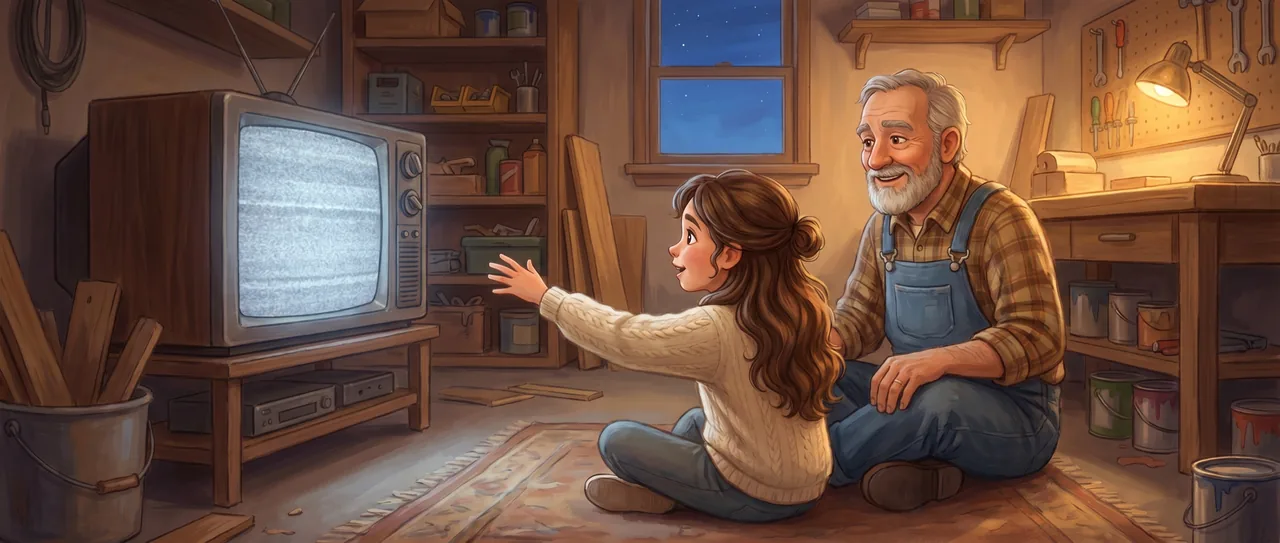
The Static Between Stations
The television had no remote, no menu, no glowing logo when it woke up. It just hummed, and the picture rolled, and Grandpa said if Maya could get it working again he would stop telling her she broke things by looking at them too hard.
She had pulled the antenna out to its full silver length. She had turned the round dial through every number. Channels two through thirteen, and between every real station, the same thing: gray snow. A hiss like rain that wasn't falling anywhere.
"That's nothing," Grandpa said from the doorway, holding his coffee. "That's just no signal. Skip past it."
But Maya had stopped on the nothing.
She leaned close to the glass. The snow wasn't still. It boiled. Thousands of tiny dots flickering on and off, too fast to count, never settling, never repeating. It looked like the screen was full and empty at the same time.
"Where does it come from," she said. Not really a question. More like a thing she set on the table to look at.
"Static comes from everywhere," Grandpa said. "Bad wiring. The fridge. Me standing here. Turn the dial, kiddo."
Maya did not turn the dial.
She folded the antenna down flat. The snow stayed. She unplugged the lamp on the bench, the one Grandpa swore caused interference. The snow stayed. She turned off the garage light, and now the only glow in the whole room was the gray storm on the screen, painting her hands the color of the moon.
"If it was the fridge," she said slowly, "covering it should change it."
She took Grandpa's coffee, ignored his sound of protest, and held a square of aluminum foil from the workbench up in front of the antenna. The snow did not care. She moved the whole television to face the wall. Faced it at the floor. Faced it up at the ceiling.
Every direction. The same hiss. The same boiling snow.
That was the thing that didn't fit, and she put it on her list. Real signals came from a direction. You turned the antenna and they got stronger or weaker. This came from all of it. Up, down, the wall, the window, her own body in the way. Whatever was sending it was not in a place. It was in every place at once.
"Grandpa," she said. "What's the oldest thing you can think of."
He laughed. "This television."
"No." She was staring at the dots. "Older."
He set the empty mug down. He was quieter now, the way grown-ups get when a kid asks a question they don't have the answer key for. "The mountains, I guess. The sea. I don't know, Maya. The stars."
"Older than the stars," Maya whispered, and the back of her neck went cold.
She knew one fact and she had never understood it until exactly now. She had read it in a library book and skimmed past it because it was just a sentence. A small part of the snow on an old television is the afterglow of the beginning of everything. She had read that and thought, fine, neat, next page.
But here it was, hissing in Grandpa's garage at eleven at night, and a fact you only read is a flat thing, and a fact that is happening to you is a door.
"Some of this," she said, and her voice didn't sound like hers, "isn't coming from the fridge."
She held her hand flat against the warm glass. Behind it the dots flickered against her palm's shadow.
"It started traveling," she said, "before there was an Earth. Before there was a Sun. Before there were any stars at all. It's been flying through space this whole time, for thirteen billion years, just to get here. To right now. To this junky television in your garage."
Grandpa didn't say skip past it.
Maya's mind was going fast, faster than she could keep up with, the way it did when something true cracked open. The light had left from the start of everything. It had crossed the entire age of the universe. It had been on its way while the dinosaurs lived and died, while the mountains pushed up, while Grandpa was a boy, while she was being born, and it never stopped, and tonight a tiny piece of it had ended its impossible trip by hitting a metal stick on a television and turning into a single flickering dot.
And then her chest got tight in a way that was almost too big to hold.
Because it wasn't ending here. Not just here.
She spun around to the garage window. Out there were houses with their own old electronics, and beyond them the town, and beyond that the curve of the whole planet. The same ancient light was raining down on all of it. On every roof. On every patch of ground. On the dark side of the Moon and the empty deserts and the middle of the ocean where no one was watching at all.
It was arriving everywhere, in every direction, all the time, and almost nobody ever stopped on the nothing to look.
"Everybody calls it static," she said. "Everybody turns the dial." The oldest light in the universe was hiding in the gap between the real stuff. You could only find it if you were the kind of person who refused to skip the nothing.
She was exactly the right kind of person to find it.
"It's not nothing," she told Grandpa. "It's the opposite of nothing. It's the first thing."
Grandpa looked at the snow for a long time. He had walked past this hiss ten thousand times in his life and never once heard what it was saying.
"Well," he said finally, soft. "I'll be."
Maya didn't fix the television.
She pulled a stool close, killed the last light in the garage, and sat down in front of the gray boiling storm with her chin in her hands. Out of every dot, she tried to pick the one that had traveled the farthest. She couldn't. They all had. She watched the oldest light in the world flicker against the dark, and she did not turn the dial.
Read the interactive version, listen to the narration, and earn a gold star →
A science-verified short story for curious kids · Curiosity Land