The Spoon That Wasn't
The box smelled like an attic and old pennies. Maya's great-uncle had left it to nobody in particular, which meant it ended up on the kitchen table on a gray Saturday with rain ticking against the window.
Soren lifted out a spoon. It was heavier than it looked, dull silver, perfectly ordinary.
"Tea spoon," he said, and set it down.
Maya picked it up and went quiet.
"What," said Soren.
"It's bending." She held it flat on her palm. "It's getting soft. In my hand."
Soren took it back. In his cooler fingers it stayed stiff. He turned it over, looking for a seam, a trick, a hollow place where something could be hidden. He found nothing. He pressed his thumbnail into the bowl of the spoon and left a small bright dent.
"Metal doesn't do that," he said.
"This one does." Maya was already curling her hand around it, making a fist, breathing on it. "Hold it long enough and watch."
They waited. Soren counted in his head, the way he did. By the time he reached forty the spoon in Maya's fist had sagged. A drop of it, a bright bead like liquid mirror, ran down the side of her wrist and hung there, trembling, not falling.
Soren stopped counting.
"It melted," he said. "You melted a spoon with your hand."
Maya tipped her palm and the bead rolled across it, leaving a shiny trail, gathering itself back into a ball at the lowest point. It looked like the mercury he'd seen in pictures, the dangerous silver liquid in old thermometers. He almost said don't touch it. But Maya was already touching it, rolling it, and nothing was happening to her except delight.
"It's not hot," she said. "It's not even warm. It just turned to liquid because I am."
That was the part Soren needed to sit with. He held his own hand flat next to hers. The room was cool. Their hands were not. The thing between a stiff spoon and a puddle was the small warmth of being alive, of having a body running at thirty-something degrees all day long without ever being asked.
"There's a temperature," Soren said slowly, "right above room temperature. And we live above it. We walk around all day being warmer than the place a metal turns to liquid."
"And nobody told us," Maya said.
They put the bead back on the table and watched it. As it sat on the cool wood it dulled, stiffened, lost its shine at the edges. It was freezing. Not into ice. Into spoon.
Soren scooped it up and pressed it back against the broken end of the spoon's handle, and it stuck, and held, like it had never come apart. A spoon that healed itself if you let it cool.
"Who would make a spoon out of this," he said.
"Somebody who wanted to know what you'd do," Maya said.
There was a note in the box. They hadn't read it because it was just a note, in faded pencil, in handwriting that climbed uphill. Maya read it now.
For the one who notices the spoon is wrong before I tell them. Make tea. Stir it. Watch what it costs you to be curious. It cost me nothing. Love it anyway.
Maya read it twice. Then she got up and filled the kettle.
Soren wanted to argue. The methodical part of him wanted to look the metal up first, to find out its name, its melting point, whether the steam from a kettle was safe, whether they should ask somebody. The other part of him, the part that kept a notebook because the inside of his head was too small for days like this, wanted to see.
The kettle clicked off. Maya poured. Steam climbed.
She lowered the spoon into the cup and began to stir.
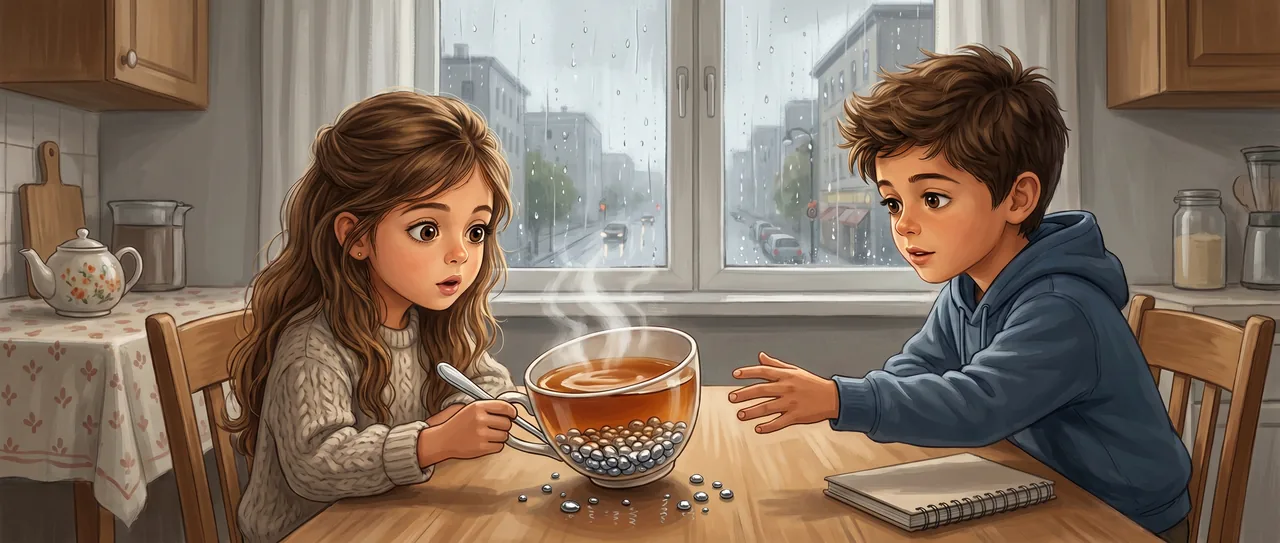
For a moment nothing. Then the bowl of the spoon went soft, then softer, then it simply was not a spoon anymore. It came apart in the hot water into a hundred bright beads that rolled and shivered along the bottom of the cup and gathered in the low center, a little pool of liquid mirror under the tea, too heavy to float, too strange to dissolve into nothing.
Maya pulled out the bare handle. The bowl was gone. The spoon had given itself to the cup.
"It didn't disappear," Soren said, leaning over it. "It's all still there. It just stopped pretending to be a spoon."
The beads at the bottom caught the kitchen light and threw it back up through the brown tea, so the surface shivered with little coins of brightness.
"Hold out your hand," Maya said.
Soren held it out. She turned the cup, slow, and let the tea cool against the side, and where the heat left, the metal remembered itself. Along the inner wall of the cup a thin bright skin began to form, gathering the beads back, stiffening, becoming solid where the cup was coolest.
The same thing. The exact same thing. Warm enough, it ran. Cool enough, it stood. And the line between those two things ran right through the middle of an ordinary afternoon, right through the middle of a human hand.
Soren got his notebook out then, but he didn't write anything yet. He just held it open on his knee and watched the cup.
"There's a whole shelf of these," Maya said. "Has to be. Things that change at temperatures we walk around inside of. Things that are solid to a fish and liquid to us."
"And we only found one," Soren said.
"Because your great-uncle hid it in a spoon."
They both looked at the box, at the other ordinary objects in it, the keys and the buttons and the dull gray marble, all of them looking exactly like what they were supposed to be.
Maya reached in and closed her fist around the marble and held it, and started to count.
Read the interactive version, listen to the narration, and earn a gold star →
A science-verified short story for curious kids · Curiosity Land