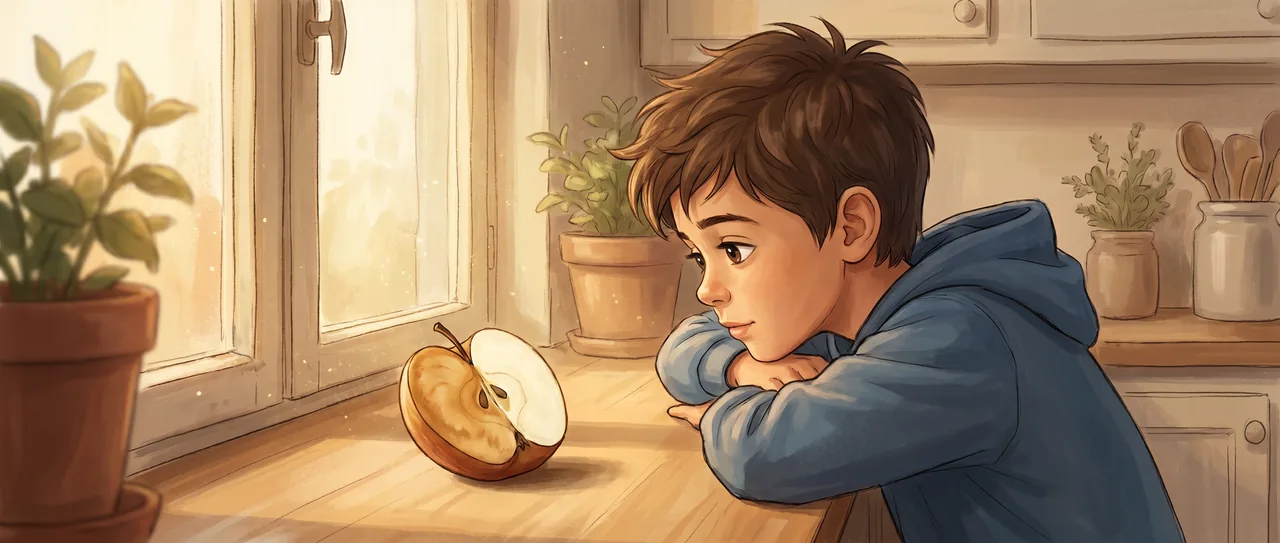
The Slowest Race in the World
Soren cut the apple wrong, and that was the start of it.
He had been told to slice it for his grandmother's pie, thin and even. But the first piece fell flat on the cutting board and he forgot it there while he hunted for a bowl. When he came back, the white face of the apple had gone the color of weak tea.
He held it up to the window. The slices he had cut a minute later were still pale. Only the first one had browned.
"It rusts," his grandmother said, not looking up from the dough. "Apples rust. Lemon stops it. Put lemon on the rest."
Soren squeezed half a lemon over the bowl. The browning stopped, exactly as she said. But he kept the first slice aside on a saucer and watched it go from tea-colored to bruise-colored to almost brown sugar, and he did not think rust was the right word, because rust took years and this took the length of a phone call.
"How does the lemon know to stop it?" he asked.
"It just does," she said. "Hand me the cinnamon."
He handed her the cinnamon. He was already somewhere else.
That night he wrote it down. Apple flesh plus air equals brown. Fast. Lemon stops fast. He underlined fast twice, because the speed was the part that would not leave him alone. Iron took years to rust through a fence. A log took a year to rot. But the apple had turned while he looked away for sixty seconds.
The next morning he did the thing he always did when something would not sit still, which was test it. He cut a fresh slice and left it. Brown in minutes. He cut another and boiled it first in his grandmother's kettle water, then let it cool and left it on the saucer next to the raw one.
The raw slice browned. The boiled one stayed pale all afternoon.
Soren stared at the two slices for a long time. Same apple. Same air. The only difference was that one of them had been hot.
"You're playing with food," his grandmother said, passing through.
"The cooked one won't turn brown," Soren said. "Heat broke something. Air didn't do it by itself. Something in the apple was helping the air."
She stopped. She was eighty-one and she had browned ten thousand apples and she had never once thought of it that way.
"Helping," she repeated.
"Boiling killed the helper," Soren said. "So the air can't get the job done anymore. Or it can, but slow. Like it should have been the whole time."
He went to the library that afternoon because the kitchen had run out of answers. He found the helper had a name. It was an enzyme. The apple was full of them, little folded machines made of protein, and the one that browned the apple grabbed onto a particular molecule in the fruit and air and slammed them together.
That was not the part that made his pencil stop.
The part that made his pencil stop was the number.
The book said that some enzymes speed reactions up by a factor of ten to the seventeenth power. Soren wrote the number out the long way to feel it. One hundred thousand billion. A reaction that would take, without the enzyme, longer than the age of the Earth. Longer than the age of the Sun. Billions of years. And the enzyme did it in a thousandth of a second.
He sat very still in the library chair.
The browning of his apple was not slow that he had sped up by leaving it out. The browning of his apple was a reaction that, left to itself, to bare air and bare fruit, would have waited longer than the universe had existed so far. The apple was not waiting. The apple carried a machine that reached into deep geologic time, into a billion years that would never come, and pulled the answer out into the length of a phone call.
He had been looking at it backward the whole time. He thought the cut apple was fast. The cut apple was a billion years of patience that something inside the fruit refused to wait through.
And there was a second thing.
The book said the enzyme was choosy. Near perfect. It grabbed its one molecule and ignored everything else in the cell, the sugars, the water, the acids, the thousand other shapes drifting past. Out of all of it, the machine held the one piece it was built for and let the rest go.
Soren thought about the boiled slice, pale on the saucer. He thought about every cell in his own hand holding the pencil, each one stuffed with thousands of these machines, each machine reaching into impossible spans of time and pulling out exactly the one reaction it was made for, millions of times a second, right now, while he sat reading. His blood was doing it. His eyes reading the page were doing it. The reason he was warm was that inside him, billions of years were being skipped over and over and over, neatly, without a single mistake, in the dark.
He was made entirely of things that would not wait.
He went home. His grandmother was rolling a second crust.
"The lemon," he said. "It doesn't stop the air. It stops the helper. The acid jams the machine."
"Does it," she said, but she was watching him now, the way you watch weather change.
He took a fresh slice and squeezed lemon on half of it, leaving the other half bare. He set it on the windowsill in the light, where she could see.
The bare half began to darken almost at once. The lemoned half stayed white, holding still, holding back a billion years.
They stood at the window and watched the two halves of one apple slice keep different time.
Read the interactive version, listen to the narration, and earn a gold star →
A science-verified short story for curious kids · Curiosity Land