The Night the River Runs
Gran lost the word for spoon.
She stood at the kitchen drawer holding one up, turning it in the light, and she said, the little, the little dipping thing, and then she laughed at herself and set it down.
Maya watched her do it. She did not laugh.
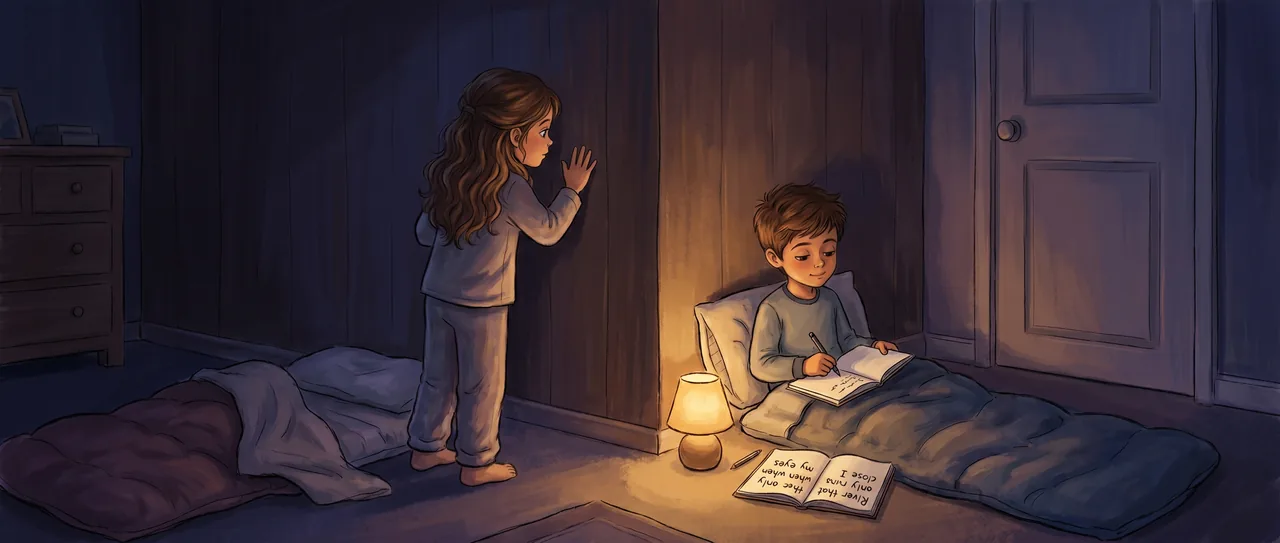
Later, in the spare room with the sleeping bags, she told Soren. He had his notebook open on his knees because he could not sleep in a new house without writing down where the bathroom was.
"She's been doing it for weeks," Maya said. "Names. Words. They slip."
"Old people forget things," Soren said.
"I know. But I think we could help. Tonight. I have an idea."
Soren put his pen down. When Maya said I have an idea in that flat fast voice, it usually meant something was about to happen that he would later have to explain to an adult.
"My idea is we keep her brain awake," Maya said. "All night. We quiz her. Capitals, songs, the names of all her sisters. If she's using the words, she can't lose them. Right? You don't lose a knife you're holding."
It sounded right. That was the dangerous thing about Maya. Her wrong ideas sounded right.
"We'd have to keep her up," Soren said slowly. "All night."
"All night."
So they tried.
They brought Gran tea and asked her the capital of Australia and she said Canberra without blinking. They asked the names of her sisters and she counted them on her fingers, Ruth, Esther, little Joan. They sang the long song with all the verses. Gran was delighted for about an hour.
Then she got tired.
And here was the strange part, the part Maya kept turning over like the spoon in the light. The more tired Gran got, the worse the words came. By midnight she called Soren by Maya's name. By one she could not find the word for the song they had just sung. The harder they worked her brain, the more it dropped.
"This isn't working," Soren said. "It's the opposite of working."
"I can see that," Maya said, which meant she was annoyed, mostly at herself.
Gran put her hand over Maya's. "Sweetheart," she said. "I need to sleep. A brain's like the rest of you. It can't run if you never let it stop."
Then she went to bed, and they heard her breathing go slow and deep through the wall.
Soren was writing. Maya could hear the pen.
"What," she said.
"You said you don't lose a knife you're holding," Soren said. "But that's not what's happening. The longer she held everything, the more she dropped. So holding on is the problem, not the answer."
Maya sat up in the dark. "Say that again."
"Being awake makes it worse. Being awake all night made it way worse." He chewed the pen. "So sleep isn't when the brain switches off. Sleep is when it does something. Something it can't do while she's using it."
"Like a kitchen," Maya said immediately.
"Like a what?"
"You can't mop the floor during dinner service. People are standing on it. You wait until everyone leaves, then you clean." She was up now, walking the little strip of carpet between the sleeping bags. "The brain's been working all day. Working makes mess. You can't clean it while it's working because the working is making the mess. So."
"So it waits," Soren said. "It waits until you're not using it."
They looked at the wall. Behind it, Gran breathed.
"There's something happening in there right now," Maya said quietly. "Right now. While she's asleep. Something's getting cleaned." The book said this. While you are awake, your brain runs, and running makes waste, tiny proteins that build up between the cells like crumbs under a table. While you sleep, channels open. Fluid pushes through the brain in slow waves and carries the waste out. The book said this cleaning runs about ten times faster when you are asleep than when you are awake. It even said that one of the proteins washed away in the night is the same kind that, when it piles up and stays, is found in the brains of people who forget.
Soren read that twice. Then a third time.
"Ten times," he said. "Not a little more. Ten times. The whole thing is built to wait for the dark."
Maya was very still, which for Maya was rare.
"We were keeping her up," she said. "We thought we were helping her hold on. We were standing on the floor while it was trying to mop."
"You couldn't have known."
"I know." She pressed her hand against the wall, flat, the way you'd feel for warmth. "But it was running the whole time. Every night. Every night of my whole life. There's a river that only runs when I close my eyes."
Soren wrote that down. River that only runs when I close my eyes. He did not usually keep Maya's sentences. He kept this one.
"It does it to us too," he said. "Right now we're awake and the crumbs are building up. They're building up while we talk about them."
Maya laughed, the surprised kind. "There's no way to feel it."
"No. You'd have to be asleep to do it and you can't watch yourself sleep."
That was the thing that got her. Not that the river ran. That she could never once be awake to see it. The most important cleaning in her body happened in the only place she could never go and watch.
Gran came in then, in her dressing gown, looking better than she had at midnight. Rested. She went to the drawer and took out a spoon and stirred her tea with it and did not stumble on the word at all.
Maya watched her stir.
"Did you sleep well, Gran?"
"Like a river," Gran said, which she could not have known to say, and Maya looked at Soren, and Soren looked at the spoon going round and round in the cup.
Read the interactive version, listen to the narration, and earn a gold star →
A science-verified short story for curious kids · Curiosity Land