The Mile of Extra
The crate was bolted shut with twelve bolts, and Soren had counted all of them before the engineer found the wrench.
"Careful," the engineer said. Her name was Dr. Okafor and she had been awake for what looked like a week. "That sphere went to the bottom. The real bottom. The Challenger Deep."
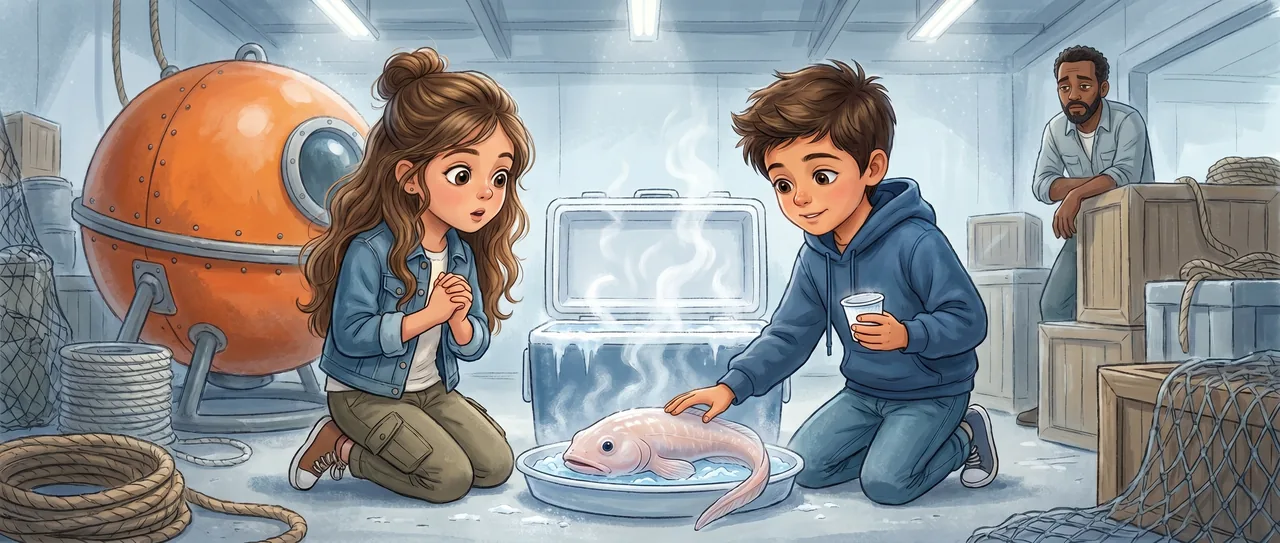
Inside the crate was a steel ball the size of a beach ball, painted orange, with a tiny window thicker than a dictionary. On a workbench beside it sat a foam cup, shrunken to the size of a thimble.
Maya picked the cup up. It was hard now, dense, the shape of a cup that had given up.
"We send those down as a joke," Dr. Okafor said, yawning. "The pressure squeezes all the air out of the foam. That cup went down a regulation size. It came back like that."
Maya turned it in her fingers. "What squeezes the cup squeezes everything," she said. "How deep."
"Almost eleven kilometers." Dr. Okafor rubbed her eyes. "You could drop Mount Everest in and the peak would still be a mile underwater."
Soren stopped with his pen halfway to the page.
"A mile," he said. "Extra."
"Extra," said Dr. Okafor. "The deepest mountain on Earth, gone, and you'd still need a mile more rope to touch the top of it."
Soren wrote that down very slowly, the way he wrote things he did not quite believe yet. He looked at the foam cup, hard as a stone in Maya's hand. He looked at the thick little window in the steel sphere.
"So nothing's down there," he said. "Right? Nothing could be. If it crushes a cup like that."
Dr. Okafor smiled for the first time, and it changed her whole tired face.
"Open the cooler," she said.
The cooler was on the floor, white, with frost breathing off the lid. Maya got there first. Inside, packed in gel and cold, was a flat plastic dish. And in the dish, pale and curled and small, was a fish.
It was not a monster. That was the first surprise. Maya had expected teeth. This was a soft pinkish thing, almost see-through, with a wide flat head and a body that tapered to nothing, like a tadpole that had kept growing and never decided what to become.
"Snailfish," Dr. Okafor said. "That one lives at eight thousand meters. There are things deeper. Shrimp. Little swimming creatures called amphipods, thousands of them, swarming in the dark. And the mud is alive. Crawling with microbes, billions of them in a spoonful."
Maya did not say anything. She was looking at the fish, then at the foam cup in her own hand, back and forth.
"That doesn't work," she said finally.
"What doesn't?"
"The cup got crushed. The fish didn't." She set the cup down next to the cooler so they sat side by side, the failure and the living thing. "Same water. Same mile of extra. One gets squashed flat. One swims around. Why."
Soren was already leaning over the dish. "The cup had air in it," he said. "That's what got crushed. The little pockets of air in the foam. The pressure had something to push on."
Maya's head came up. "And the fish doesn't have pockets."
"The fish is full of water." Soren pressed his own arm, then his cheek, thinking with his hands the way he did. "We're mostly water too. Water doesn't squash. You can't squeeze water smaller. So if you're made of water, and the water inside you pushes out exactly as hard as the water outside pushes in..."
"Then nothing's crushing you," Maya said. "You're not fighting the pressure. You're the same as it."
They both looked at the snailfish. It did not look brave. It did not look like it was straining against anything. It looked relaxed. It looked, Maya thought, like it was exactly where it belonged, and the foam cup beside it was the thing that had come from a softer, weaker, easier place and could not handle the dark.
"It's not surviving down there," Maya said slowly. "It's not holding on. It just lives there. Like up here would crush it."
Dr. Okafor nodded. "Bring one to the surface too fast and it dies. The pressure it needs, the pressure that would flatten you and me, that's its normal. That's its sea level. We're the ones who can't go there."
Soren had stopped writing. He was just staring into the cooler.
"There's a whole place," he said. "At the bottom of everything. Darker than anywhere. Heavier than anywhere. And it's not empty. It's full. It's been full this whole time and almost nobody's ever seen it."
"Almost nobody has," Dr. Okafor said. "More people have stood on the Moon than at the bottom of that trench."
Maya turned the orange sphere on the bench until the thick little window faced her. She put her eye close to the glass, the way you would put your eye to a keyhole.
"What's the deepest one," she asked. "The deepest thing anybody's pulled up. The record."
Dr. Okafor opened her mouth. Then she closed it. She looked, for a moment, less tired and more awake than she had all afternoon.
"That's the thing," she said. "We keep finding them deeper. Every time we send something down, we find life lower than the last record. Microbes living in the rock under the seafloor. Things eating chemicals instead of sunlight. We genuinely do not know where it stops." She laughed, quiet. "We don't know if it stops."
Maya pulled her eye back from the little window. The trench was eleven kilometers down. Everest fit inside it with a mile to spare. And somewhere in that mile of extra, in the dark and the weight, things were swimming around right now, this second, with nobody watching, having no idea they were the deepest living things in the world. Or maybe not the deepest. Maybe there were deeper ones still, under those, waiting for somebody to send a light.
Soren picked up the shrunken foam cup. He held it in one hand. With the other, very gently, he reached into the cold and touched the soft pale fin of the fish that the same ocean had not crushed at all.
The two of them sat there on the warehouse floor, the failure in one hand and the survivor under the other, the frost breathing up out of the open cooler between them.
Read the interactive version, listen to the narration, and earn a gold star →
A science-verified short story for curious kids · Curiosity Land