The Curve That Wouldn't Be Caught
The vine had grown four more inches overnight, and it was not growing straight.
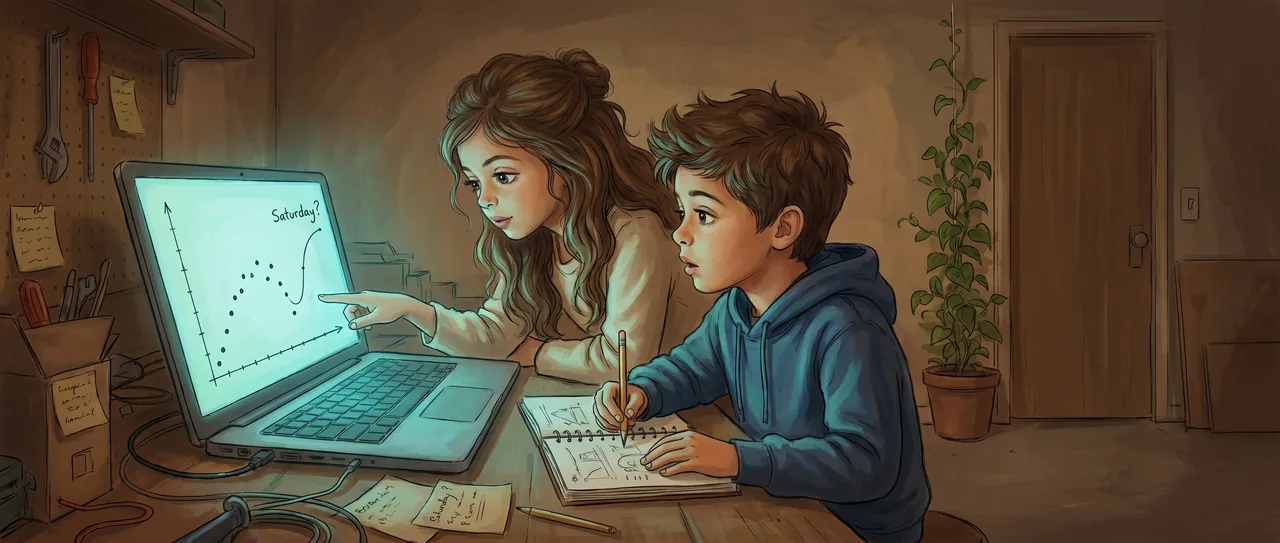
Maya had measured it every morning for two weeks. Soren had typed every number into the laptop. Now there were fourteen dots on the screen, climbing and curling, and the little program they had written was supposed to draw a line through them so they could guess where the vine would be on Saturday.
The line was a disaster. It cut straight through the middle of everything and ignored the curl completely.
"It's lazy," Maya said.
"It's a single neuron," Soren said. "It can only draw a straight line. That's all one neuron does."
He had read about this. A neuron took the numbers in, multiplied them, added them up, bent them once, and pushed them out. One bend. The vine had at least three bends in it. You could see them.
"So give it more bends," Maya said.
Soren added a hidden layer. Four little neurons, sitting in a row between the input and the answer, each allowed one bend of its own. He pressed run. The line wobbled, twitched, and then folded itself around the dots like a cat settling into a basket.
Maya leaned in so close her nose nearly touched the screen.
"It caught it," she said. "How did four straight lines catch a curve?"
"They add up," Soren said slowly, working it out as he spoke. "Each neuron bends in a different place. You stack the bends. Enough little bends in the right spots and it looks smooth."
"Like a staircase looking like a ramp if the steps are tiny."
"Yes. Exactly like that."
Maya sat back. Something was turning over in her head, and she did not have words for it yet, only the feeling that the floor had dropped a little.
"Soren. If four bends catch this vine. What can't you catch?"
He didn't answer right away. He found the article again and read the part he had skipped before, the part with the careful sentence in it.
"There's a theorem," he said. "It says one hidden layer, just one row of neurons like ours, can copy any smooth curve at all. Any one. As close as you want. A heartbeat. A coastline. The sound of someone saying your name. If you let the row be wide enough."
"Any curve." Maya said it flat, the way she said things she didn't believe yet. "That can't be right. The vine, fine. But any shape that has ever existed?"
"Any continuous one. That's what it says. Proven. Not a guess."
Maya stood up and walked to the garage door and back. She did this when a thing was too big to hold sitting down.
"Then make ours catch the curl perfectly," she said. "All the way. If it can do anything, make it do this."
Soren widened the layer. Four neurons became twenty. He pressed run.
The line went wild. It snapped to one side, flattened, missed half the dots entirely. Worse than the four. He pressed run again, the same network, the same dots, and it came out different, a whole new wrong shape.
"You broke it," Maya said, but she was grinning, because broken things were interesting.
"I didn't change anything. I ran it twice. It found two different answers."
"That's not allowed. Math doesn't get two answers."
"The theorem," Soren said, and he stopped, and read it one more time, the whole paragraph, the part nobody quotes. "The theorem says a network exists that catches the curve. Somewhere in all the possible weights, there's a perfect set. It promises me the perfect set is in there."
He looked up.
"It does not tell me how to find it."
Maya stopped walking.
"Say that again."
"There's a right answer hiding in the numbers. The theorem swears it's there. But it gives no map. No directions. The training just feels around in the dark, nudging the weights a little at a time, downhill, hoping. Sometimes it walks into the right valley. Sometimes it gets stuck in a wrong one and sits there."
"So the answer exists and you still might never reach it."
"You might never reach it."
They both looked at the screen, where twenty neurons that were mathematically capable of perfection had drawn something that looked like a startled worm.
Maya felt the floor drop the rest of the way. It was not a bad feeling. It was the feeling of a room she thought was the whole house turning out to have a door in the back of it.
"That's everything, though," she said quietly. "That's not just our vine."
"What do you mean."
"The perfect set of numbers for everything is sitting in there. The ones that recognize every face. The ones that fold every protein. The ones that read a kid's bad handwriting. All of them already exist, right now, in the space of possible weights, the way a statue already exists in a block of stone. Nobody made them. They're just there. Waiting."
"And finding them is the whole problem," Soren said. "The existing was free. The finding is the work."
"Then somebody has to go look." Maya turned to him. "That's a job. That's a real job that exists. Walking around in the dark inside a thing that's already perfect, feeling for the valley."
Soren wrote that down. He had to. The inside of his head had gone too small to hold it.
Maya wasn't waiting. She had pulled the laptop toward her and dropped the layer back to four neurons, then six, then trained it again, watching where the line settled.
"Smaller is finding it more," she said. "The wide one has too many dark valleys to fall into. The small one only has a few."
"So the trick isn't the biggest net. It's the net you can actually search."
"For now," Maya said. "For us. With this laptop." She pressed run again. Six neurons curled themselves around the fourteen dots, gentle, snug, almost the whole curl. Almost.
She reached out and put one finger on the screen, on the empty space past the last dot, where Saturday's vine was not yet and the line guessed it would go.
"There," she said. "It thinks the next bend is there."
The vine sat in its pot by the door, four new inches taller, growing toward a shape that already existed somewhere and had not been found yet.
Read the interactive version, listen to the narration, and earn a gold star →
A science-verified short story for curious kids · Curiosity Land