The Wrong Kind of Honest
The gym smelled like floor wax and old balloons. Everyone else had gone home. Maya and Soren had been left to count the leftover donation slips from the read-a-thon, which meant typing dollar amounts into a spreadsheet while a janitor stacked chairs at the far end.
"Forty-seven slips," Soren said. "I'll read, you type."
Maya typed. Soren read amounts off the little paper rectangles, one after another. Twenty-three dollars. Sixty-one. Eighty-eight. Forty-four. Ninety-two.
Maya stopped typing.
"What," said Soren.
"Nothing. Keep going."
Seventy-six. Thirty-three. Fifty-nine. Eighty-one. Sixty-seven.
"Stop," Maya said. "These are wrong."
Soren looked at the slip in his hand. "Fifty-nine dollars. That's what it says."
"Not wrong like a typo. Wrong like." She waved her hand, hunting for it. "There aren't enough small ones."
"Small donations?"
"Small first numbers. Nothing starts with a one. We've done like fifteen and nothing starts with a one."
Soren put the slip down. He didn't tell her that made no sense, even though part of him wanted to. He had learned that when Maya said something was wrong before she could explain it, the explaining usually arrived. "Why would that matter? People can donate any amount they want."
"I know. That's what's bugging me." She scrolled back up through the column they'd already entered. "At my cousin's bakery they had a thing taped by the register. Receipts. He said more numbers start with one than anything else. Way more. Like a third of them."
"A third start with one specifically?"
"That's what he said. He said it sounds fake but it's real. Prices, populations, river lengths, whatever. One wins."
Soren pulled his notebook out of his back pocket because the inside of his head had just gotten too small. "Okay. So if that's true, then in forty-seven donations, you'd expect." He chewed the pen. "Roughly fourteen or fifteen of them to start with one."
"And how many have we hit?"
He scanned the screen. "Zero."
They looked at each other.
"Read me the rest," Maya said. "All of them. Don't type. Just read."
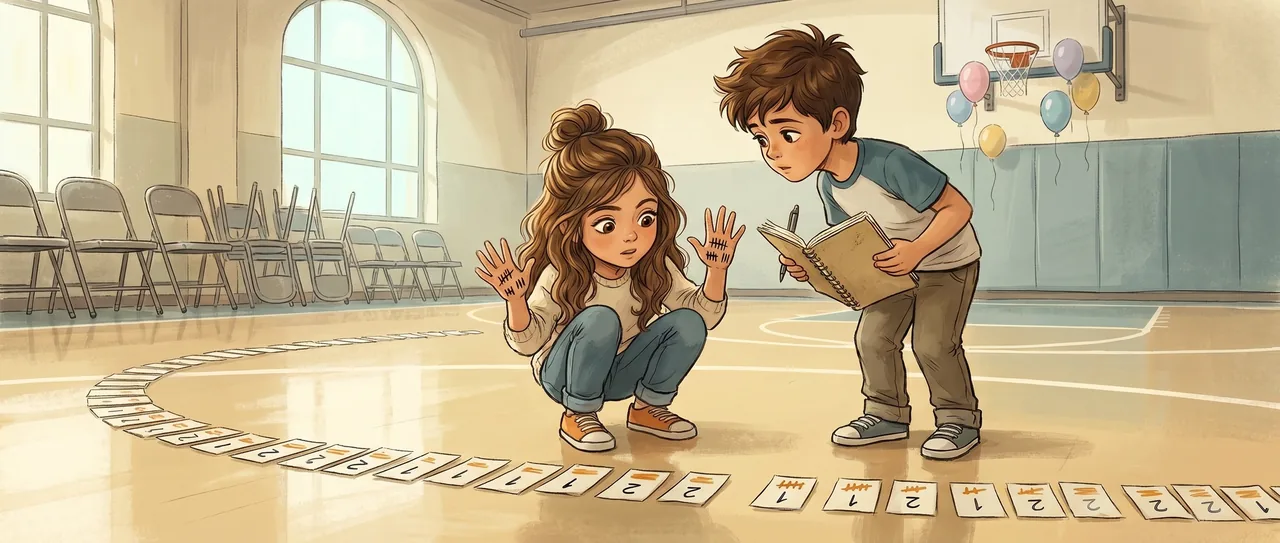
Soren read all forty-seven amounts out loud while Maya made a little tally on the back of his hand with a marker, a tick for each leading digit. When he finished, she held her hand up to the light.
"Ones," she said. "Two of them."
"Out of forty-seven."
"Twos, four. Threes, fours, fives, sixes, sevens, eights, nines. All bunched up. Loads of sevens and eights." She frowned at her own hand. "It's backward. The big digits are winning."
Soren did the arithmetic in the margin. "If one is supposed to be about thirty percent, we should see fourteen. We see two." He underlined it twice. "That's not a little off. That's the opposite of what should happen."
"So either my cousin's bakery sign is wrong," Maya said slowly, "or these slips are."
Soren went quiet, the way he did when he wanted the mechanism before he'd believe the conclusion. "Think about why one would win in the first place. Say a river is one hundred kilometers long. To grow past the ones, into the twos, it has to get all the way to two hundred. That's a whole hundred more."
"Right."
"But once it's at, like, eight hundred, to leave the eights it only needs a hundred and one more to hit nine hundred. Then nine hundred and one more and it rolls over to one thousand. Back to a one." He was writing fast now. "Things spend more of their time being led by a one than by a nine, because climbing past one takes the longest. It's not magic. It's just how growing works."
Maya was nodding before he finished. "So real numbers limp up from one and you catch most of them still down low."
"And these don't limp. These are spread out flat. Like somebody." He stopped.
"Like somebody made them up," Maya said. "When you make up numbers, you go random. Seventy-six feels random. Forty-four feels random. Nobody invents thirteen dollars because thirteen feels too plain. So the made-up ones skip the small leaders." She looked at the stack of slips, suddenly careful with them, the way you get careful with something that turned out to be evidence. "These aren't real donations."
The janitor's chairs clanked at the far end of the gym.
Soren turned the slips over. The real read-a-thon slips, the ones kids had actually filled in, were a different color. He found them in the bottom of the envelope, a thinner stack, crumpled and pencil-smudged. He read those leading digits while Maya tallied on her other hand.
"Ones," she said, and her voice changed. "Nine of them. Out of thirty-one."
"Close to a third."
"Close to a third." She held both hands up side by side, the fake stack on the left, the real stack on the right. The right hand was crowded with tick marks down near the front. The left hand was smooth and even, too tidy, the way a lie is tidy.
"Someone replaced the real slips with rounder, bigger fake ones," Soren said. "To make the total look bigger. And the only reason we caught it is that fake numbers don't know how to start small."
"They don't know the rule," Maya said. "They couldn't know. Nobody invents numbers thinking one should win."
Soren looked down at his hands, then at hers. He thought about every time a teacher had said stop counting things that don't matter, stop noticing, just do the worksheet. He thought about how Maya had felt the wrongness ten slips before either of them could say why.
"That thing you do," he said. "Where you know before you know. That's a real thing. That's this."
Maya wasn't listening. She had grabbed the math the way she grabbed everything, fast and sideways. "Soren. If made-up numbers leave fingerprints, then somewhere there are people who do this for a living. Looking at giant piles of numbers, waiting for the ones to go missing."
"There are," he said. "My uncle said auditors use it. On taxes."
"On taxes," she repeated, like it was the start of something enormous. "On anything. Any pile of numbers anybody ever faked. You could just hold it up to the light."
She spread all forty-seven fake slips across the gym floor in a long row, leading digits up, and crouched over them.
"Read me a number you'd make up," she said. "Right now. Don't think."
"Sixty-two," said Soren.
Maya pointed at the row of slips without looking up. "See. You didn't start with one either."
Read the interactive version, listen to the narration, and earn a gold star →
A science-verified short story for curious kids · Curiosity Land