The Thing With Four Names
The blue thing on the sand looked like a popped balloon that had decided to keep being beautiful anyway.
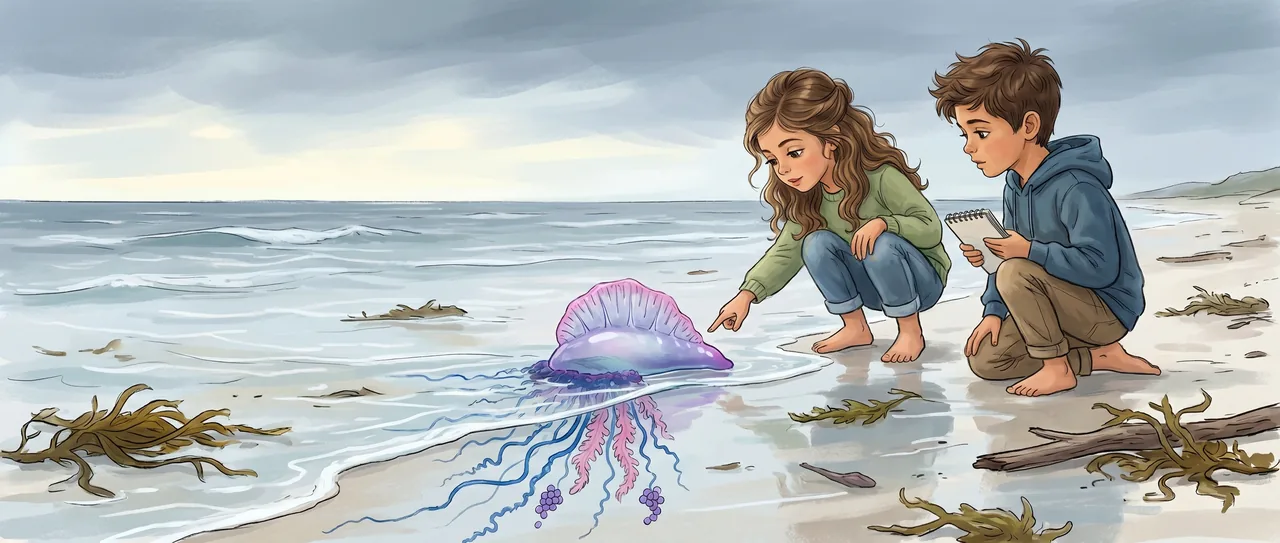
Maya crouched over it without touching. The storm had thrown a whole line of seaweed up the beach, and bottle caps, and one dead crab, but this thing was different. A bubble the size of her fist, clear and violet at the edges, with a frilly pink crest on top like a sail somebody had folded by hand. Underneath, a tangle of blue threads went on much longer than seemed fair.
"Don't touch the strings," Soren said, already three steps back. He had read a sign at the parking lot. "It's a man-of-war. The sting still works even when it's dead."
"It's not dead," Maya said.
"It's on the beach. It's out of the water."
"I know. But look." She pointed at the float. A slow shiver was moving across the top of it, a ripple that started at one end and traveled to the other, like the thing was trying to lie on a different side.
Soren came one step closer. The crest really did look folded, creased down the middle the way paper is.
"It's trying to roll over," he said.
"Things that are one thing don't have parts that argue," Maya said. "The top is doing one job. The strings are doing a different job. They don't match."
Soren got out his notebook, because the inside of his head had just gotten too small. He drew the bubble. He drew the strings. Then he stopped, because he didn't know how many things he was drawing.
"It's a jellyfish, though," he said. He said it like a question.
"Jellyfish are one bell," Maya said. "This isn't a bell. This is a bag with a sail glued on top of a curtain." She tilted her head. "Too many ideas for one animal."
Soren looked at the float. He looked at the threads. He thought about the way the sail was tilted, not straight, leaning like a ship catching wind.
"If the top is full of gas," he said slowly, "and the bottom is full of stings, then whatever made the top didn't make the bottom."
"Right." Maya's voice went fast the way it did. "And whatever made the stings isn't the part that eats. Look closer at the curtain."
They both knelt. Among the long blue stinging threads were shorter, frillier ones, curled and lumpy and folded in on themselves.
"Those aren't for stinging," Soren said. "Those are doing something else. They look like little mouths."
"So that's three," Maya said. "Float. Stingers. Eaters." She held up three fingers and then frowned at her own hand, because she felt one more coming and didn't have it yet.
A wave reached up the sand and slid back, and the whole creature rocked, and in the rocking Soren saw tiny grape-cluster shapes tucked up near the float, separate from the mouths, separate from the stingers.
"Four," he said. "There's a fourth kind. Up there."
Maya sat back on her heels.
"Okay," she said. "So which one is the actual animal?"
Soren opened his mouth to say the float, because the float was the part you saw, the part on the sign, the part that had a name. Then he closed it. The float couldn't catch food. It would starve. The stinging threads couldn't digest anything they caught. The little mouths couldn't float or sting or move themselves anywhere. The grape clusters couldn't do any of the rest.
"None of them," he said. "None of them is the animal. None of them can live by itself."
"Then it's a team," Maya said.
"It's more than a team." Soren was staring at his drawing now, at the four kinds of parts he'd sketched without knowing they were the answer. "A team is a bunch of animals that could go home after. These can't go home. There's no home to go to. There's no one in there who's a whole one."
Maya went very still, which she only did when something was rearranging itself in her head.
"They started as the same," she said. "They must have. Same instructions. Then one batch turned into a balloon and one batch turned into poison and one turned into a stomach and one turned into the babies. Same blueprint. Different jobs." She looked at her own arm. "That's. Hold on."
"That's us," Soren said quietly. "Your skin cell and your eye cell have the same blueprint. They just turned into different jobs."
"So this thing did with whole animals," Maya said, "what we do with cells."
They looked at each other. The wind pushed the folded sail flat and then let it spring back up.
Soren felt the size of the idea before he could say it. He had always counted himself as one. One Soren. The kind of one who didn't fit, who needed extra steps, who carried a notebook nobody else carried. But the thing on the sand said the line around an individual was not where he thought it was. You could draw it around a cell. You could draw it around a body. You could draw it around four bodies that had given up being separate so that something larger could be alive.
"Nobody in there is the main one," he said. "It only works because nobody's the main one."
Maya stood up. The tide was climbing. The next wave came higher and pushed a thin sheet of water under the float, and the float lifted, just slightly, the way a boat lifts off a trailer.
"It's going back," she said. "We can't carry it. The stingers would get us. But the water can."
They stepped back together and let the sea do it.
The wave pulled out, and the colony of four went with it, sail up, curtain trailing, four separate kinds of alive holding onto each other in the gray water, none of them in charge, all of them sailing.
Read the interactive version, listen to the narration, and earn a gold star →
A science-verified short story for curious kids · Curiosity Land