The Stripes on the Ocean Floor
Soren's grandfather had a garage that smelled like rope and old metal, and in the corner stood a cardboard tube taller than Maya. Inside was a map. Not a road map. A map of the bottom of the ocean.
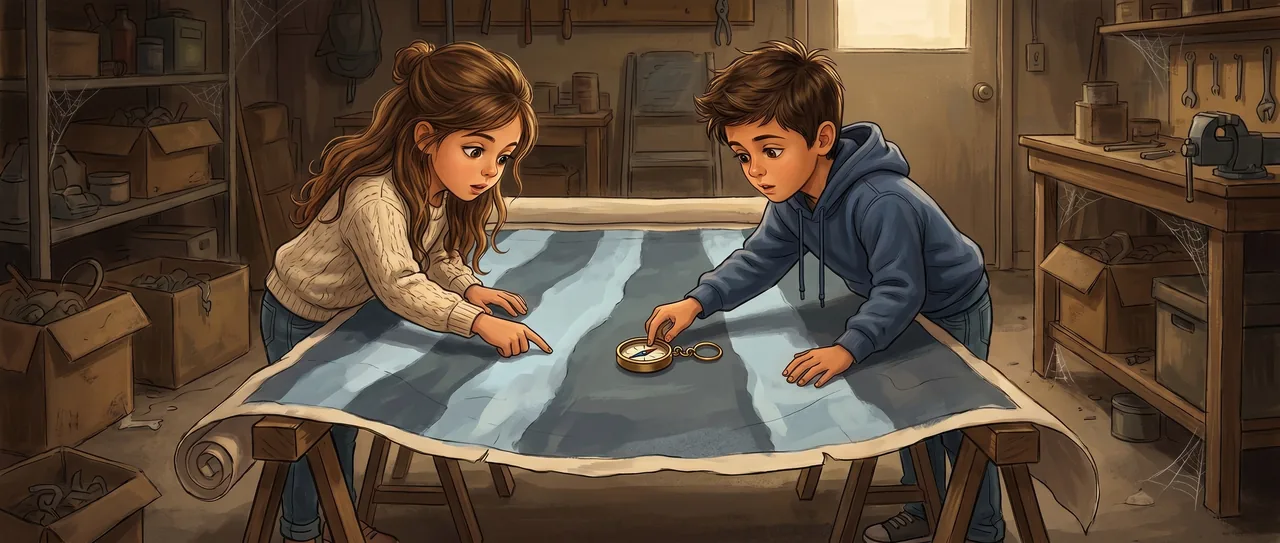
They unrolled it across two sawhorses, holding the corners with cans of paint. The seafloor was covered in stripes. Long, wavy, parallel stripes, dark and light, dark and light, running for hundreds of miles down the middle of the Atlantic.
"Tiger floor," Maya said.
"They're magnetic," said Soren's grandfather, from his chair, not getting up. "We measured them off the back of the ship. Boring work. Drag the magnetometer, write the number, drag it again." He waved a hand like the memory was dust. "The dark stripes were one way, the light the other. Nobody on board could tell me why. I stopped asking."
Then he went inside to find his glasses, and did not come back for a long time.
Maya put her finger on a dark stripe. "One way," she said. "What way?"
Soren read the tiny legend in the corner. "It says the dark stripes are rock where the magnetism points north. The light stripes point south."
"Rock can't point south," Maya said. "South is just down the map."
"It's where the rock froze," Soren said slowly, working it out. "This is the mid-ocean ridge. Lava comes up the crack in the middle. It's liquid, so the little iron bits inside it can swing around. They line up with Earth's magnetic field, like compass needles. Then the rock hardens and they're stuck. Frozen pointing wherever the field was that day."
Maya looked at the stripes again. Her finger moved out from the center crack, crossing dark, then light, then dark.
"But the rock spreads," she said. "New stuff in the middle. Old stuff pushed out to the sides. So the farther from the crack, the older the rock."
"Right."
"Then this isn't a map of the floor," Maya said. She had gone very still, which was how she got right before she said something large. "It's a map of time. The middle is today. The edges are millions of years ago."
Soren stopped. He looked at the stripes with new eyes, the way you look at a word you have read a thousand times and suddenly see is made of letters.
"Then the stripes mean," he said, and stopped, because he didn't want to say it before he was sure. "Dark, light, dark, light. The little iron bits froze pointing north. Then south. Then north again."
"The field flipped," Maya said.
"It can't flip."
"Look at the rock. It already did." She tapped the light stripe. "Right here, a compass would have pointed that way." She pointed at the floor, toward the garage door, away from the actual north she knew was behind her by the workbench. "South. The needle would swing all the way around and point south, and that would just be normal. People would have made maps with it."
Soren felt the back of his neck go cold. He pulled his little brass keychain compass out of his pocket, the one he always carried, and set it on the dark stripe nearest the center. The red end quivered and settled, pointing past the paint cans toward the back wall. North. The way it always pointed. The way he had trusted it to point his whole life.
"It's pointing north because we're living on a dark stripe," he said. "A new one. Not finished yet."
Maya counted the stripes from the center outward, her lips moving. Then she counted the same number going back in time in her head, the way she counted everything. "They're not even," she said. "Some stripes are fat. Some are skinny."
"Fatter stripe means it stayed that way longer before flipping," Soren said. "Skinny means it flipped again soon."
"So the flips aren't on a clock."
"No. The last one was about seven hundred and eighty thousand years ago. The dark stripe we're standing on has been going that whole time." He stared at the width of it. "Maya. Look how fat ours is. Look how long it's been since the last flip."
They both looked at the center stripe. It was wide. It was, Maya thought, maybe a little overdue.
"What happens during a flip?" she asked. "Does it just snap?"
"It can't snap, it's in the rock here as a smear," Soren said, tracing the blurry edge where dark faded into light. "It's not a sharp line. It's fuzzy. That fuzz is thousands of years of the field getting confused. Going weak. Dropping to maybe a tenth of what it is now. The needle wandering. Two norths some places, no clear north at all."
"For thousands of years," Maya repeated. "Long enough that nobody alive at the start would see the end."
They were quiet. Outside, a car went by, its driver pointed somewhere by a phone that listened to satellites and to a magnetic field it trusted completely.
"Everybody thinks north is a fact," Maya said. "It's not a fact. It's the weather. Just very, very slow weather."
Soren picked up his compass. The needle held its red end toward the back wall, steady, certain, the way it had been certain his entire life and his grandfather's entire life and every life ever recorded with ink and instruments.
But the map said the needle was only borrowing its direction. The map said somewhere out in the dark Atlantic mud there was a stripe where the same brass needle would have spun around and pointed the other way and felt nothing strange about it at all.
"Soren," Maya said. "When the next flip starts, will anybody even notice at first? Or will the compasses just start to disagree, a little, in different cities, and nobody will believe it?"
Soren didn't answer. He set the compass back down on the widest, oldest part of the dark stripe, the part nearest the center crack, the part that meant now.
The red needle swung, hunted, and settled north.
He watched it the way you watch something you have just learned can change its mind.
Read the interactive version, listen to the narration, and earn a gold star →
A science-verified short story for curious kids · Curiosity Land