The Spoon That Wouldn't Stay
The drawer in Grandma Ife's kitchen stuck the way it always did, and when Maya yanked it free, the spoon rolled to the front.
It was silver, but the wrong kind of silver. Too bright. Too soft-looking, like it had been poured rather than stamped. There was no brand stamped on the handle, no little dents from years of stirring.
"Whose is this?" Maya asked.
Grandma Ife didn't look up from the dough she was folding. "Some box your uncle left. Junk, mostly. Keep it if you want."
That was the whole conversation. Grandma Ife was not a person who explained things. She was a person who made bread.
Soren picked the spoon up and turned it in the window light. "It's heavy for its size," he said. He pressed his thumb against the bowl of it. "And smooth. No scratches."
They took it out to the back step, where the afternoon sat thick and hot against the bricks. Maya wanted to bang it on something. Soren wanted to look at it longer. That was usually how it went.
Maya held the spoon flat across her palm while she argued for the banging.
Then she stopped talking.
"Soren."
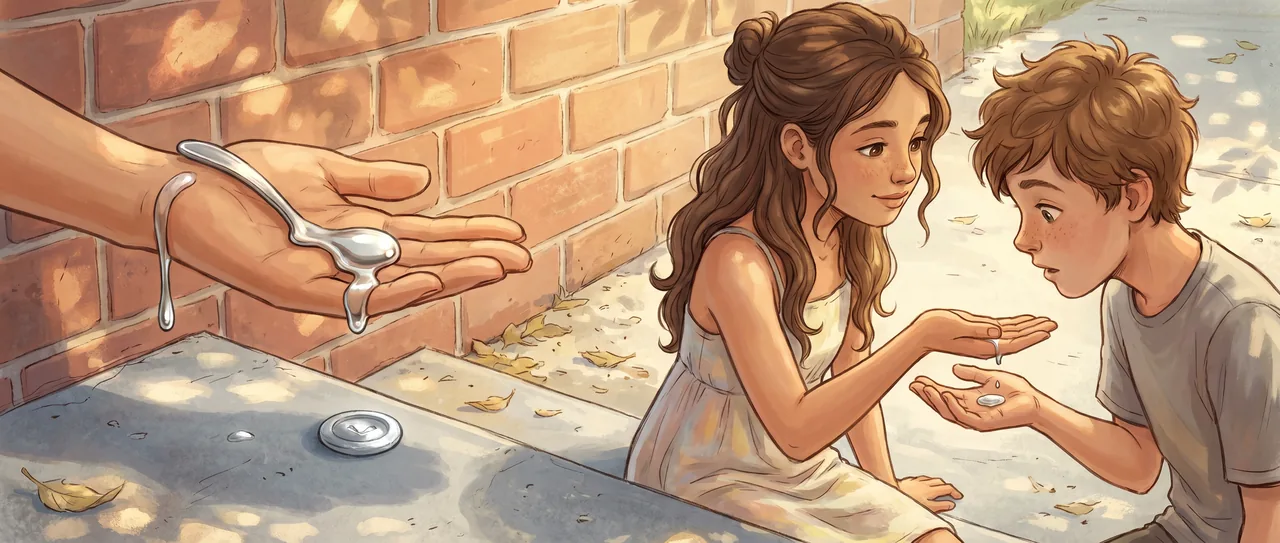
The handle was bending. Not snapping, not breaking. Drooping. The end of it sagged toward her wrist like a candle left too near a stove, and a bright bead was gathering at the very tip, swelling, getting ready to fall.
Maya turned her hand and let it drop onto the concrete step.
The drop hit, spread for half a second into a shining coin, and then went still. Solid. A little silver button stuck to the step.
Neither of them said anything for a moment.
"It melted," Soren said carefully. "In your hand. It was room temperature out here and it melted in your hand."
"Pick up the button," Maya said.
He peeled it off the concrete. It was cool and hard between his fingers. He held it in his closed fist and counted in his head, the way he always counted when he wasn't sure he believed something yet.
He opened his hand. The button had a dent in it now, a soft hollow where his fingers had pressed. The edge nearest his thumb had gone shiny and wet.
"It's me," he said. "It's us. It's our hands doing it."
Maya took the rest of the spoon, the part that hadn't dripped, and laid it back on the cool concrete. Within seconds it firmed up again, frozen mid-droop, a spoon caught in the act of giving up.
"So it's solid when it's sitting in a drawer," she said, talking fast now. "Solid all winter. Solid this morning. But your hand is what, like thirty-something degrees?"
"Body temperature," Soren said. "Skin's a little cooler. Twenty-nine, thirty maybe, on a hot day like this."
"And the spoon needs less than that." Maya pressed the button to the back of her hand and watched the corner go to liquid against her skin. "It melts below us. We're hotter than the thing that melts it." Because she had spent her whole life sorting things into two piles without ever noticing she was doing it. Things that melt with fire. Ice cubes, butter, candle wax, chocolate. And metal. Metal was the other pile. Metal was the pile that stayed. You could trust a spoon. A spoon was the example you used when you wanted to say something would never, ever change shape on its own.
And here was a metal that had been waiting in a drawer for the simple warmth of a person to walk up and touch it.
"There's a temperature," Maya said slowly, "that's right between a drawer and a hand. And almost nothing on Earth happens to live there. So we never see it."
Soren had his notebook out, but he wasn't writing. He was holding the button in his palm and watching it go from coin to puddle and back to coin as he opened and closed his fingers, opened and closed, melting it with himself and freezing it with the air, over and over.
"It's reading the difference," he said. "Between me and the day. The puddle is the size of how much warmer I am than the step."
"Make it a bigger puddle," Maya said.
He cupped both hands around it and breathed on it, warm slow breaths, and the button slumped and ran into the creases of his palms, finding every line, a tiny silver river following the map of his own hand.
Then Grandma Ife's voice came through the screen door. "You two are going to drop that in the grass and never find it."
"Did Uncle Theo know what this was?" Maya called back.
"He knew it was clever," she said. "He liked clever more than useful. That's why it's in a drawer and not in a spoon."
The screen door creaked and she was gone again, back to her dough, her bread that needed an oven, real heat, the kind of heat the rest of the world insisted you needed before anything would change.
Soren tilted his hand and let the silver pour from one palm to the other, back and forth, a thread of liquid metal hanging in the air for an instant each time before it gathered again.
"There are probably others," Maya said. She wasn't looking at the spoon anymore. She was looking past the yard, past the fence, at the heat shimmering off the neighbor's tin roof. "Things that melt at temperatures we never visit. A metal that's a puddle at the temperature of a winter morning. A metal that's a liquid in a fish."
"A metal that's only solid in space," Soren said.
"Things that are doing the boring thing," Maya said, "only because nothing ever asks them the right temperature."
Soren closed his hand around the silver one more time. He could feel it letting go inside his fist, softening, becoming whatever the warmth of him told it to become.
He opened his fingers and turned his palm over the cool concrete step, and the bright drop fell, spread, and froze.
Read the interactive version, listen to the narration, and earn a gold star →
A science-verified short story for curious kids · Curiosity Land