The People Who Lived in the Margins
Soren was supposed to be asleep. Instead he had the ancient DNA project open, the one the museum had put online so anyone could poke at it. Forty thousand years old, the page said. A single finger bone from a cave. The scientists had pulled a whole genome out of it, and now they wanted help comparing it to living people.
"Read me the numbers again," Soren said to the speaker on his desk.
"There are sequences in the bone that match no living human population," the AI said. "But fragments of them appear in modern people. Very small percentages. On every continent."
Soren wrote that in his notebook, then stopped, pen hovering. Something about it was wrong, or not wrong, but strange enough that he wanted to look at it sideways.
"Every continent," he said. "That's the part that doesn't fit."
"Why doesn't it fit?"
He thought about how to say it. "Old DNA from one cave should be in the people who stayed near that cave. Most ancient stuff is clumpy. It pools where the people pooled. But this is everywhere. A little bit, everywhere. That's not how leaving a place works."
"Would you like to map it?" the AI asked. "I can place each modern sample where it was collected and shade it by how much of the ancient sequence it carries."
"Do it."
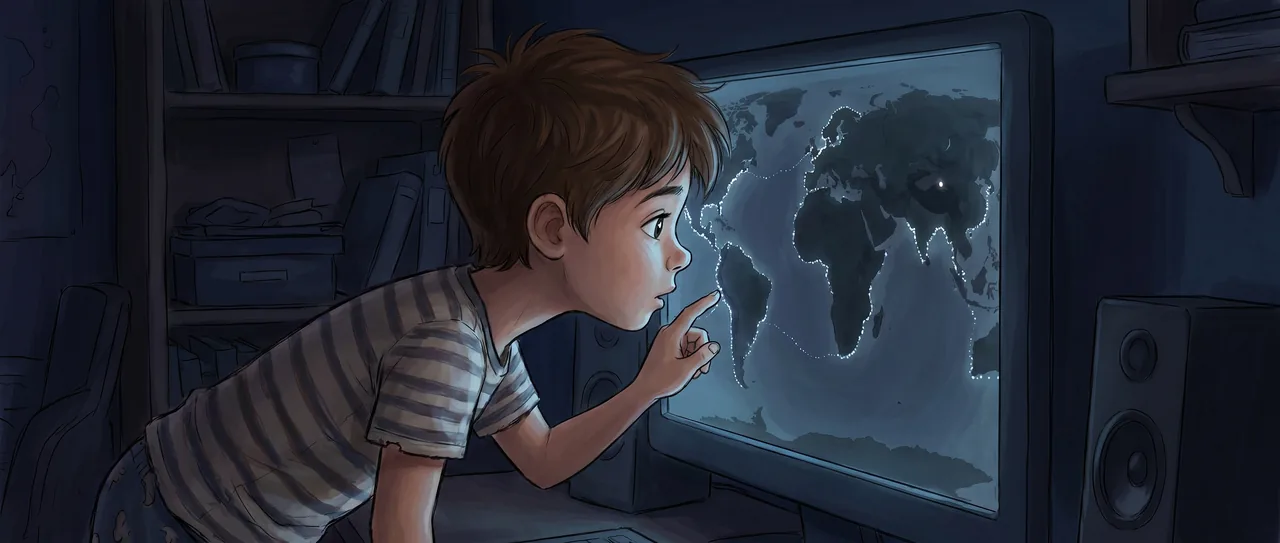
The map filled in slowly, dot by dot, thousands of samples. Soren leaned close. From far away it looked like noise, a faint dusting over the whole world. He made himself not look at the whole thing. He looked at one corner, the way you look slightly to the side of a dim star to see it better.
The darker dots, the ones carrying more, were not spread evenly. They sat in thin lines.
"Pull the inland samples off," he said. "Just for a second. Show me only the ones near water. Oceans. Big rivers that reach the sea."
"Filtering."
Half the map went dark. What stayed lit was a thread. It ran down the edge of one continent, jumped a strait, traced the rim of another. It followed the coastlines like a finger run along the lip of a bowl.
Soren stopped breathing for a second.
"The signal is stronger near coasts," the AI said. "The correlation is real. I did not expect that."
That last part made Soren sit back. "You didn't expect it?"
"I map what I am asked to map. I noticed the coastal clustering only because you removed the inland samples. I would not have separated them on my own. You gave me the idea of looking sideways."
He wrote that down too, slowly. The machine that knew a million genomes had needed a kid who couldn't sleep to tell it where to look.
"Okay," Soren said. "So think about it. There's a kind of person whose DNA is faint, but it's faint everywhere along the water. What kind of people end up everywhere along the water?"
"People who travel by water," the AI said.
"People who travel by water," Soren repeated. He stared at the thread of dots. "Forty thousand years ago. Nobody's supposed to be sailing forty thousand years ago. We barely have boats in the story that old."
"There is very little evidence of early seafaring," the AI agreed. "Boats were made of wood and skin. Those do not survive. Coastlines from that time are now underwater, because the sea was lower then and rose. Any villages would be drowned." People who pushed off from a beach and came back, and pushed off again, and married into village after village along a thousand miles of shore. People who left no bones anyone had found, no boats, no tools above the waterline. They had left exactly one thing. They had left themselves, scattered thin, a few letters of code tucked into strangers who would never know.
"They didn't disappear," he said quietly. "That's the thing. Everybody thinks gone means gone. But they're still here. They're in the map. They're just spread out so thin nobody saw the shape."
He thought about being the kid who got picked last, who sat at the edge of things, who noticed stuff nobody else bothered to notice. Spread thin. Easy to miss. Still there if you looked sideways.
"Can you check something," he said. "The inland dots that still light up. The ones away from the coast. Are they near old rivers? Rivers that used to reach the sea even if they don't now?"
A pause. The AI was fast, but he heard the pause anyway, and it felt like the machine taking a breath.
"Checking river paths from forty thousand years ago is hard," it said. "The data is incomplete. But the inland clusters I can see do sit along ancient drainage routes. Old water. You are asking a question I do not have enough information to fully answer."
"Good," Soren said, and he meant it. "That means I found something the answer doesn't exist for yet."
"It exists," the AI said. "It is underwater. Drowned coastlines, forty thousand years deep. Whoever maps the seafloor villages will find the rest of these people. If they are findable at all."
Soren looked at the clock. It was very late. His parents thought he was asleep, and tomorrow there would be a test he had not studied for, and none of that felt like it was happening to the same person sitting in this chair.
"One more thing," he said. "The bone. The finger bone they started with. Where was the cave?"
The AI placed a single bright point on the map. It sat inland, in mountains, far from any coast.
"That's wrong," Soren said, and then, slower, "no. That's right. One of them died far from the water. One of them went inland and stayed and got buried in a cave, and that's the only one we ever found. The only one. The rest are still out there under the sea."
He leaned toward the screen until his nose almost touched it and traced the drowned coastline with one finger, following the thread of faint bright dots all the way around the edge of the world.
Read the interactive version, listen to the narration, and earn a gold star →
A science-verified short story for curious kids · Curiosity Land