The Library Inside the Yogurt
The yogurt would not set.
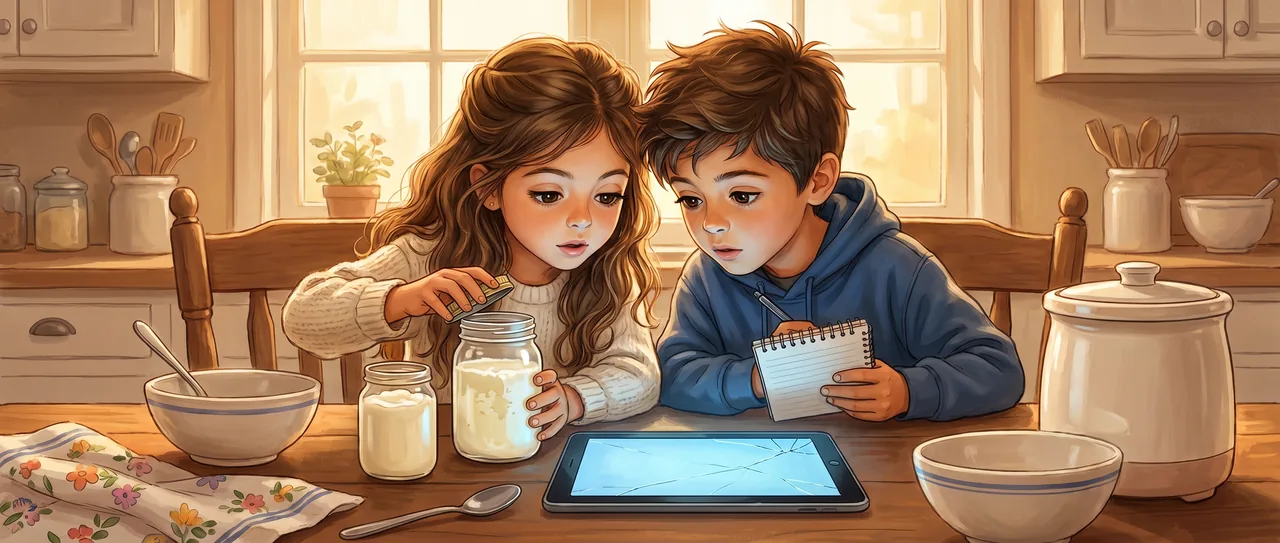
Maya tilted the jar sideways. The milk inside sloshed, thin and warm, refusing to become anything. Beside her, Soren held the second jar up to the window light, frowning at it the way he frowned at things that were behaving wrong.
"Grandma's set fine," he said. "Ours didn't. Same milk. Same spoon."
"Same bugs," Maya said. She meant the little culture they had spooned in, the living starter, the bacteria that turned milk into yogurt by eating it and breathing out sourness.
Grandma was at the stove, half listening, stirring something for dinner. "Sometimes a batch just dies," she said. "A virus gets in. Kills the culture before it can work."
Maya went still. "A virus eats the bacteria?"
"Bacteriophage," Grandma said, like it was an ordinary word, because to her it was. She had made cheese and yogurt her whole life. "The dairy people fear them. A phage gets into the vat and your whole culture is dead. They have to start over with a strain that survived."
Soren had the notebook open already. "A strain that survived," he repeated, writing it. "So some bacteria fight the virus off."
"Some do," Grandma said, and turned back to her pot, finished with the conversation.
Maya was not finished. She set the dead jar down. "How," she said. "How does a bacterium fight off a virus. It doesn't have a body. It doesn't have, like, blood. It's one cell."
Soren tapped his pen. "It has DNA. That's all it has, basically. A loop of DNA and the stuff to read it."
"Then the fighting has to happen in the DNA," Maya said. She said it fast, the way she said things before she could explain them. "It has to remember the virus somehow. In the only place it keeps anything."
Soren stopped writing.
"Say that again," he said.
"If a bacterium survives a virus," Maya said slowly, "and its kids survive the same virus, the memory got passed down. And the only thing that passes down is the DNA. So the memory of the virus is stored in the DNA. As DNA."
They looked at each other. The kitchen smelled like warm milk and onions.
"That can't be right," Soren said. But he said it carefully, the way he said things he wanted to be wrong about. "You're saying the bacterium keeps a copy of the enemy. Inside itself. On purpose."
"Like a wanted poster," Maya said.
Soren got Grandma's old tablet from the counter, the one with the cracked corner, and searched. He searched the way he did everything, one careful word at a time. Bacteria. Virus. Memory. DNA.
The screen filled. He read it twice before he read it out loud, because the first time he did not believe it.
"When a phage attacks a bacterium and the bacterium survives," he read, "it grabs a piece of the virus's DNA. A little chunk. And it files that chunk into its own genome. In a special section. With the other chunks from other viruses it has beaten before."
"A section," Maya said. "Like a shelf."
"Like a shelf," Soren said. "Rows of them. Each piece a different virus. And in between each piece there's the same spacer, over and over, like the gaps between books." He looked up. "They have a name. The whole shelf. They call it CRISPR."
Maya pulled the tablet toward her. "What does it do with the shelf, though. A shelf doesn't fight."
Soren read ahead, lips moving. "When the same virus comes back, the bacterium copies the matching piece off the shelf. Makes a little tag out of it. And the tag goes looking through the whole cell until it finds DNA that matches. The virus's DNA."
"And then?"
"And then there's a protein that rides along with the tag," Soren said. "And when the tag locks onto the matching virus DNA, the protein cuts it. Right there. Cuts the virus in half before it can do anything."
Maya sat back. The dead jar of milk sat between them, gone wrong, killed by exactly this kind of war, a war so small they had needed a screen to see it.
"So the bacterium reads the wanted poster," she said. "Finds the criminal. And cuts him in half at the exact spot the poster describes."
"A cut at an exact spot," Soren said. He was very quiet now. "Maya. An exact spot. In DNA. They figured out how the bacterium aims it."
Maya was already there. She always got there first and explained second. "If you can aim it," she said, "you don't have to give it a virus. You could give the tag anything. Any piece of DNA you wanted to find."
"Any gene," Soren said.
"In anything. A plant. A person." Maya's hands were flat on the table. "You'd write the poster yourself. Hand it the address. And it would go find that exact spot in three billion letters and cut."
Soren looked down at the tablet, then up at her, then at Grandma, who was still stirring, who had said bacteriophage like it was nothing, who had no idea that the thing she feared in her cheese vat was the most precise pair of scissors in the world.
"That's the tool," he said. "That's the thing they edit genes with. It's in the news. My cousin's friend, the one with sickle cell, they fixed it with this. This exact thing." He pointed at the screen. "It's not invented. They didn't invent it. They found it. In the bacteria. The bacteria were already doing it."
"For billions of years," Maya said. "Before anybody was watching. The whole time we thought a dead batch of yogurt was just a dead batch."
Soren wrote one line. Then he stopped writing, because he wanted to look at the jar instead.
The two of them leaned over the failed yogurt, the thin warm milk that had lost its war. Somewhere in there, too small to see, were bacteria that had not lost. Cells carrying shelves of old enemies, filed letter by letter, waiting.
Maya unscrewed the lid. The sour smell rose between them.
"Grandma," she said, not taking her eyes off the jar, "can we save the batch that survived. Just that one. I want to see what it remembers."
Read the interactive version, listen to the narration, and earn a gold star →
A science-verified short story for curious kids · Curiosity Land