The Hundred-Year Animal
The footage was numbered like chapters, and Soren had them out of order.
Clip eleven. Clip three. Clip nineteen. He kept rewinding to the same gray shape on the seafloor, three thousand meters down, lit by a robot's lamp. A dead whale. Doctor Okafor had filmed it for years from the submersible, and now she was asleep down the hall, and the two of them had the data bay to themselves and a screen the size of a window.
"It's a different animal in each clip," Soren said.
"It's the same whale," said Maya.
"That's not what I mean."
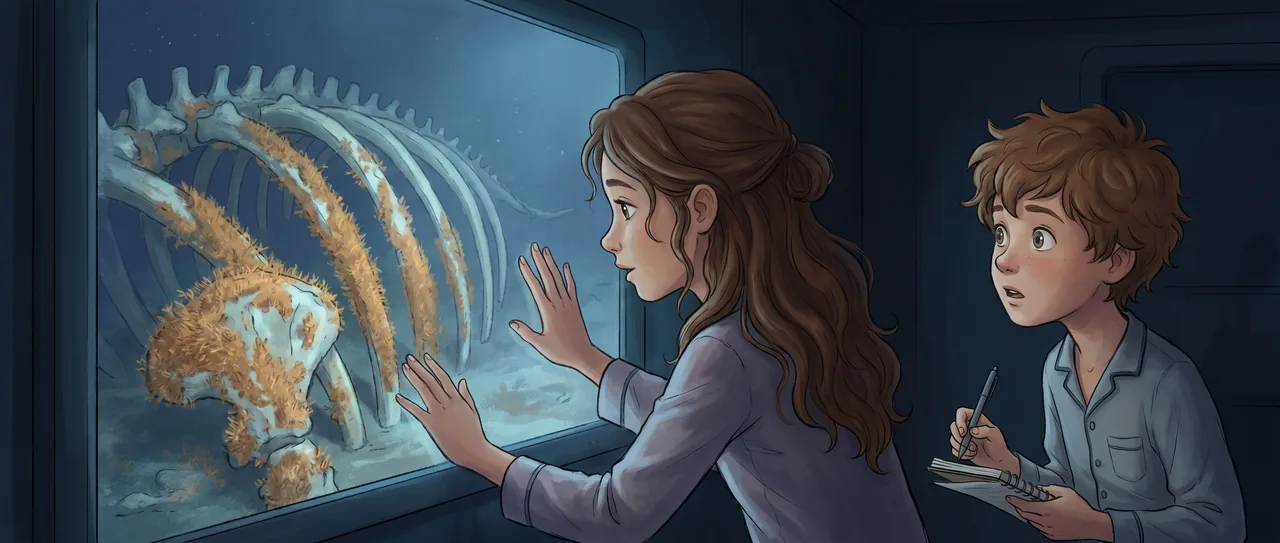
Maya looked. In clip three the whale was a mountain, smooth and whole, and the water around it boiled with hagfish and sleeper sharks, hundreds of them, peeling it like fruit. In clip eleven the mountain was a frame. Ribs. And the bones were not bare. They were wrong. They were furred, red and gold, growing.
"Stop," she said. "Go back. The bones are alive."
Soren froze the frame. The ribs wore a coat. Something woolly and rust-colored covered every inch, waving a little in the current.
"Bacteria," he guessed. "Or a plant. There's no light down there, so not a plant." He wrote no light, gold, waving in his notebook, and underlined no light twice. "It can't be eating sunlight. So what's it eating."
"The whale," Maya said. "Still. It's still eating the whale. Years later."
They ran the clips in order this time. It was like watching a single creature change its mind about what it wanted to be.
First the eaters. The hagfish and the sharks and the crabs, stripping the body in months, a feeding so dense the water looked like static. Then they thinned out and left, and the next clip was quieter. The bones lay in a dark stain on the seafloor, and the stain was crawling. Worms. Snails. Things with no names Maya knew, living in the grease the whale had soaked into the mud.
"It changed tenants," Soren said. "The first crowd ate the meat and left. Now there's a second crowd that eats what the first crowd left behind."
"And then the gold," Maya said.
Clip nineteen was the gold. The bones in their rusty fur. Doctor Okafor had labeled this one with a date, and Maya did the subtraction and felt her stomach tilt.
"Soren. This clip is six years after the first one."
"Six."
"Same whale. Six years. And it's busier than ever."
They sat with that. The data bay hummed. Somewhere under them the actual ocean went down and down past anything the lamp could reach.
Soren tapped the gold fur. "This is the part I don't get. The meat's gone. The grease is gone. There's nothing left but bone. So what's the gold living on?"
Maya leaned close to the screen until her nose almost touched it. "What's inside a bone?"
"Marrow. Fat."
"Fat," she said. "Inside. Sealed up. The eaters couldn't get it because it's locked in the bone." She pulled back. "So the gold isn't eating the bone. It's breaking into it. It's drilling for the fat that nobody else could reach."
Soren wrote drilling for buried fat and stopped with the pen on the paper.
"That's not how eating works, though," he said slowly. "There's no mouth. It's just fuzz on a bone. Fuzz can't drill."
"Then it isn't doing it alone."
They looked at each other.
Soren scrolled. Doctor Okafor kept notes on each clip, short ones, and on clip nineteen the note said: bone-eaters, no gut, no mouth. inside: bacteria. they do the chemistry. the worm builds the garden.
"The worm farms," Soren said. "It can't eat. So it grows the things that can, inside its own body, and lives off what they make."
"It's a garden," Maya said. "On a bone. In the dark. Three thousand meters down."
There was one more clip. Doctor Okafor had not finished labeling it. The gold was thinning here, the bones grayer, and in the cracks of the bone something paler had moved in, a haze, a film, and around the film the mud itself seemed to shimmer.
"What's the haze," Soren said.
"Read her note."
The note said only: sulfide stage. could last decades. some of these species live nowhere else on Earth. nowhere. only here. only on the bones of the dead.
Maya read it twice.
"Nowhere else," she said. "There are animals that have no home except a dead whale."
"That can't be a lot of animals," Soren said. "How many dead whales can there even be on the bottom of the ocean at one time?"
And then he heard himself, and went quiet, and Maya was already there.
"Enough," she said. "There have to be enough. Right now. Tonight. Or those animals wouldn't exist." She pressed her palm flat against the screen, over the shimmering mud. "Somewhere under us there's a whale that died this week, and the hagfish are arriving. And somewhere there's one in the gold stage. And somewhere there's one a hundred years old, and it's still feeding things, and the things it's feeding live nowhere else, and nobody has ever seen them, and they're down there right now in the dark, fed."
Soren did not write anything. The pen sat on the open page.
"A whale falls down," he said, working it out in the air, "and it doesn't end. It opens. It's a door for a hundred years. Different things walk through at different times."
"And the last ones through the door," Maya said, "are the ones that have nowhere else to go."
Doctor Okafor's footsteps came down the hall, slow, half awake. "You two still up? That's clip twenty. I haven't even sorted it yet. Whole communities in there I can't name."
"How many of these are happening right now?" Maya asked. "On the whole seafloor. Tonight."
Doctor Okafor stopped in the doorway and rubbed her eyes and gave the honest answer, which was the one Maya wanted and the one that helped least.
"We genuinely don't know," she said. "Thousands, maybe. We find them by accident. We've mapped almost none of it."
Then she went to make coffee, because it was the middle of the night and she had clip twenty to sort.
Maya kept her hand on the screen. On the dark mud the haze drifted, feeding something with no name, and Soren reached over and pressed play.
Read the interactive version, listen to the narration, and earn a gold star →
A science-verified short story for curious kids · Curiosity Land