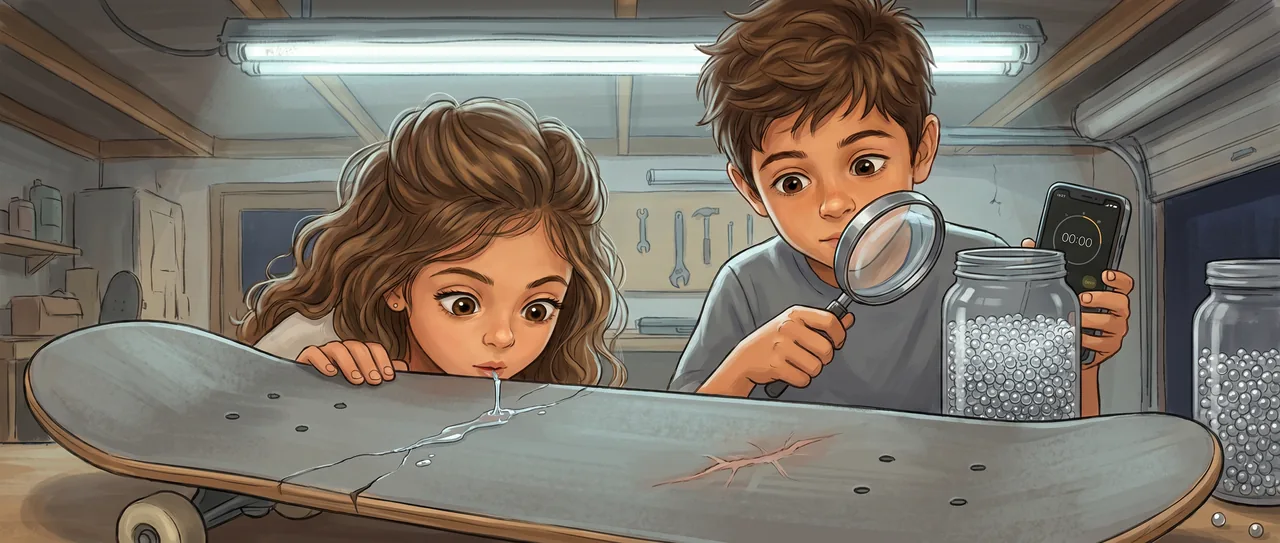
The Crack That Closed
The skateboard had cracked clean across the middle, and Maya was furious about it in the quiet way she got, where she didn't say anything and just stared at the break like it owed her money.
"It's done," Soren said. "That's a structural crack. We could glue it, but it'll snap again the first time you land on it."
"My uncle sent stuff," Maya said. She was already digging through the cardboard box on the workbench. Her uncle worked at a coatings company and mailed them his leftovers sometimes, which was how they had ended up with paint that glowed and tape that conducted electricity.
She pulled out a small jar of pale gray resin with a label that just said TEST BATCH. No instructions. No explanation. There was a sticky note on the lid in her uncle's handwriting that said: brush on, let cure, then try to break it. Tell me what happens.
"That's not an answer," Soren said. "That's a dare."
They brushed the gray stuff over both halves of the deck, clamped the crack shut, and let it sit overnight under the fluorescent light that buzzed. In the morning the resin had hardened into a dull skin over the wood.
Soren pressed it. "Hard. Like normal cured resin." He took the utility knife and dragged it across the surface, leaving a thin scratch. "Scratches like normal too."
Maya leaned in close, almost touching her nose to the cut. "Wait."
The scratch was darkening. Along the line where the blade had gone, a wet shine was rising up out of the dry surface, like a paper cut beading blood, except slower and clearer. It welled into the groove and then stopped.
"Did you spill something?" Soren asked.
"I didn't touch it." Maya watched the liquid sit in the scratch. "It came from inside."
They waited. Soren timed it on his phone because that is the kind of thing Soren does. After about forty minutes the wet line had gone matte again. He ran his thumbnail across the old scratch.
It was gone. Not filled in like spackle, not glued over. Gone, like it had never been cut.
"Do it again," Maya said.
Soren cut a fresh line right beside the healed one. Again the clear liquid rose into the new groove. The old healed scratch did not bleed at all. He cut directly across the old scar, the exact same spot.
Nothing came up there. The healed scar stayed dry while the fresh part of the cut wept liquid.
Soren sat back. "Okay. So wherever it's already healed, it's empty. It can heal a place once. After that, that exact spot is used up."
Maya was quiet, doing the thing where she got somewhere before she could explain how. "It's not coating," she said. "It's full of something. Little pockets."
"Pockets of what?"
"The liquid. The clear stuff." She picked up the jar and held it to the light, tilting it. The gray resin in the jar wasn't smooth. Suspended in it were thousands of tiny round specks, so small they looked like dust until you moved the jar and saw them all catch the light at once. "Look. It's not gray. It's clear resin full of little balls."
Soren got the magnifying glass. Under it the specks resolved into perfect tiny spheres, smaller than salt grains, scattered all through the resin like seeds in jam.
"They're capsules," he said slowly. "They're little capsules and the liquid is inside them." He looked at the scratch. "So when the knife cuts through, it breaks open every capsule it crosses. They spill. The liquid runs into the crack and hardens."
"And once they're broken, they're broken," Maya said. "That's why the scar doesn't heal twice. You popped all the balls there already. Empty pockets."
They looked at each other.
"That's how a scab works," Soren said. "Sort of. You cut yourself, something rushes to the cut, it seals. The material doesn't know it's hurt. It just has the stuff already loaded everywhere, waiting, and the damage itself is what opens it."
Maya was turning the jar so the spheres flashed and went dark, flashed and went dark. "The breaking is the trigger," she said. "You can't heal it on purpose. The only thing that opens the medicine is the wound." Soren wrote it down, because the inside of his head felt too small. Then he looked up. "My grandmother had a thing about her hip. They put a metal piece in. She said the doctor told her if it ever cracked inside her, that was it, they'd have to go back in."
"Imagine if the metal had this in it," Maya said.
"It can't. Metal's too hot when they make it. The liquid would cook off." Soren paused. "That's a guess."
"Good guess," Maya said. "But somebody's trying. My uncle's trying. That's what this is." She gestured at the jar. "This is somebody figuring out how to put scabs in things that don't bleed."
Soren tested it three more times anyway, because believing took him more steps than it took Maya. New cut, liquid rises, healed. New cut, liquid rises, healed. Across an old scar, nothing. Every time, the material answered exactly the same way, like it had decided something a long time ago and would not be talked out of it.
"It only gets to save itself so many times," he said. "Every place is a one-time thing."
"So you'd want the capsules small," Maya said, leaning her chin on her hands. "Smaller and smaller, more and more of them. Then even a healed spot still has fresh ones right next to it. The smaller you make them, the more times the thing can come back."
Soren stopped writing. He looked at the jar, at the thousands of spheres he could only see because the light moved across them.
"How small could you go," he said. It wasn't really a question to her. It was a question to the jar.
Maya picked up the cracked half of the skateboard and pressed it against the other half. Where the gray skin met the gray skin, a thin clear line of liquid rose up between them and held the two pieces together.
Read the interactive version, listen to the narration, and earn a gold star →
A science-verified short story for curious kids · Curiosity Land