How Long Is the Lake?
The flyer at the library said it plainly. Whoever measured the most accurate shoreline of Heron Lake would get their name on the new trail map. Maya read it twice and then went to find Soren, because Soren owned a measuring wheel and Maya owned the kind of stubbornness this would require.
"Easy," Maya said. "We walk the edge with your wheel. We write the number. We win."
Soren clicked the counter back to zero. The wheel had a little arm that ticked once every revolution, and a tiny window that counted meters. They started at the boat ramp and walked, the wheel rolling over packed dirt and grass, around the long curve where the cattails grew, all the way back to the ramp.
"Four hundred and ten meters," Soren said. He wrote it in his notebook. Four hundred ten.
"Done," said Maya.
But Soren was frowning at the wheel. "We cut every corner. Look at where we walked. The wheel skipped right across the little bays. We didn't measure the lake. We measured a rounder lake that isn't there."
Maya looked back along the shore. He was right. They had walked a smooth loop, but the actual edge of the water poked in and out, in and out, around rocks and reeds and a fallen log.
"Fine," she said. "We do it properly. We follow every wiggle."
They went back to the ramp. This time they pushed the wheel into every little inlet, around every stone that stuck out, hugging the place where wet met dry. It took an hour. The wheel kept getting stuck in mud.
"Five hundred and ninety," Soren read. He stared at the number. "It got longer. The same lake got longer."
Maya felt the first small itch at the back of her mind, the kind she kept a list of. "It didn't grow. We just looked closer."
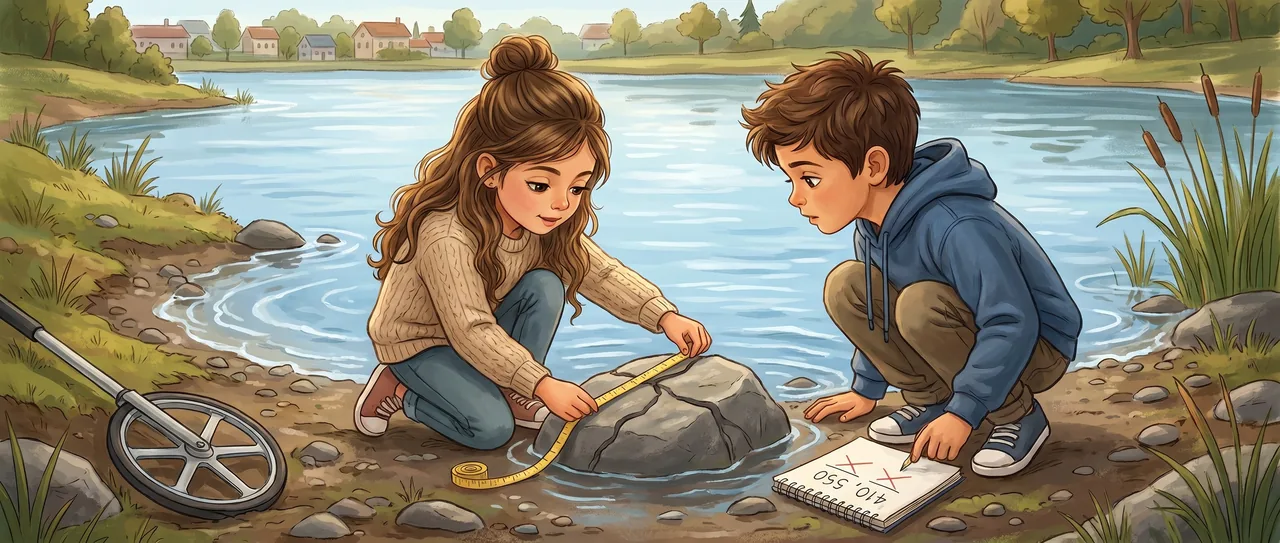
Soren crouched by the water. There was a single rock, gray and rounded, sitting half in the lake. The wheel had rolled past it in one smooth arc, treating it like a bump. But the rock had an edge of its own. It went in and out. It had little notches where water sat in the cracks.
"The wheel's too big," he said. "It can't feel anything smaller than itself."
Maya pulled the measuring tape out of her backpack, the soft yellow kind that bends. She knelt by the rock and laid the tape along its actual edge, into every notch, around every bump. The piece the wheel had called one meter, the tape called almost two.
They looked at each other.
"If we did the whole lake like that," Maya said slowly. "With the tape. In every crack."
"It'd be longer again," Soren said. "A lot longer."
They tried a stretch of it, ten meters of wheel-shore, down on their knees with the tape, following the true wet edge between every pebble. The ten meters became nineteen.
Maya sat back on her heels. The itch in her mind had become something else. "Soren. What if we used a ruler. A little one. For every pebble."
"Longer."
"What if we measured around every grain of sand."
Soren's pencil stopped moving. He looked at the strip of shore in front of him, which had seemed so simple an hour ago, a line you could draw with one stroke.
"Every grain has an edge too," he said quietly. "And the grains are made of bumpy bits. And those have edges."
A man was walking a dog along the path behind them. He slowed down. He was the kind of adult who liked to be helpful and liked even more to be right.
"You kids measuring for the contest?" he asked. "My nephew got it last year. Four hundred and four meters. Used a proper wheel. That's your answer right there, that's the real number."
"Which real number?" Maya asked.
The man blinked. "The length of the lake. There's just the one."
"We got four hundred ten," said Soren. "And five hundred ninety. And if we use the tape it's more. And if we use a ruler it's more than that."
"Well, you're doing it wrong, then," the man said, pleasant and certain. "A thing has a length. You just have to measure carefully."
"That's the problem," Maya said. "The more carefully we measure, the longer it gets. It doesn't stop."
The man laughed like she had made a joke, gave the leash a tug, and walked on. Maya watched him go without any anger. He had a wheel-sized idea of the lake. She had stopped having one about forty minutes ago.
Soren was very still. "Maya. Where does it stop?"
She didn't answer right away, because she was actually checking. Pebble, grain, the bumps on the grain, the bumps on the bumps. Each time you looked closer there was more edge hiding inside the edge.
"I don't think it does," she said. "I think the closer you look, the more shore there is. Forever."
"Then the lake doesn't have a length," Soren said. He said it slowly, testing it, the way he tested everything before he believed it. "It has as many lengths as the size of the thing you measure it with. The number isn't in the lake. It's in the ruler."
Maya laughed, not because it was funny but because it was huge. The lake hadn't changed at all this whole afternoon. The same water, the same reeds, the same gray rock. But it had stopped being a thing with one true size and become something that opened up the more you leaned into it, like a question that grew more questions instead of an answer.
"We can't win the contest," Soren said.
"No," said Maya, grinning now. "We found out the contest is impossible. That's better."
They didn't write down a final number. There wasn't one to write. Soren put his pencil away and they sat at the edge of the water, where the small waves kept rearranging the line between wet and dry, a line that was never the same two seconds together, never finished, never one length.
Maya reached down and laid her yellow tape along a single wet pebble, following it into a crack no wider than a thread, and watched the numbers climb.
Read the interactive version, listen to the narration, and earn a gold star →
A science-verified short story for curious kids · Curiosity Land