What the Arm Knew
Soren's aunt cleaned the tidepool aquarium three nights a week, and on Tuesdays she brought him along because there was nobody home to argue about it. He was supposed to sit in the staff room and do homework. He did not do homework.
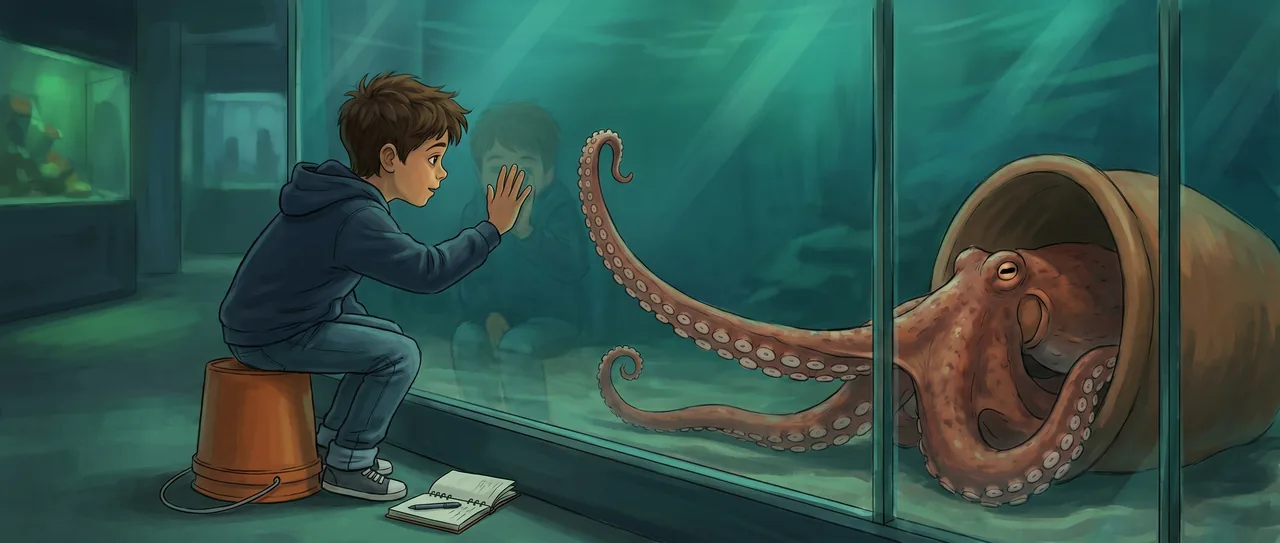
He sat on an overturned bucket in front of the octopus tank with his notebook open on his knee, watching an arm.
Just one arm. The rest of the octopus was folded into a clay pot at the back of the tank, and only a single arm came out, moving along the gravel like it was reading it. The tip curled around a snail shell, paused, let it go. Curled around a pebble, paused, let it go. Curled around a second snail shell and this time did not let go. It carried that one back toward the pot.
Soren wrote: picks some up, drops some. Knows which is which before looking. He underlined before looking, because the arm had not looked at anything. The eyes were back in the pot. The arm was out here, alone, choosing.
"You're not eating crackers in there, are you," his aunt called from down the hall. The floor buffer hummed. She was not really asking. She was the kind of busy where questions were just sounds you made to keep track of a kid.
"No," Soren called back, which was true.
He leaned closer. The arm came out again. It went into the dark gap under a rock, the kind of crevice his own hand would never go into without his eyes checking first for anything with teeth. The arm did not hesitate. It poured itself into the gap, and Soren could see the suckers along its underside opening and closing against surfaces he could not see.
That was the part he wrote down next, and it was the part that made him stop writing.
The suckers were doing something. Not just gripping. Each one settled on the rock, held a moment, lifted, moved on. Held, lifted, moved. Like a person walking a dark room with their hands out. But hands out in the dark feel for shape. This was not shape. The arm already had the shape. It was feeling for something else.
Soren guessed. He always guessed when he was stuck, out loud or on paper, because a wrong guess was a step and standing still was not. He wrote: it's not feeling the rock. It's feeling what's ON the rock.
He thought about his own tongue. About how he could close his eyes and tell salt from sugar without seeing either one. About how taste was just his body reading molecules, mouth pressed to a thing, deciding.
The arm came out of the crevice holding a small crab.
Soren had not seen a crab in there. The arm had. Or the arm had not seen it either, because the eyes were still in the pot, sixty centimeters away and pointed at the wall.
He put the pen down.
The whole arm, all the way along its length, was a tongue. Two thousand of them, give or take, one in every sucker, and they were touching and tasting at the same time, so that to touch a thing at all was to know what it was made of. The octopus had reached into a hole it could not see and tasted the crab hiding there, tasted it the way Soren tasted a chip, and known.
He sat very still on the bucket. He tried to imagine it from the inside and could not. He could imagine seeing with his eyes closed, sort of, like remembering a room. He could not imagine his fingers tasting the doorknob. Tasting the floor as he crossed it. Knowing the table was a table because his palm pressed it and the molecules said wood, said varnish, said the orange somebody set down here yesterday and took away.
The arm moved across the gravel again. To the octopus this was not a floor of pebbles. It was a floor of flavors. Snail, snail, nothing, crab-was-here, salt, the copper taste of the pipe, the place where another octopus had passed a week ago and left itself behind in a smear of molecules only an arm could read.
Soren looked down at his own hand on his own knee. He pressed his palm flat against the denim and felt only denim. Pressure. Warmth. The dumb, blind report of skin that could feel but could not taste, that touched the whole world every day and never once knew what any of it was made of.
Somewhere in the building the floor buffer went quiet.
He thought about how many times a teacher had told him he asked too many questions, that not everything needed taking apart. He thought about how it had always felt like there was more information in a thing than he was allowed to want. And here was an animal that wanted all of it, that could not help wanting all of it, that reached into the dark and pulled back the full chemistry of everything it touched and called that, simply, an arm.
The octopus, he was fairly sure, did not ask too many questions. It just had a body that could not stop answering them.
"Soren." His aunt was in the doorway with her coat half on, keys looped on one finger. "That's me done. You ready?"
"One second," he said.
He wanted to tell her. He could feel the sentence trying to assemble, the arm is a tongue, the whole arm, it tastes the dark, but she was jingling the keys and looking at the lights she still had to shut off, and the sentence would land in that and disappear. Some things you said out loud just became sounds for keeping track of a kid.
So he did not say it. He turned back to the tank for one more look.
The arm had reached the front glass. It pressed there, suckers spreading and sealing against the surface, opening and closing, opening and closing. Reading the glass. Reading, maybe, the salt of his own breath fogged onto the other side, and the oil from his fingertips where he had touched it earlier without thinking.
Soren lifted his hand and laid it flat against the glass, over the spot where the arm was working, with only the cold pane between his blind palm and its tasting one.
Read the interactive version, listen to the narration, and earn a gold star →
A science-verified short story for curious kids · Curiosity Land