Three Days Late
The chicks were hatching and there was nothing to feed them.
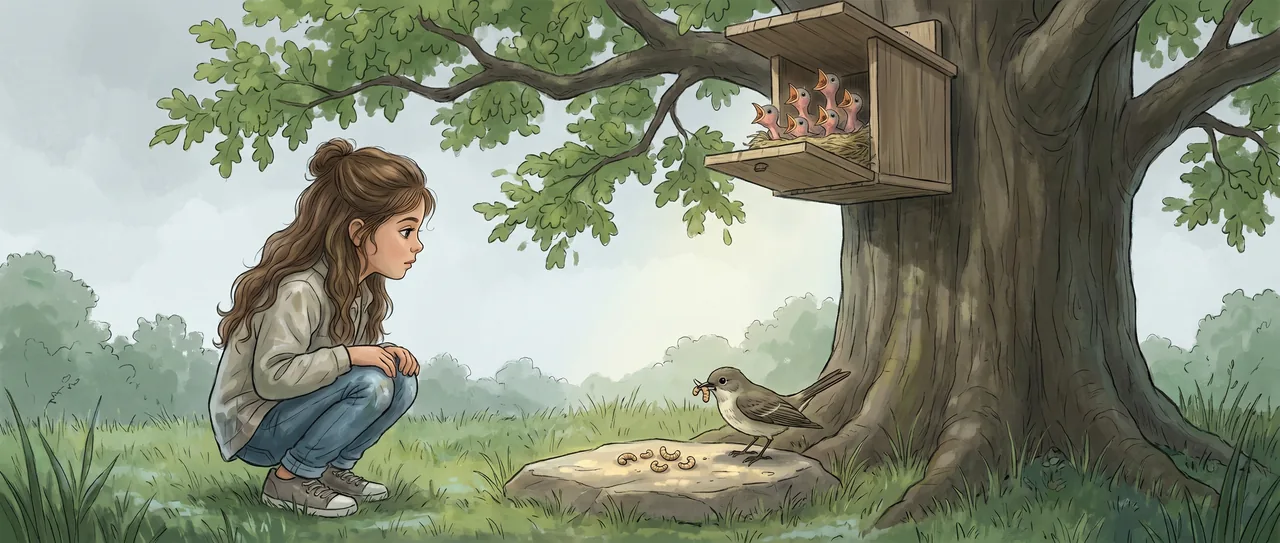
Maya knew the second she lifted the lid of the nest box. Five flycatcher chicks, mouths open, skin pink and loose, necks wobbling toward the light. And the parents going in and out, in and out, faster than she had ever seen them, like they were running a race they were already losing.
Last year the box had been full of fat noisy chicks by now. This year the parents looked thin.
She put the lid back down gently and sat on the cold grass and started counting.
The oak above the box was already green. Fully green, leaves the size of her hand. That was the thing that didn't fit, and she didn't know why yet, only that it didn't fit. She kept a list in her head of things that didn't fit. The oak went on the list.
In the shed she found her grandmother's gardening logs, a stack of them, one little notebook a year going back further than Maya had been alive. Grandma had written down everything. First crocus. First frost. The day the oak by the nest box came into leaf.
Maya found this year's oak date in her own head. Two weeks ago.
She opened the oldest log. Same oak. Leafing out a full three weeks later than it had this year.
Three weeks earlier now. The oak was waking up three weeks earlier than it used to.
She sat with that. It was a fact. It just sat there being a fact and not telling her why it mattered to five hungry chicks.
Then she remembered the caterpillars.
Every spring the oak filled with little green caterpillars. They chewed the new leaves full of holes. When she was small she had hated them. Grandma had said leave them, the birds want them, and Maya had watched the flycatchers haul caterpillar after caterpillar into the box until the air buzzed with begging chicks.
Maya looked up at the oak now. The leaves were green and tough and barely holed. The caterpillars had already come and gone. They had hatched with the young leaves, eaten, fattened, and dropped to the ground to become moths. Three weeks early. Right on time with the early oak.
The caterpillars followed the leaves.
She walked the length of the yard turning that over. The leaves came early because the spring was warm. The caterpillars came early because the leaves did. Everything in the oak was running on the oak's clock, and the oak's clock had moved.
But the birds.
The birds had come from somewhere far away. She did not know where, exactly. Africa, Grandma had said once, vaguely, somewhere across the sea. The flycatchers had spent the winter on the other side of the world, and they had started flying north when something told them to start, and that something was not the oak. The oak was here. The birds had been thousands of miles away, in a place where the spring was not warming the same, on a schedule set long before there was a warm March in her grandmother's yard.
The birds were not late. They had arrived exactly when they always arrived.
The caterpillars were early.
And the chicks had hatched into the gap between.
Maya stood very still in the middle of the yard. Both halves were here. The birds were here, building, hatching, trying. The caterpillars had been here. Everyone had shown up. No one had failed. There was no villain, no missing piece, nothing she could point at and say there, that is the broken thing.
The broken thing was the timing. Only the timing. Two clocks that used to strike together, sliding apart a few days every year, and a few days was the whole difference between a box full of fat chicks and a box full of thin ones.
She felt the size of it open under her like a floor giving way. It was not one yard. The flycatchers flew over whole continents. Every oak, every spring, every bird coming up from the south to meet a feast that was now ending before it landed. All of it sliding. All of it still technically present, every species still alive, and the whole arrangement coming apart anyway because the world had quietly changed what early meant.
She had thought you needed to lose a thing to lose it. You didn't. You only needed to lose the appointment.
The parents shot past her head with empty beaks.
Maya did not call for her grandmother. There was no answer her grandmother could carry out to the box. The caterpillars were already moths. You could not move spring back three weeks.
But you could move the question.
She thought about the chicks needing soft small things, alive, the size of caterpillars. She thought about what else in the yard hatched soft and small and late. The compost. The compost heap behind the shed, warm and wet and crawling all summer with little pale grubs and larvae, things that came up on their own slow rotting clock and did not care what the oak did.
Maya went and dug.
She found them under the top layer, soft and curled and slow. She picked out the smallest, the ones a flycatcher beak could carry, and she carried a handful to the flat stone below the box and laid them in the sun where the parents passed a hundred times an hour.
Then she backed away and crouched in the wet grass and waited, knees soaked, not moving.
It took a long time. Long enough that her legs went numb.
The female dropped to the stone. Cocked her head at the pale wriggling things. Took one. Flew it up into the box, and the box erupted with the sound Maya remembered, that buzzing desperate joyful racket of chicks who think the world is about to feed them.
Maya knew it was a handful against a continent. She knew the moths were already gone and would be gone earlier next year. She knew one stone of grubs did not fix the sliding of two clocks across half the planet.
She dug out another handful anyway and laid them on the stone, and the female came back down, and this time she did not fly off. She stood there on the warm rock among the grubs, beak full, watching Maya the way Maya was watching her.
Read the interactive version, listen to the narration, and earn a gold star →
A science-verified short story for curious kids · Curiosity Land