The Shortest Way to Say It
The dryer had a window, and Soren had forty minutes.
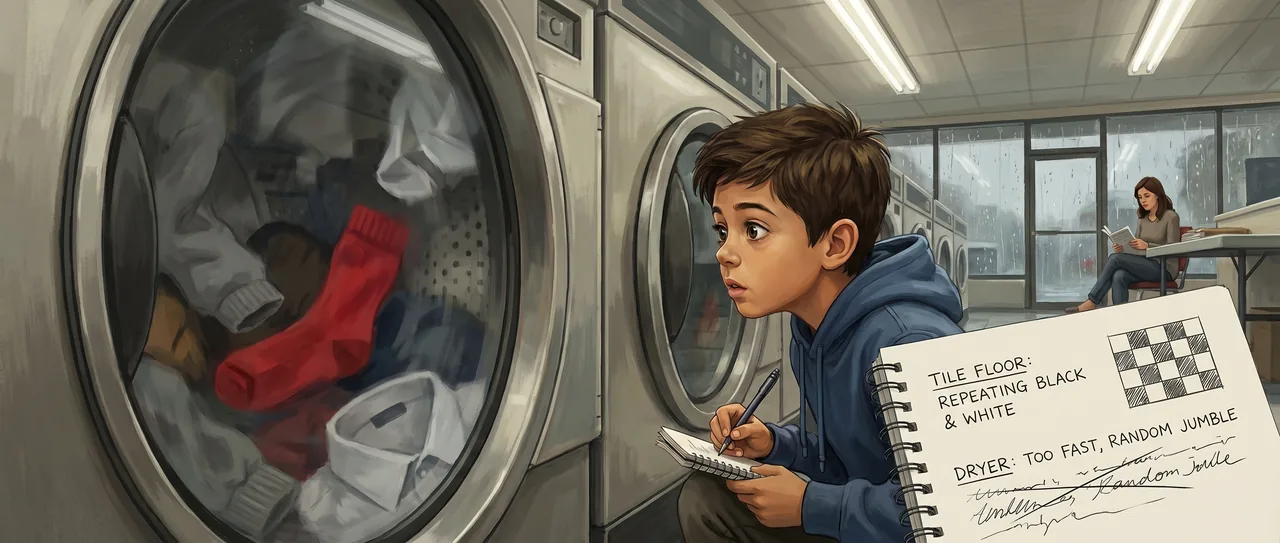
His mother was reading at the folding table. The rain came sideways against the glass. Soren had filled one page of his notebook with the tile pattern on the floor, because the tiles were easy. Black, white, black, white, all the way to the door.
He wrote it down in a way that pleased him. Instead of drawing every tile, he wrote: black white, repeat eighty times.
That was the whole floor. Eight words for two hundred tiles.
He sat with that for a second. He had said the entire floor with eight words. The floor was big and the sentence was small, and the floor had not lost anything. Anyone reading the eight words could build the floor back, tile for tile, and never know the difference.
So he tried it on other things.
The row of washers along the wall: machine, repeat six times. Five words. The buttons on the soap machine, all the same gray squares, a short sentence. The fluorescent lights, evenly spaced, hum included. Everything in the laundromat seemed to fold down into a few words, the way a fitted sheet eventually surrenders.
Then he looked into the dryer window.
Inside, his clothes turned over each other. A red sock, a sleeve, the collar of a shirt, gone, back again, never the same way twice. He picked up his pen to write it down short, the way he had written the floor.
He could not.
He tried tumble, repeat. But the next turn did not match the last turn. The sock was high, then low, then tangled in a pant leg, then flung out alone. There was no repeat. There was no rule he could catch. To write down what the dryer was doing, he would have to describe every single instant, one by one, and the description would be exactly as long as the thing itself.
The floor he could say in eight words.
The dryer he could not make shorter than the dryer.
Soren put his pen down. This was new. This was a thing he did not have a place for yet.
He looked back at the tile floor to make sure he was right. Black, white, black, white. Yes. Short. The shortness came from the pattern. The floor repeated itself, so you only had to say the repeating part once and then say how many times. The pattern was a kind of promise. Once you knew it, you knew the rest for free.
The dryer made no promise. Every turn cost you the full price.
His mother turned a page. "You're quiet," she said, not looking up. "Usually quiet means you found something."
"Which is more complicated," Soren asked. "The floor or the dryer?"
She glanced at the floor, then the dryer. "The floor, obviously. Look how much of it there is. The dryer's just socks."
Soren shook his head slowly. He did not say she was wrong, because he was still finding out why. But he could feel it sitting the other way around.
The floor was big and simple. You could hold the whole floor in eight words. The dryer was small and you could not hold it in anything shorter than itself. If complicated meant how much you had to say to pin a thing down exactly, then the dryer beat the floor. The dryer beat the floor easily.
The messiest thing in the room was the most complicated thing in the room. Not because it was big. Because it could not be made smaller.
He felt the floor of his thinking tilt.
Because he tried it on himself next. He tried to write himself down short. Soren, eleven, keeps a notebook. But that was the floor version, the eight-word version, and he knew it left almost everything out. The real him, the actual whole of what happened in a day, every thought that turned over and never came back the same way twice, would that compress? Or was he like the dryer? Was the shortest way to say a person just the entire person, every instant, no rule, no shortcut, nothing you could get for free?
He wanted that to be true. It felt better than being eight words.
He stared into the turning window and tested it the only way he could, which was to predict. He watched the red sock fling up and tried to guess where it would land. He guessed left. It went right. He guessed tangled. It came out clean. Six times he guessed, A thing you cannot predict is a thing you cannot shorten. He had just proved it with a sock.
And the strange part, the part that made his arms feel cold and awake, was that this was not a failure of his. It was not that he was not clever enough to find the pattern. There was no pattern to find. The shortness was not hiding. It genuinely was not there. Some things in the world were exactly as long as themselves and could be no shorter, not for him, not for anyone, not for the smartest machine ever built.
Which meant the messy things, the things that would not fold, the things adults swept past on the way to the obvious big floor, those were not the boring leftovers of the world.
They were the ones with the most inside them.
The dryer slowed. The window stopped turning. His clothes settled into a still heap, warm, ordinary, a red sock on top exactly where no one could have called it.
"Done," his mother said. She closed her book. "Eight words for that floor, then? You can write down the whole place and we can leave."
"Not the whole place," Soren said.
He opened the dryer and the heat came out against his face. He reached in and pulled the warm clothes toward him, the sleeve, the collar, the sock, all of it tumbled into an order that had never existed before and would never exist again, and he held the load against his chest, not folding it, not yet, just holding the part of the room that could not be made any smaller than it was.
Read the interactive version, listen to the narration, and earn a gold star →
A science-verified short story for curious kids · Curiosity Land