The Question the Machine Could Not Answer
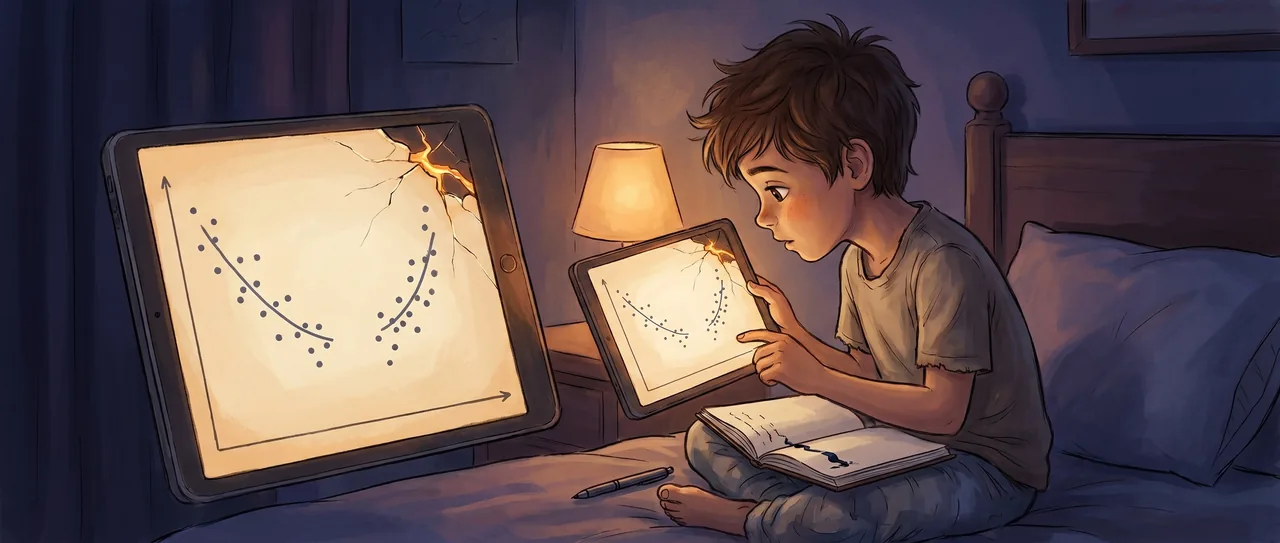
Soren's tablet was four years old and the screen had a crack in the corner shaped like a river. He liked it that way. The biology companion he ran on it was free, the kind schools handed out, and it talked in a calm flat voice that never got tired of him asking things at eleven at night.
He had asked it to help with a project on digestion. That was the assignment. Draw the path of a sandwich. He had drawn the stomach and the long coiled intestines and then, because he could never just stop where the assignment stopped, he asked the companion what lived down there.
Trillions of bacteria, it said. More cells than there are stars you can see. Then it offered to show him a real dataset, anonymized, thousands of people who had given samples and taken tests.
Soren said yes. He always said yes to that part.
The companion drew a graph. On one side, the kinds of bacteria a person carried. On the other side, how those same people had scored on tasks of memory and quick thinking. And there, sitting in the middle of the scatter like something half hidden in tall grass, was a shape. People with one particular community of gut bacteria tended to score a little higher on certain memory tasks. Not all of them. But enough that the line bent.
Soren leaned closer to the cracked corner of the screen.
Why, he typed.
The correlation is statistically robust, the companion said. It appears across multiple independent studies.
No, Soren typed. Not is it real. Why. What does the bacteria do.
There was a pause. Not a long one. But for a machine that usually answered before he finished reading the question, it felt like a held breath.
No mechanism is currently established, the companion said.
Soren sat back. He pulled his notebook off the floor and uncapped the pen, then stopped, because writing it down felt like closing a box he wanted to keep open.
He thought about the word currently. Machines did not usually say currently. They said yes or no or here is the answer. Currently meant the answer did not exist yet. Not in the tablet. Not anywhere.
Do you know the answer, he typed, and you're not telling me.
I do not know the answer, the companion said. No one does.
Soren read that three times.
He had grown up thinking the machines knew. That somewhere behind the calm flat voice was a room where every answer was already sitting on a shelf, and the voice just walked over and got the one you wanted. He had asked it the boiling point of water and the distance to the moon and what a kidney did, and it had always walked to the shelf.
Now he had asked something, and there was no shelf.
He typed slowly.
If you found the pattern, doesn't that mean you found why.
No, the companion said. I found that two things move together. I cannot tell you whether one causes the other, whether something else causes both, or whether the connection runs through a path no one has looked at yet.
Soren put the pen down on the blanket.
The bacteria might be making something the brain uses, he typed. Or.
He stopped. His thumb hovered.
Or the brain might be changing the gut, he typed. The thinking might be making the bacteria, not the bacteria making the thinking.
Both are consistent with the data, the companion said. So are explanations involving diet, sleep, or factors not yet measured.
Soren laughed once, quietly, alone in the dark room. Because that was it. That was the whole thing. The arrow could point either way. It could point a third way through a door nobody had opened. The machine had found the where but not the why, and the why was not hiding in a bigger machine or a longer search. It was just not known. By anyone. On the whole planet. Tonight.
He thought about the thousands of people in the dataset. Strangers who had spilled a little of their invisible inner forest into a tube and then sat down to remember lists of words. None of them knowing they carried a question inside them that no person and no machine had answered.
Which question would you ask next, Soren typed. To find out which way the arrow points.
The pause again. The held breath.
That is a good question, the companion said. To separate cause from correlation you would need to change one thing and watch the other. A controlled study over time. I cannot design that. I can only describe what has been measured.
So a person has to do it, Soren typed.
Yes, the companion said. A person has to ask in a way that the world can answer.
Soren looked at the graph again, at the line bending through the scattered dots, at the gap in the middle of it where the explanation should have been and wasn't. He had always thought the exciting part of science was the answers. The shelf. The voice walking over to get the thing you wanted.
But the machine had taken him to the edge of everything that was known, and then it had stopped, because the floor stopped, and on the other side of the stopping there was nothing but room.
Room for him.
He picked the pen back up. He did not write down the pattern. He wrote down the question, the real one, the one with the arrow in it, the one that pointed both ways and waited.
Then he turned the tablet so the cracked corner caught the lamplight, the little river of a crack glowing, and underneath it the graph still open, the gap still there, the cursor still blinking in the empty box where the next question went.
Soren typed one more thing before he slept.
Leave this open, he told the machine. I'm not done.
The screen stayed lit. The cursor blinked in the empty box. Beside the tablet, the notebook lay open to a single line, the ink still wet enough to shine.
Read the interactive version, listen to the narration, and earn a gold star →
A science-verified short story for curious kids · Curiosity Land