The Photon's Instant
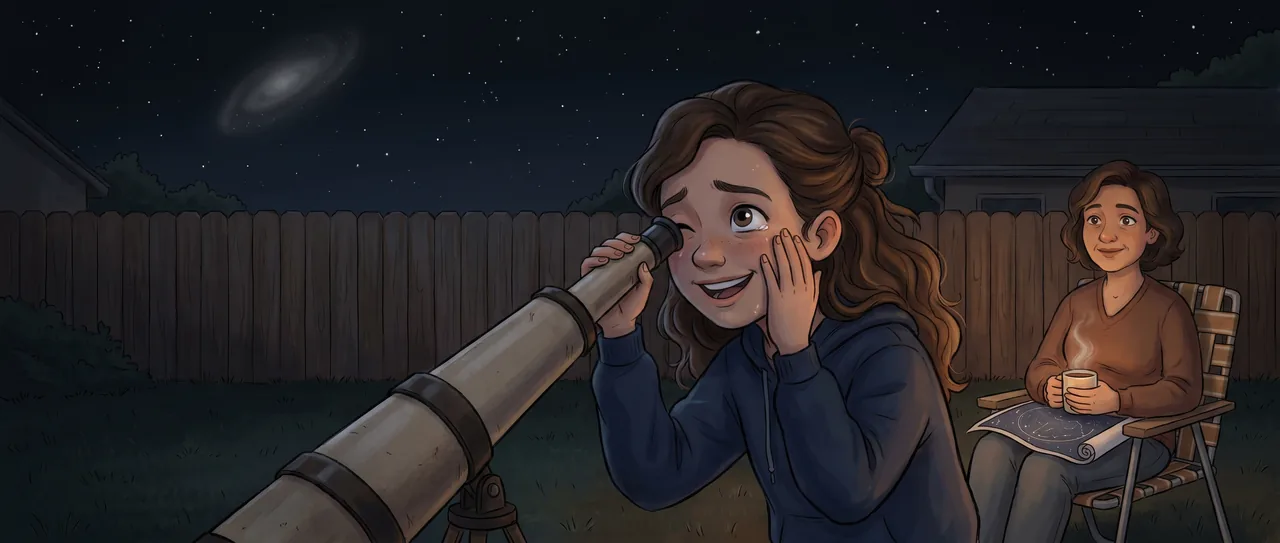
Maya had the galaxy in the eyepiece, finally, after an hour of nudging the telescope a finger-width at a time.
It was a smudge. A faint gray oval, dimmer than she expected, hanging in the black above the neighbor's fence. Her aunt Renata had told her its name and its number, but Maya had stopped listening at the part she could not stop thinking about.
"Two and a half million years," Maya said. "That's how long the light took to get here."
"That's right," said Renata, who was sitting in a lawn chair with a mug of coffee and a star chart she wasn't really reading. "The light left before there were people. It's older than our whole species."
Maya kept her eye on the smudge.
That was the part that didn't sit right. Everyone always said it like it was sad. Old light. Tired light. Light that had been traveling alone across emptiness for two and a half million years and arrived at last, exhausted, into her one small eye.
But something in her wouldn't agree with it.
"Aunt Ren," she said. "Does the light know how long it took?"
Renata laughed. "It doesn't know anything. It's light."
"That's not what I mean." Maya straightened up. She was already three steps ahead of her own mouth, the way she got. "You told me about the clocks. The fast one and the slow one."
Renata sipped her coffee. Last summer she had shown Maya a video of two clocks, one sitting still and one flown around the world in an airplane, and how the flying one came back a tiny bit behind. Moving fast through space meant moving slow through time. Maya had not stopped turning that over since.
"The airplane clock went slower," Maya said. "Because it was moving fast."
"A tiny bit slower, yes."
"So what about something really fast."
"Faster makes the effect bigger."
"What about as fast as you can go."
Renata set the mug down on the grass. "Nothing with mass can go that fast. Only light goes that fast."
"I know," Maya said. "I'm asking about the light."
The backyard was quiet. A dog barked two streets over and stopped.
Maya was working it backward now, hand over hand, the way she did when an answer was hiding just under the floor. Faster meant slower time. The fastest possible thing. She tried to picture the clock for a beam of light, the little clock the light would carry if it could carry one.
She pictured it ticking slower. And slower. And as the thing got closer to the speed of light, the clock got closer to.
Maya stood very still.
"It stops," she said.
"What stops?"
"The clock. For the light. It doesn't tick at all." She turned away from the telescope for the first time all night and looked straight at her aunt. "The light didn't travel for two and a half million years. Not for the light. For the light it was no time at all."
Renata opened her mouth, then closed it. She picked the chart back up and put it down again. "I'm not sure that's exactly," she started.
"No, listen." Maya wasn't being rude. She was just somewhere Renata hadn't gotten to yet, and she needed to get her there. "You measure two and a half million years. From out here. From the side. But that's your clock. The light has its own clock and its own clock never moved."
She looked back into the eyepiece, at the gray oval.
"From where the light is," Maya said slowly, "it left that galaxy and it hit my eye in the same instant. The leaving and the arriving are the same moment. There's nothing in between. There's no in between to be in."
The smudge sat in the eyepiece, patient, the same as before.
Except it was not the same as before. Maya felt the whole sky tip very slightly, the way the floor of an elevator does when it starts to move.
Because it meant the distance was a thing she made up. The distance and the two and a half million years, those belonged to her, standing still in the grass. The light had not crossed a gap. For the light there was no gap. The photon that was sinking into her eye right now had touched the inside of a star in another galaxy and was touching her eye, and to the photon those two touches were one single touch with nothing separating them.
The star and her eye were, from the light's side, pressed together.
"It's not far," Maya whispered.
"What?"
"It's not far. We say it's far. The light doesn't say it's far. The light doesn't say anything took any time." She pressed her hand flat against her own cheek, just under her eye, where the photon had landed. "It's like the galaxy is touching me. Right now. Right here."
Renata was quiet for a long moment. "I've looked through telescopes for twenty years," she said finally, "and I always thought of it as looking back in time. Old light, far away."
"It's only old to us." Maya was grinning now, and she couldn't stop, and her eyes had gone wet for some reason she didn't fully have words for. "Every single point of light up there is touching us. The leaving and the arriving in one instant. The whole sky is touching my eye at the same time it left, and the same time is two and a half million years ago, and it's also no time at all, and all of those are true."
"That can't all be true," Renata said, but she didn't sound sure.
"It is, though. It's just true from different places." Maya laughed. "Everybody always told me I asked too many questions. Nobody ever told me the answer would be that the question has more than one answer and you have to stand somewhere to pick." Maya turned back to the telescope. She put her eye to the eyepiece. The gray oval was waiting, two and a half million years away, no distance at all, leaving and landing in the same breath.
She closed her other eye and held perfectly still and let the galaxy touch her.
Read the interactive version, listen to the narration, and earn a gold star →
A science-verified short story for curious kids · Curiosity Land