The Metronome in Your Head
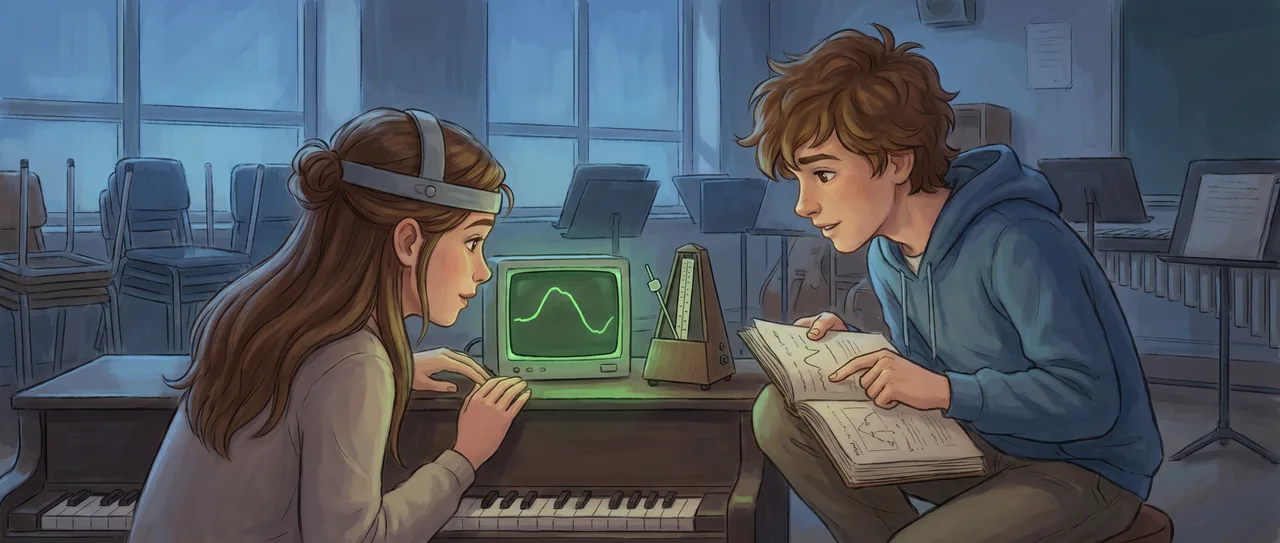
The band had packed up an hour ago, but the metronome was still ticking. Somebody had left it on top of the piano, clicking away at a tempo nobody was playing.
Maya sat on the floor turning a thin gray headband over in her hands. The science club had left it behind too, tangled in a charging cable, with a sticker on the case that said EEG, please return.
"It reads your brain," Soren said, looking at the little screen that had woken up when Maya pressed the band to her forehead. "Not your thoughts. The electricity. Brains run on tiny pulses, and the pulses come in rhythms."
"Like the metronome," Maya said.
"Faster. Slower. Lots of speeds at once." Soren had the manual open on his knees, because of course he had found the manual. "It says here the waves have names. Slow ones when you're sleepy. Faster ones when you're paying hard attention."
Maya slid the band onto her head and went still. On the screen a green line jittered, then settled into a long lazy roll, like swells on a calm sea.
"Close your eyes," Soren read.
She did. The lazy rolls grew taller, smoother, more sure of themselves.
"Open them."
The smooth waves shattered into a fast scribble.
Maya opened and closed her eyes three more times. Each time the big slow waves rose when the lights went out and broke apart when they came back. "It changes the second I look," she said. "My eyes aren't even doing the math. Something underneath is."
Soren wrote down the times. He couldn't help it. Then he took a turn.
They tried things. Counting backward from one hundred made a band of medium-fast waves light up. Listening to the metronome, really listening, pulled a different band into a steady pulse, as if part of Soren's brain had decided to play along with the piano.
"Look," Soren said. The screen showed not one line now but a row of little bars, one for each rhythm. "When I focus, this fast one gets stronger. And the manual says the fast rhythm shows up in two places far apart in your head at the exact same moment. The front and the back. Talking to each other."
"How do they keep time?" Maya asked. "They're not touching. There's a whole brain in between."
"The rhythm is how," Soren said slowly. "The beat is the message. If the front of your brain and the back of your brain are pulsing together, on the same beat, then they know they're working on the same thing. The timing is the handshake."
Maya sat up. "So your brain isn't one thing. It's a room full of players. And the only reason it sounds like one song is they're all keeping time."
She looked at the metronome on the piano, ticking to nobody.
"What happens if they don't?" she said.
Soren turned a page. He went quiet in the way he got when the answer was bigger than the question. "It says here that when the rhythms fall out of step, that's when things go wrong. There's a whole list. Seizures are the rhythms getting too strong and dragging everyone into one giant beat, until the whole orchestra is just slamming the same note. And some scientists think that in autism, and in some other conditions, certain rhythms run too fast or too slow, or the far-apart parts don't lock together as tightly."
Maya took the band back and held it without putting it on.
"Out of step," she said.
"They're still studying it," Soren said. "It's not solved. They can see the rhythms are different. They can't always say why, or what it feels like from inside."
Maya was thinking about her cousin Dev, who flapped his hands when he was happy and covered his ears at the school bell and noticed the exact thing nobody else in the room had noticed, every single time. Once Dev had told her the fluorescent lights buzzed. She hadn't believed him. Then she stood very still under them, and they did.
"His brain keeps a different time," she said. "That's all. Not broken. Different time."
Soren looked up from the manual. "The science doesn't say broken," he said carefully. "It says different patterns. A different rhythm picks up different things. If your fast waves are turned up, maybe you catch the buzz in the lights that everybody else's brain throws away."
Maya put the band back on. She stared at the metronome and tried to make her brain match it, pulse for pulse, the way you try to fall asleep on purpose and can't.
The screen did something then that made them both lean in.
One of the slower bands had started rising and falling in time with the click. Not because she ordered it to. Because she was listening, and somewhere under the listening, a crowd of cells she would never meet had agreed, all at once, to keep the beat.
"I'm not doing that," Maya whispered. "I can't feel myself doing that."
"Nobody can," Soren said. "That's the strangest part. The thing keeping the orchestra together is happening below the part of you that knows it's happening. You're the music. You don't get to see the players."
Maya pulled the band off slowly and held it in both hands, looking at the little screen go flat and patient, waiting for the next head.
"There are billions of them in there," she said. "And they found a way to agree on the beat. And when they don't, you get a seizure, or you get the buzz in the lights, or you get a song nobody else can hear."
"And the band can see it," Soren said. "It can actually see the rhythm. We just watched it."
Maya stood and walked to the piano. The metronome was still ticking, indifferent, certain.
She reached out and stopped the arm with one finger.
The room went silent, but inside her skull the beat kept going, the way it had her whole life, the way it would keep going whether she watched it or not.
She pressed the headband flat against the case with the sticker that said please return, and listened to a room that only sounded empty.
Read the interactive version, listen to the narration, and earn a gold star →
A science-verified short story for curious kids · Curiosity Land