The Map That Wouldn't Fit
Maya's grandmother called the spoon a boat.
She knew it was wrong. Maya could see her know it. Gran's mouth opened, the word boat fell out, and her eyes flinched like she had stepped on a stair that wasn't there. She pointed at the spoon again and tried. Cloud. Then she laughed, because what else, and the laugh was the same laugh as always.
"The doctor said a small part stopped getting blood," Maya's mother said in the kitchen, quietly, like quiet would help. "A little piece. She's still all there."
Maya kept looking at her grandmother. A little piece. That was the part nobody would explain right. If it was little, why did a whole word fall out of the world? Where did spoon go?
She sat down on the floor by Gran's chair with a pad of graph paper, the kind with the little blue squares. She liked the squares because they made counting honest.
"I'm going to draw your brain," she told Gran.
Gran patted her head and said, "Good boat."
Maya started with one dot. One brain cell. She had read the word in a library book, neuron, and she liked that it sounded like a small machine. One dot in one square. Easy.
Then she read the next part of the book, the part she had folded the corner on.
Eighty-six billion.
Eighty-six billion neurons in the head leaning against the chair above her. Maya stopped drawing dots. She did the arithmetic the way she always did, fast and a little reckless. If she drew one dot every second, never sleeping, never stopping to eat, she would finish in something like two thousand seven hundred years. Just the dots. Just for one Gran.
She looked up. Gran's head did not look big enough to hold two thousand seven hundred years of dots. It looked exactly the size of a head.
Then the book got worse, which is to say better.
Each neuron, it said, connects to as many as ten thousand others.
Maya stared at her single dot. She drew a second dot and a line between them. A connection. Then she tried to draw a dot with ten thousand lines coming out of it, and her pencil made a black smear, a little angry sun, and she stopped. You couldn't draw it. The squares couldn't hold it. The page couldn't hold it.
She started multiplying anyway, because she had to know how big the wrongness was.
Eighty-six billion, each one reaching out ten thousand ways. The number got long and then it stopped being a number she could feel. It became a shape instead, a tower of zeros leaning over her.
And it still wasn't the real number.
Because, the book said, what mattered wasn't how many connections there were. It was how many ways they could be arranged. On or off. This neuron talking to that one, or staying quiet. Every possible pattern a different thought, a different memory, a different word for a spoon.
Maya knew about that kind of counting. Two coins had four arrangements. Three coins had eight. Every new thing doubled it. She had eighty-six billion things, each one reaching ten thousand ways, every connection a coin that could be heads or tails.
The doubling went off the edge of the paper. It went off the edge of the apartment.
She flipped to the back of the book to see if it gave the answer, and it did, in one sentence that she read three times.
The number of possible patterns in a single human brain is larger than the number of atoms in the observable universe.
Maya put the book down on the carpet very carefully, the way you put down something that is heavier than it looks.
The universe. All of it. Every star she had ever seen and every star behind those, every galaxy in every telescope, every grain of everything, all the way out to the dark edge where the pictures ran out. Count every atom in all of that.
That number was smaller than the number of ways to be Gran.
Maya looked at her grandmother, who was watching the window, who had called a spoon a boat and a cloud and laughed both times.
A little piece had stopped getting blood. The word spoon was still in there. It had to be. It was just on the far side of a bridge that wasn't carrying traffic today, and the whole rest of the impossible country was still lit up, still humming, still finding other ways across.
"Gran," Maya said. "Don't say spoon."
Gran turned.
"Say what you eat soup with."
Gran's eyes did the flinch again, reaching for the broken bridge. Maya shook her head.
"No. Don't reach for the word. Tell me what it does."
Gran's mouth worked. The flinch faded. She was going a different way now, around, through some other part of the impossible map.
"You," Gran said slowly, "hold it. You dip. You bring it up. Round." Her hand made the motion in the air, a small careful scoop, and Maya could see it, the bowl of it, the soup lifting.
"Round," Gran said again, pleased.
It wasn't the word. It was the road around the word. And it had worked.
Maya's mother came to the kitchen doorway with a dish towel in her hands, not saying anything, watching her daughter sit on the floor with a smeared page of blue squares.
Maya picked the pencil back up. She wasn't going to draw eighty-six billion dots. She knew that now. There wasn't enough paper, there wasn't enough time, there wasn't enough universe.
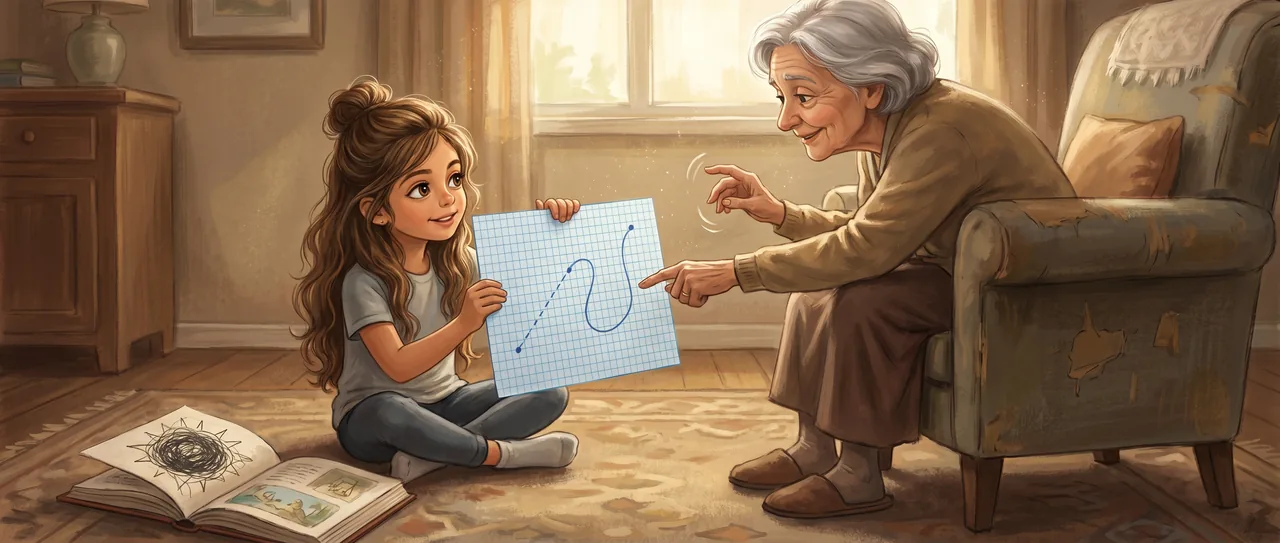
Instead she drew two dots far apart, with a clean straight line between them. The broken bridge. Then she drew a longer line, curving, going the long way around, touching the two dots from a different side.
She held the paper up so Gran could see it.
Gran looked at the long curving line, and pointed at it, and said, "Boat."
Then she pointed at Maya, and got it exactly right.
"Smart," Gran said.
Read the interactive version, listen to the narration, and earn a gold star →
A science-verified short story for curious kids · Curiosity Land