The Eye That Watches the Dark
The museum was supposed to be empty by now, but the curator was still wrestling a crate that did not want to close.
"You two can keep looking," she said, not really looking at them. "Don't touch the case at the end. The glass is older than your grandmother."
Maya was already at the case at the end.
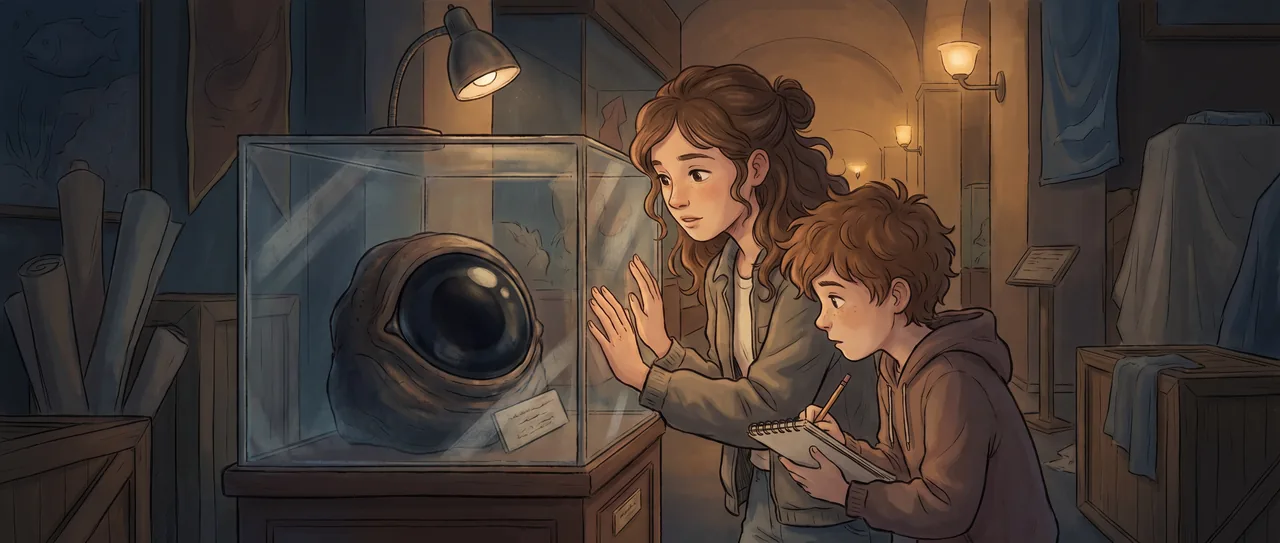
Inside it, on a bed of pale cloth, sat an eye. Just the eye, preserved, the size of a dinner plate. A label said colossal squid. It said twenty-seven centimeters across. It said largest eye of any animal that has ever lived.
"That's not an eye," Maya said. "That's a window."
Soren leaned in until his breath fogged the old glass. He had his notebook open already, the museum lamplight sliding across the page.
"Why would anything need an eye that big," he said. It was not quite a question. He was working toward something.
"Big eye, more light," Maya said. "Like opening a curtain wider."
"But a bigger eye costs more," Soren said. "It's heavy. It's expensive to grow. It's easy to hurt. Evolution doesn't make a thing that big unless the thing is worth it." He tapped the page. "So what's worth it?"
Maya put her finger near the glass, not on it. The black pupil seemed to drink the lamplight rather than reflect it.
"Where does it live?" she asked.
"Deep," Soren said. "Really deep. A thousand meters. Maybe more."
"There's no light down there."
"There's almost no light down there."
They both went quiet at the same time, which was a thing that happened to them. Maya was looking at the eye. Soren was looking at the word almost.
"Okay," Maya said slowly. "That's wrong. That's backwards."
"What is?"
"If there's no light, why grow the biggest eye in the world? You don't build a giant telescope for a room with the lights off." She frowned. "Unless."
"Unless there is light," Soren said. "Just barely."
The curator's crate banged shut somewhere behind them. Neither of them turned.
"There's a creature down there that makes light," Maya said. "Has to be. Something glows."
"Lots of things glow in the deep," Soren said. He was writing fast now. "Bioluminescence. Little flashes. But you don't need a plate-sized eye to see a glow that's right in front of you." He stopped. "You'd need an eye that big to see a glow that's far away. Faint. Coming toward you."
Maya turned to him.
"Coming toward you," she repeated.
"Something the squid would want to see early," Soren said. "Early enough to run."
They stood very still in front of the dinner-plate eye.
"What hunts a colossal squid?" Maya asked, but she already had the shape of it. She always got the shape first.
"Something huge," Soren said. "Has to be huge, to eat something this size."
"Sperm whales," Maya said.
Soren looked up from the page.
"A sperm whale doesn't glow," he said.
"No." Maya was talking fast now, the way she did when she was past politeness and into the thing itself. "But it's enormous. And it dives down into all those tiny glowing creatures. And when something that big moves through a cloud of things that flash when they're disturbed." She moved her hand through the air, slow, like a whale through dark water. "It lights them up. The whole shape of it. A glowing whale-shaped wake in the black."
Soren stopped writing.
"The whale switches the ocean on as it comes," he said quietly.
"And the squid sees it," Maya said. "In light a million times dimmer than anything we could see. Light that to us is just black. Just nothing." She looked back at the eye. "It's not a window to look at pretty things. It's a smoke detector. It's a whole eye built for one job. Seeing the thing that's coming to eat you, while there's still time."
The curator's voice drifted over, distracted, half there. "You know that eye still has the lens in it. People always ask if it works. It doesn't work. It's been dead a long time."
"It worked," Soren said, almost to himself. "Down there, it worked perfectly."
Maya wasn't listening to the curator anymore. She had gone somewhere else, the way she did.
"Soren," she said. "Think about what that means."
"Tell me."
"We're standing here with all the lights on, and we still can't see well. Look." She pointed at the shadows pooled under the far cases, at the dark corners the lamps didn't reach. "That's the brightest this room ever gets and there are still places we can't see into. We think we live in a lit-up world. We think dark is empty."
She put both hands near the glass now, framing the great dark eye like she was cupping it.
"But down there, in the place we call totally black, the place we'd call nothing, this thing is watching an entire whale arrive. There's a whole world of seeing happening in the dark we gave up on. We just don't have the eyes for it."
Soren wrote one line and then couldn't write anymore because the inside of his head had gotten too big for the page.
"There could be things seeing us," he said. "In dark we think is empty. Right now."
"Not us," Maya said. "We're not down there. But the dark isn't empty. That's the part. We always thought the dark was where seeing stopped." She shook her head slowly. "It's just where our kind of seeing stops."
The curator came up behind them, wiping her hands, ready to send them home.
"Found it interesting, then?" she said, the way adults say things when they've stopped finding it interesting themselves. "Big old eye. Hard to imagine what it ever did with all that."
Neither of them answered her right away.
Maya reached over and switched off the little lamp above the case. The room dropped into deeper shadow, and the eye went from black to a blacker black, a pupil with no bottom to it.
The two of them stood in front of it in the dim, not moving, looking into the dark to see what the dark could see.
Read the interactive version, listen to the narration, and earn a gold star →
A science-verified short story for curious kids · Curiosity Land