The Compound Nobody Followed
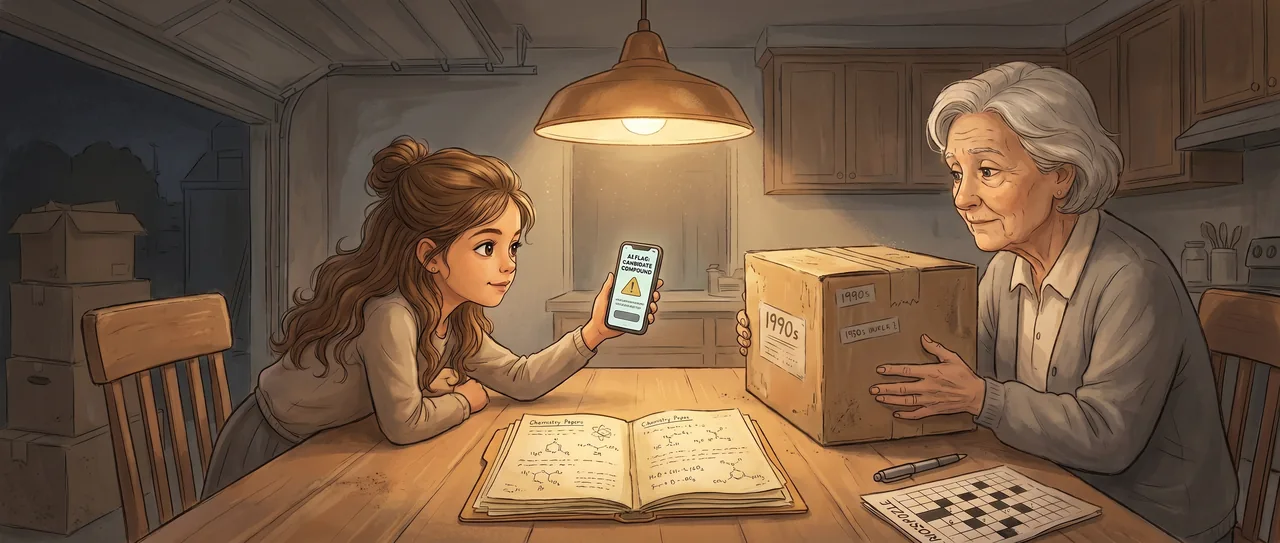
Maya's grandmother kept her old work in cardboard boxes that smelled like dust and lemon. She had been a food chemist for thirty years, and when she retired she stopped explaining any of it. She just labeled the boxes by decade and stacked them against the garage wall.
Maya was supposed to be sorting them for recycling. Instead she was feeding them to an AI.
Not a fancy one. A literature-scanning tool her science teacher used, the kind that read papers and pulled out the chemistry hidden in the words. Maya had been photographing her grandmother's faded reports and letting the tool match them against everything published since. Mostly it said the same thing over and over. Known compound. Already studied. Nothing new.
Then, on a paper from nineteen ninety-four, it said something else.
Molecular profile flagged. Properties consistent with candidate room-temperature superconductors.
Maya read it twice. She didn't know what it meant yet. She knew it didn't fit.
The paper was about a preservative. Her grandmother and two other chemists had designed a molecule to keep packaged bread from going stale. It worked. It went into factories. Then everyone moved on, because that was the whole job. Keep the bread fresh. Done.
Nobody had ever asked the molecule a different question.
Maya went inside. Her grandmother was at the kitchen table doing a crossword in pen, which Maya had always found a little terrifying.
"This bread thing," Maya said, holding up her phone. "The one you made in ninety-four."
"The stabilizer." Her grandmother didn't look up. "Good little molecule. Cheap to make. Why."
"Did anyone ever test if it carried electricity?"
Now her grandmother looked up. "It's a food additive, Maya. Why on earth would we run current through bread."
"That's what I mean. Nobody would. So nobody did."
Her grandmother set down the pen. "What put that in your head?"
"The computer noticed the shape. The way the atoms stack. It says it looks like the molecules people are excited about right now. The ones they want to carry electricity with no resistance. No waste. No heat." Maya pulled out the chair across from her. "A superconductor that works at room temperature would change everything. Power lines that lose nothing. Trains that float. People have been hunting for one for a hundred years."
"And you think we made one by accident. To keep bread soft."
"No," Maya said. "I think nobody knows. That's different."
Her grandmother was quiet for a moment. "We characterized that compound six ways. We knew its melting point, its solubility, its safety profile. We knew everything we needed to know."
"Everything you needed for bread," Maya said.
That sat in the kitchen for a while.
Maya wasn't trying to be clever. She was caught on something she couldn't put down. The molecule had existed for thirty years. Real, made, sitting in factories, printed in a paper her grandmother could touch. And the whole time it had been carrying a second question inside it that no human had ever thought to ask, because the people who made it were thinking about toast.
"How many," Maya said slowly.
"How many what."
"How many other ones are there. Molecules somebody made for one thing. That are secretly good at something else. And nobody checked because the person who made them was only looking for one answer."
Her grandmother opened her mouth and then closed it.
"I don't know," she finally said. And she said it like the number frightened her a little.
Maya went back to the garage. She sat on the cold floor with the laptop and looked at the flag again. Properties consistent with candidate room-temperature superconductors. The word that mattered was candidate. The computer wasn't saying her grandmother had made a superconductor. It was saying the molecule looked like it might be worth testing. It had the right shape, the right stacking, the right kind of bonds. It was a question wearing the clothes of an answer.
Maya understood the difference. The computer could read a million papers and see that two molecules rhymed. It could not walk into a lab, cool nothing down, run current through a sample, and watch the resistance fall to zero. It could find the question. It could not ask it.
A person had to ask it.
She thought about that. The tool had read more chemistry in one afternoon than every scientist in her grandmother's old company had read in their whole careers. It had seen the rhyme they couldn't see, because they were three people thinking about bread and it was a machine thinking about everything at once.
But it had stopped at the rhyme. It had handed the question back. To her. On a garage floor.
Maya had always been the kind of person who asked one question too many. Teachers got a particular look. Her own mother had a sigh she saved just for it. Maya had decided a long time ago that the extra question was a thing wrong with her, like a squeaky wheel, something she should learn to keep quiet.
The machine had read everything ever written and the last step, the part it could not do, was the extra question.
She took a photograph of every box label in the garage. Ninety-four. Ninety-five. Eighty-eight. All those decades, all those molecules, every one designed by somebody who stopped the moment their molecule did the one job they wanted.
She went back inside. Her grandmother was still at the table, the crossword abandoned, the pen capped.
"I want to find out if it's real," Maya said. "The bread one. I want to find someone with a lab who'll run current through it."
"They'll tell you it's a long shot," her grandmother said. "Most flags are nothing. You understand that. The computer is wrong far more than it's right."
"I know," Maya said. "But it's not nothing until somebody checks. Right now it's not yes and it's not no. It's just nobody asked."
Her grandmother looked at her granddaughter for a long moment. Then she stood, went to the garage, and came back carrying the oldest box, the one marked with the earliest decade. She set it on the table between them.
"If you're going to ask the wrong questions," she said, "ask them in order."
Maya opened the box. Inside were folders of molecules nobody had finished thinking about, and she lifted out the first one and laid it flat under the kitchen light.
Read the interactive version, listen to the narration, and earn a gold star →
A science-verified short story for curious kids · Curiosity Land