The Two Clocks
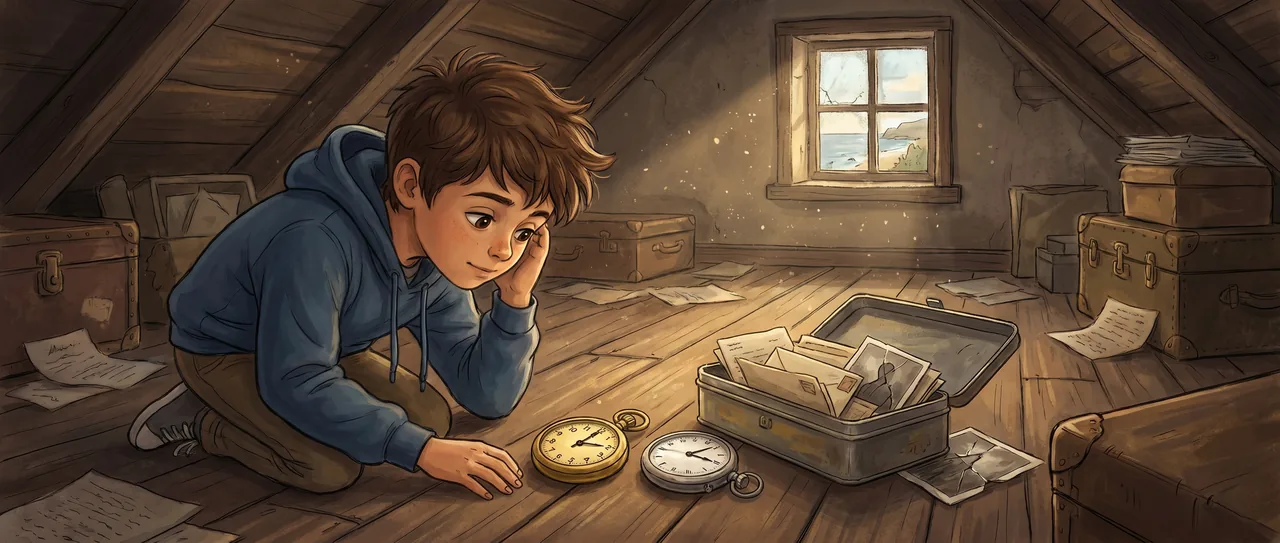
The box smelled like old paper and pencil shavings. Soren had been told to bring down the Christmas decorations, and instead he was sitting on the attic floor with a tin box on his knees, the kind that once held biscuits.
Inside were letters, a cracked photograph, and two stopwatches. Not modern ones. Heavy brass things with a single button each. He pressed one. It still ticked.
He wrote in his notebook: two clocks, one box. Why two.
The letters were between his great-grandfather and someone named Aunt Lena, who lived, the postmark said, in New Zealand. His great-grandfather had lived right here, in this town, on this coast. As far from New Zealand as you could get and still be on the planet.
The letters were full of numbers and one strange phrase, repeated. Soren read it three times to be sure he had it right.
The little black drop. Watch for the little black drop.
He did not know what that meant. He wrote it down anyway, because the inside of his head felt too small to hold it.
The earliest letter explained the plan, the way you explain something to a person you trust to do it exactly. There would be a day, Aunt Lena wrote, when the planet Venus would cross in front of the sun. From the Earth it would look like a small black dot sliding slowly across the bright face, taking hours.
Soren stopped reading and looked at the two stopwatches.
One for him. One for her.
The letter went on. You will time when the dot first touches the edge, and when it finally leaves. I will do the same, from here. Then we will trade our times by mail and add them to the others.
The others. Soren read that twice too. There was a list folded into the next letter, names and places in handwriting that was not his great-grandfather's. Norway. Tahiti. A ship somewhere in the cold south. Dozens of people, all watching the same black dot on the same sun on the same day, each one a tiny lonely figure with a clock.
He sat back. The reason for two clocks was starting to come apart in his hands, and he wanted to understand the mechanism before he believed it.
Why would it matter where you stood? The sun was the sun. The dot was the dot.
He held up one finger close to his face and closed one eye, then the other. His finger jumped against the far wall, left, then right. He had done this a hundred times without thinking about it. He did it now thinking about it.
Two eyes. One finger. The finger seems to move because each eye sees it from a slightly different place.
He looked at the names on the list. New Zealand and this coast were the two eyes. Venus was the finger. And the back wall, impossibly far, was the sun itself.
From New Zealand, Aunt Lena would see the black dot cross the sun along one line. From here, his great-grandfather would see it cross along a slightly different line, a little higher or lower, because he was standing somewhere else on the round Earth. The dot would seem to jump, just a little, the way the finger jumped.
Soren's breath went strange.
If you knew how far apart the two watchers stood, and you measured exactly how much the dot seemed to jump, you could work out how far away the dot truly was. And once you knew the distance to Venus, the geometry handed you the rest. The distance to the sun. The size of the whole solar system, measured with two clocks and the mail.
Nobody on Earth had known that distance before. Not really. People had guessed for thousands of years. And then a crowd of strangers had agreed to stand in the cold and the heat at the ends of the Earth and click two buttons at the right instant, and between them, by sharing, they had measured the sky.
He understood now why his great-grandfather had kept both watches in one box.
He read on, faster. The last letters were harder. There was the little black drop again, and this time Aunt Lena was upset. When Venus touched the edge of the sun, she wrote, it had not made a clean dot. It had stretched, like a drip of ink refusing to let go, smearing the exact instant she was supposed to time. She could not be sure of her moment. Maybe to the second. Maybe more.
Soren felt that in his stomach. All that distance. All that cold. And the universe had blurred the one number she needed, right at the edge.
He looked it up later, and it was true. They call it the black drop effect, and it really did spoil the timings in 1769, and people argued about the exact distance for years afterward because of it. The first global experiment in history had a smudge in it that nobody had predicted.
But here was the part that made him sit very still on the attic floor.
They had still done it. Not perfectly. Close enough to change everything. Aunt Lena's blurred second and his great-grandfather's clean one, added to Tahiti and Norway and the cold ship in the south, had pinned the sun in space, give or take. Dozens of imperfect people, each holding one small wrong number, had passed them all into one room until the wrongness mostly cancelled and the truth showed through.
Soren had always felt like the kind of person who counted for too little. One boy with a notebook nobody else carried. He read the list of names again, slower, and understood that not one of those people had been enough alone. Aunt Lena alone was a smudge. His great-grandfather alone was a single line on a single sun. The answer had only existed in the space between them.
He picked up both stopwatches. Their two faces were a little different, one yellowed, one not, as if they had aged on opposite sides of the world and only now come home.
There would be another transit one day. He had read that too. Not for a long time. A long time after the next one, even. The dates were so far ahead they felt like a dare.
He wound both watches until they ticked together, set them side by side on the attic floor, and crouched down with his ear close, listening to the two of them slowly drift out of time.
Read the interactive version, listen to the narration, and earn a gold star →
A science-verified short story for curious kids · Curiosity Land