The Thing the Machine Could Not Say
The waiting room smelled like wet towels and disinfectant, and Soren had been there long enough to count the ceiling tiles twice. His grandmother was in with the vet and Biscuit, who was old and slow and had cloudy eyes, and Soren had been told to wait out here because there wasn't room for everyone.
So he wandered. He always wandered when his head felt too full.
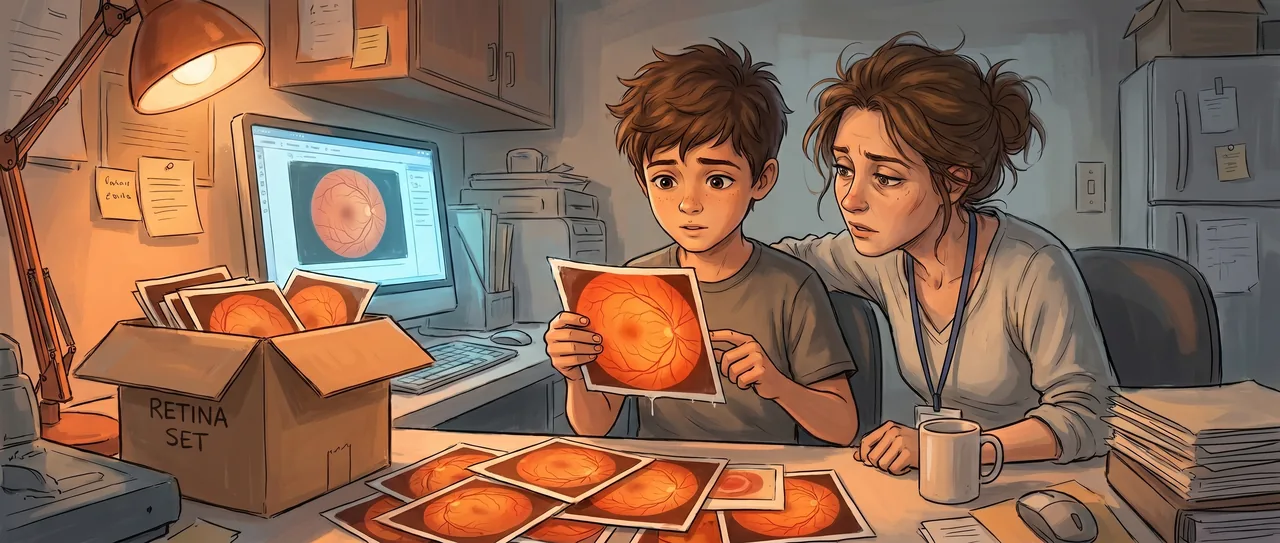
The back hallway had a door propped open with a chair, and inside was a small room with a computer and a cardboard box on the desk. The box said RETINA SET on the side in marker. Inside were hundreds of printed photographs, each one a circle of orange and red, like the surface of a strange planet. Branching rivers ran across each one. Some had tiny dark spots. Some had pale smears.
A woman came in behind him, holding a coffee. She wore a lanyard and looked tired in the specific way of someone who has been staring at a screen.
"Those are eyes," she said. "The inside of eyes. Cameras can photograph the retina now, even in animals. I'm here testing a program on dog eyes this week."
"Testing it for what," Soren asked.
"To see if it can spot disease. The same way a system already spots it in human eyes. Diabetic damage. Bleeding. The little signs." She sat down heavily. "It finds them. Better than I do, on a bad day. That's the part nobody likes to say out loud."
Soren picked up two photographs. "How does it know what to look for?"
"That's the strange part." She blew on the coffee. "We didn't tell it the rules. We don't fully know the rules. We showed it hundreds of thousands of pictures. This one is sick. This one is healthy. Sick. Healthy. Over and over. And somewhere in all that, it learned to tell. But it can't explain how. It just points."
Soren turned the two photographs over in his hands. To him they looked identical. Same orange. Same rivers. He could not have said which was which to save his life.
"Try it," the woman said, almost daring him. "Which one's sick?"
He stared. He looked for spots. He looked for smears. He guessed the left one, because it felt a tiny bit wrong, though he could not have said why.
She checked the labels on the back. "Left is sick. Lucky guess."
"It wasn't lucky," Soren said, and then stopped, because he didn't actually know if that was true. It had felt like something. A wrongness he couldn't name. But maybe that was just a story he was telling himself after the fact.
The woman smiled the way adults smile when they think a kid has gotten cute. "The machine doesn't guess. It's seen more eyes than every doctor in this city combined will see in their whole lives. That's the trick. Not cleverness. Volume."
She turned to her screen and started typing, half gone from the conversation already.
Soren stayed with the box. He pulled out ten photographs and laid them in a row. He didn't try to find spots anymore. He let his eyes go soft, the way he did at night looking at faint stars, when looking straight at a thing made it disappear. He let the whole picture land on him at once.
And something happened that he could not put into words. Three of the ten felt different. Not darker. Not spottier. Just other, the way a wrong note in a song is other even before you can name which note.
"Can I check these," he said.
The woman glanced over. "Sure."
He flipped them. Three of his three were marked sick. The other seven, healthy.
She put the coffee down.
"Do it again," she said. Her voice had changed.
She shuffled a fresh stack, twenty this time, and held them so he couldn't see the backs. Soren let his eyes go soft again. He didn't think. Thinking made it worse. He just pointed at the ones that felt wrong. Six of them.
She checked. Five were sick. One was healthy. One sick eye he had missed.
"That's," she started, and didn't finish.
"I can't tell you why," Soren said. "That's the thing. I'm doing what your program does. I looked at a lot of pictures just now and something in me started catching it. But if you asked me the rule, I don't have one. There's no rule in my head. There's just, this one is wrong."
The woman sat very still. "You looked at maybe forty pictures," she said slowly. "My system looked at hundreds of thousands. You shouldn't be able to do that yet."
"Maybe I've looked at a lot of other things," Soren said. "Faces. Clouds. Which kid is about to cry before they cry. My whole life is looking at things and not knowing how I know."
He meant it about the pictures. But it came out bigger than the pictures, and it landed in the middle of him somewhere he had not expected.
Because this was the thing teachers always wanted him to fix. Show your work. Explain your reasoning. And he never could, not really, because the answer arrived before the reasoning did, and he had to walk backward to find out why he was right. He had always thought this meant something was broken in him.
And here was a machine that had matched the best doctors in the world. And it could not show its work either. It just knew. It pointed and it was right and it could not say how.
"You and the program," Soren said. "You're doing the same thing. Neither of you can explain it. You both just saw enough that the knowing got built in."
The woman looked at the box, then at him, then at the box again, like she was seeing both for the first time.
Down the hall a door opened. His grandmother's voice, and the click of Biscuit's nails on the tile, coming closer.
The woman picked one last photograph out of the box, a fresh one, no label written yet, the ink still wet from the printer.
"This one came off the camera an hour ago," she said. "Nobody's checked it. Not me. Not the program. Tell me."
Soren let his eyes go soft. He held the wet orange planet in both hands and looked at it without looking, and after a moment he put his finger on the lower edge, on a place that felt wrong in a way he could not have named.
Read the interactive version, listen to the narration, and earn a gold star →
A science-verified short story for curious kids · Curiosity Land