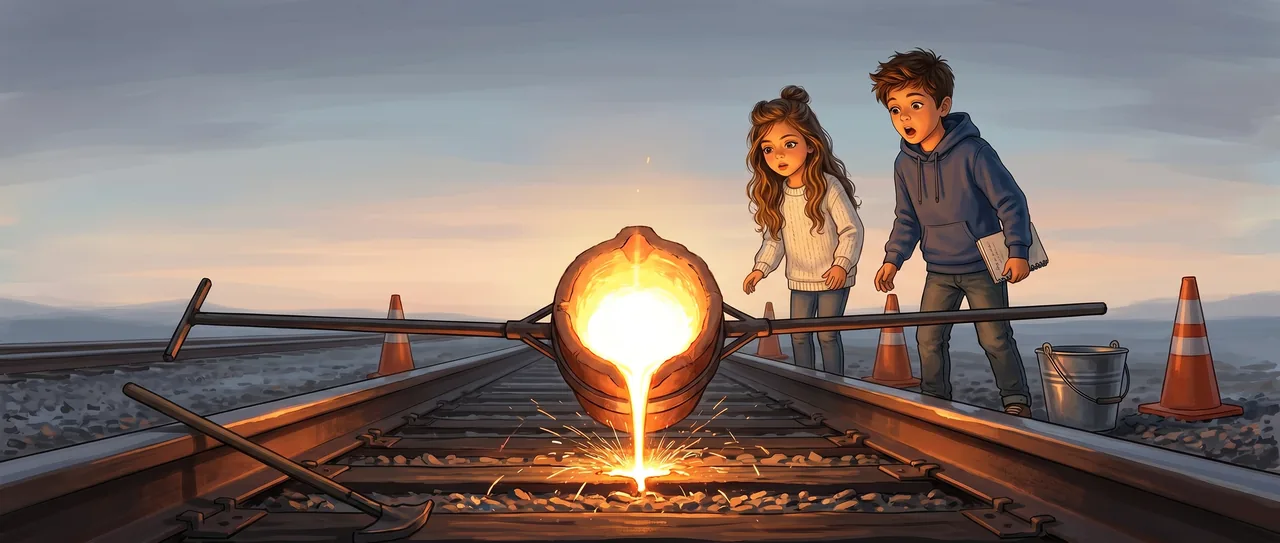
The Seam in the Rail
The bucket of water by Soren's foot was the first thing that didn't fit.
Maya looked at it the way she looked at a wrong note in a song. There was a fire about to happen. Right there, on the railway, a crucible packed with gray powder sat over a gap between two rails. And the nearest person to it was Soren's aunt Reza, and the nearest fire-fighting equipment was a bucket of water nobody seemed worried about.
"They're going to light that," Maya said. "And the water's just sitting there."
"Maybe it's for after," Soren said. He had his notebook open against his knee, pencil ready. He had written the time, the temperature of the morning, and the smell, which was cold rust and diesel.
Reza walked the line, checking the clay mold packed around the rail ends. She had grease to her elbows and the patience of someone who had done a thing four hundred times.
"Stand behind the cones," she called. "Don't look straight at it. I mean it. You'll see spots for an hour."
"Why not?" Maya asked.
"Because it's bright," Reza said, which was the kind of answer Maya found circular.
Soren was still on the bucket. "If the water's for the fire," he said slowly, "then water puts the fire out. But she's not nervous about the fire. She's nervous about us looking at it."
Maya turned the thought over. A fire you protected your eyes from but not your hands. A fire with a bucket of water that nobody guarded.
"What if the water isn't for the fire," she said.
Reza struck the igniter. There was a hiss, then a sound like the whole morning inhaling.
Maya had seen campfires. She had seen a welder once at the hardware store, a blue spark that made her squint. This was not those. This was a small white sun arriving on the ground. It was so bright it had no color, just absence, a hole punched in the dawn. Sparks didn't fly up from it the way sparks fly up from wood. They poured. Liquid metal, running, finding the seam between the rails and filling it.
Soren forgot his notebook. His mouth was open.
"That's iron," he said. "That's iron being a liquid. You'd need—" He stopped. He didn't have the number. He knew you needed an oven for clay and a furnace for glass and that those were already hot enough to scare adults. This was hotter than anything he had a word for.
The heat reached them across ten meters of cold air and pressed on their faces like a hand.
Maya watched the white center and did not look away even though her eyes wanted to. She was thinking about the bucket. About how Reza, who feared nothing about this fire, had set the water far away from it. About how, if you threw that water onto that white center, you would not be fighting the fire. You would be feeding it something.
"Soren," she said. "The water would make it worse."
"Worse how?"
"I don't know how. But she's keeping it away. You keep the thing that makes it worse away."
The reaction was already dying down, settling, the white going orange, the orange going to a sullen glow inside the mold. Reza picked up the bucket then, walked it past the cooling weld, and used it to rinse her hands, casual as anything, a full meter from the iron that was still bright enough to read by.
Soren wrote one word. Then he crossed it out, because it was a guess, and then he wrote it again, because he committed to guesses.
"It burns its own oxygen," he said. "It has to. A normal fire needs air, you smother it, it stops. But that didn't pull from the air, the sparks went down, not up. If the fire carries its own air inside the powder, then taking air away does nothing. And water—" He looked at Maya.
"Water is air," Maya said, and then heard herself, and laughed. "No. Water has air in it. Stuck together. Oxygen."
"Hydrogen and oxygen," Soren said. "And something that hot doesn't see water as water. It tears it. It rips the oxygen right out and burns it and lets the hydrogen go." He stopped writing. "You'd be pouring fuel on it. You'd be pouring rocket fuel on it."
The two of them stood very still with that.
Maya had spent her whole life being told that water put out fire. It was the most settled fact she owned. You learned it before you learned to read. And here was a fire so hungry that the thing everyone trusted to stop it became the worst thing you could do, because the fire was strong enough to take ordinary water apart into its pieces and eat them.
"Everything I know about fire," Maya said, "only works up to a certain temperature."
Reza came over, wiping her hands, blinking the brightness out of her own eyes. "Told you not to look," she said. "You looked."
"What is it?" Soren asked. "The powder."
"Rust and aluminum, more or less," Reza said. "Welders have used it on rails for over a hundred years. Cheaper than dragging a furnace out to the middle of nowhere." She nodded at the joint, where two separate rails had become one rail, the seam between them gone, healed with iron that had been liquid thirty seconds ago. "Now there's no gap. Train rolls over it like it was always one piece."
She walked back toward the truck.
Maya crouched by the cones. The weld glowed orange in the gray morning, a fierce little ember the length of her hand, the seam already invisible inside it. She could feel the heat from where she crouched, steady, refusing to hurry, a fire that did not care about air and would have laughed at rain.
Soren crouched beside her. He held his hand out toward it, palm flat, stopping well short, feeling for the exact distance where the warmth turned to a warning.
Maya put her hand out next to his, into the same warm air, and held it there.
Read the interactive version, listen to the narration, and earn a gold star →
A science-verified short story for curious kids · Curiosity Land