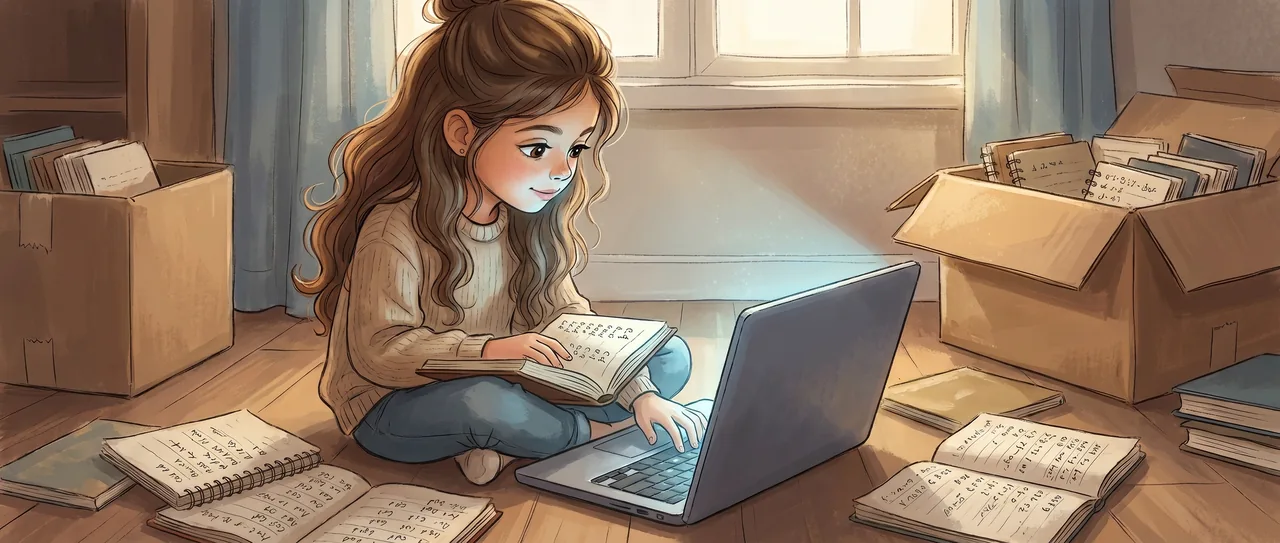
The Machine That Never Saw the Board
Maya found the boxes in her grandfather's closet, three of them, full of little books no thicker than her thumb. Each page was columns of the same strange shorthand. e4 e5. Nf3 Nc6. Bb5 a6. Pages and pages of it, decades of it, in his small slanted handwriting.
Her mother said he had written down every game his chess club ever played. Sixty years of Tuesday nights. Then she went to deal with the kitchen and left Maya alone with the boxes and the borrowed laptop she was supposed to be using to make a list of what to keep.
Maya did not know how to play chess. She knew her grandfather had loved it. She knew the shorthand was a language she could not read, and that bothered her, the way a closed door bothered her.
She typed some of it into the laptop just to see. The chat program her cousin had left running answered her.
What is e4 e5 Nf3 Nc6, she typed.
That is the opening of a chess game, it wrote back. White moves a pawn, Black answers, then a knight comes out. A common start. Would you like me to continue the game?
Yes, she typed.
It gave her the next moves. Then more. It offered to play her. She typed her grandfather's moves from a random page, one at a time, and the machine answered each one fast and sure, and after a while it said, this is a strong position for White, you should be winning here.
Maya sat back. The machine was good. Better than good. It talked about the game the way her grandfather's friends used to, leaning over the board, certain.
She got curious in the way that does not let go. She found her cousin's number and called.
How does it know chess, she asked.
Her cousin laughed. It doesn't, really. It just read a giant pile of text. Everything. Books, websites, all of it.
But does it know the rules.
Not the way you mean. Nobody typed in the rules. It just saw a billion games written down, and it learned what move usually comes after what.
Maya was quiet.
Did anyone show it the board, she asked.
What board.
The chessboard. The squares. Did anyone tell it where the pieces go.
No, her cousin said. It never saw a board. It only ever saw the writing. The little letters and numbers. That's all a model like that gets. Text.
Maya hung up and looked at the screen for a long time.
She thought about her grandfather's books. To her they were nonsense. Bb5 a6. But to him each line had been a real night, a real board, a friend across the table, a cup of something gone cold. The writing pointed at a world. He could read the writing and the whole world stood up behind it.
The machine had only the writing. It had never sat at a table. It had never touched a piece or seen a square or felt the wood. It had read the pointing without ever once seeing the thing pointed at. And somehow, from nothing but the shapes of how people wrote the moves down, it had learned which move came next so well that it could beat almost anyone.
Maya wanted to test that. She did not trust a thing she had been told without trying it.
She opened a fresh game and made up a position no one had ever played. She typed moves that made no sense, random, scattered, just to break it. Then she asked, whose turn is it and who is winning.
The machine paused. Then it said, this position is unusual, and it is hard to evaluate, but Black seems slightly better.
Then it played a move. A reasonable move. In a position that had never existed in any of those billion games, the machine still knew what reasonable looked like. It had not memorized the games. It had caught something underneath them, some shape that lived inside the writing itself, a shape no one had ever written down on purpose.
Maya felt the floor of the room get further away.
Because here was the thing. The machine had learned a whole world it had never seen. It built chess out of pure description, out of marks on a page, and the chess it built was real enough to win. Which meant the marks on a page were not just pointing at the world.
The marks carried the world inside them.
She looked back at her grandfather's boxes. Sixty years of Tuesday nights, written in a code she could not read. She had thought the writing was dead without him. A locked door with no key, now that he was gone.
But the machine had taken writing exactly this strange, this closed, and grown an entire understanding from it, without anyone alive to explain.
Maya pulled the first little book onto her lap. She found the very first game on the very first page. The ink was a little faded. e4 e5. She did not know what it meant.
Not yet.
She typed the first move into the laptop and asked it to teach her, slowly, what each mark stood for. The machine began. A pawn here. This square is called e4. Picture the board like a grid.
And the strange part, the part that made her hands a little cold, was that the machine had never pictured the board at all. It was telling her to imagine something it could not imagine. It was handing her a world it had only ever known as words, and the world was true, and it worked, and she could walk straight into it through a door she had thought was locked forever.
She read her grandfather's first move out loud to the empty room. e4.
Then she made the move on the screen and waited to see what the machine, who had never seen a single square in its life, would say came next.
Read the interactive version, listen to the narration, and earn a gold star →
A science-verified short story for curious kids · Curiosity Land