The Last Pair on the Wall
The storm had knocked out half the gym lights, so the chess tournament froze in the middle of round three. No power for the clocks. No reason to keep sitting at the boards.
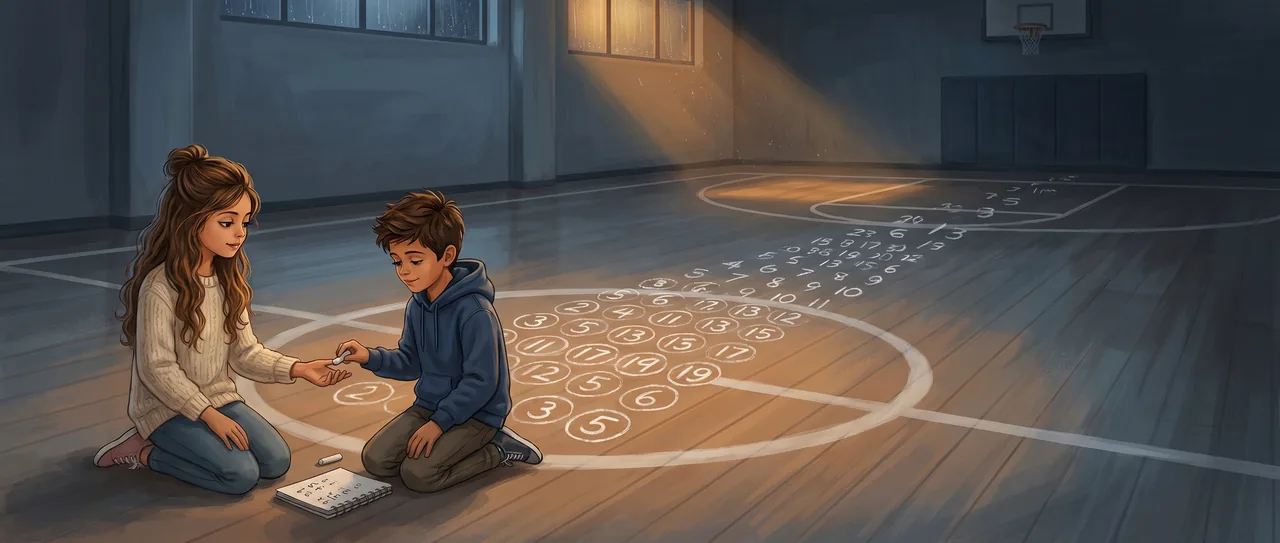
Maya had a piece of sidewalk chalk in her pocket because Maya always had a piece of sidewalk chalk in her pocket. She started writing numbers on the gym floor, in the strip of light from the one window that still glowed.
"Crossing out the ones that aren't prime," she said. "Old game. My uncle showed me."
Soren crouched beside her. Two, three, five, seven. She crossed out four, six, eight, nine. He watched the survivors line up.
"Three and five," he said. "Two apart. Five and seven. Also two apart."
"Twins," Maya said. "That's what they're called when they sit that close. Eleven and thirteen. Seventeen and nineteen."
Soren pulled out his notebook, because the inside of his head was already too small for this. He wrote the pairs in a column. Three and five. Five and seven. Eleven and thirteen. Seventeen and nineteen. Twenty-nine and thirty-one.
"They keep coming," he said.
"For now," Maya said. She was already further down the floor, chalk squeaking, crossing things out fast. "But look. They're getting lonelier."
He looked. Between two and twenty the primes were thick as gravel. Past forty they spread out. The twins came less often. Forty-one and forty-three. Then a long dry stretch. Then fifty-nine and sixty-one. Then nothing for a while.
"The primes thin out," Soren said slowly. "That part I can almost feel. The bigger the number, the more things can divide into it. So fewer slip through."
"Right." Maya stood up and looked back at the whole chalk river of numbers running across the gym. "So if single primes get rarer the higher you go, then twins, two of them landing right next to each other, that should get really rare. Crazy rare. Should just stop."
"Should," Soren said.
They both stared at the floor.
"Let's find the last one," Maya said.
That was the thing about Maya. She didn't want to read about whether the twins stopped. She wanted to walk to the end of the chalk and stand on the last pair herself.
So they kept going. Sixty-one. Sixty-seven. Seventy-one and seventy-three, a twin, Soren circled it. Seventy-nine. Eighty-three. Eighty-nine. Ninety-seven. The chalk reached the free-throw line. The pairs were thinning, just like she said. The gaps yawned wider.
"One hundred one and one hundred three," Soren said. "Twins. Still going."
"They're holding on," Maya said. She was on her knees now, chalk worn to a stub. "But they have to quit eventually. The numbers get too big. Too many things divide them."
They crawled the pairs across the painted center circle. One hundred seven and one hundred nine. One hundred thirty-seven and one hundred thirty-nine. The gaps between twins grew. Sometimes a hundred numbers with no pair at all. Soren's notebook filled. His hand cramped. The single window light was fading as the storm thickened outside.
"We can't actually reach the end this way," Soren said finally. He sat back on his heels. "There's always a next number. We could chalk the whole floor and the whole parking lot and never get to the end of the numbers. They don't stop."
"The numbers don't," Maya said. "But do the twins?"
That was a different question, and the moment she said it the gym felt bigger.
"Okay," Soren said, working it. "Here's what bugs me. The twins are getting rarer. We watched it. So a part of me says, sure, somewhere up there is the last pair. The biggest two primes that ever sit side by side, and after them, never again. Just lonely primes forever, scattered, no neighbors."
"And the other part?" Maya asked.
"The other part says, how would you ever know?" He tapped the notebook. "Rare isn't gone. We hit dry stretches down here and the twins came back. What if they always come back? Just farther and farther apart, forever, all the way up, and they never truly stop, they just get harder to find?"
Maya was quiet. She looked at the river of chalk, all those crossed-out numbers, the circled pairs getting lonelier toward the dark end of the gym.
"So which is it," she said.
"I don't know," Soren said.
"Guess."
He committed, because he always committed. "They go forever. The twins. I think they never stop. Just thinner and thinner and never quite zero."
"I think that too," Maya said. "But thinking isn't knowing."
A coach was walking the rows of dead chessboards with a flashlight, herding kids toward the door. He swung the beam across their floor and stopped.
"What is all this?"
"Prime numbers," Maya said. "The ones that come in twos. We're trying to find out if they ever stop."
The coach laughed, not unkindly, the laugh of a man who wanted to lock up and go home. "Somebody's worked that out by now, kiddo. Math's all figured out. Mop's in the closet, clean it up."
Maya looked at Soren. Soren looked at Maya. Neither of them moved toward the closet.
Because they had just learned the thing the coach didn't know. Nobody had worked it out. Not the chalk way, not any way. People had been chasing the twins up the number line for two thousand years, with paper and with machines that count higher than any human could, and the twins kept appearing, thinner and thinner, and no one on Earth had ever proven whether there was a last pair or no last pair at all.
The flashlight beam waited on them.
"It's not figured out," Soren said quietly. "That's the part. Nobody knows."
The coach shrugged and moved his light to the next aisle. To him it was just chalk.
Maya stood up in the fading window light. She walked to the dark end of the gym, past the last pair they'd found, into the empty floor where the numbers would keep going if they kept writing, up and up, smaller and lonelier and maybe never stopping.
She held out her hand without looking back.
"Chalk," she said.
Soren put the last stub in her palm, and they knelt together at the edge of the dark and kept counting.
Read the interactive version, listen to the narration, and earn a gold star →
A science-verified short story for curious kids · Curiosity Land