The Cushion You Can't See
The griddle was so hot it made the air above it shiver.
Maya's tía Carmen ran the pupusa stand, and Maya's job was to keep the workspace wet so the masa wouldn't stick to her hands. She kept a bowl of water by her elbow and flicked her wet fingers at the surface to test it. That was the part she liked. When the griddle was barely warm, the water spread out flat and steamed away with a tired hiss.
But today the griddle was at full roar, and when Maya flicked her fingers, the water did something else.
The droplets pulled themselves into tight little beads and went skating. They raced across the iron, dodging each other, spinning, lasting whole seconds before they vanished. On a cooler griddle a drop died instantly. On this one it lived and ran.
"Soren," she said. He was sitting on an upturned crate doing nothing useful, which was his weekend specialty. "Come look. The water's faster when it's hotter."
Soren came over and looked. He had his notebook, because of course he did.
"That's backward," he said. "Hotter should kill it quicker."
"I know. Watch."
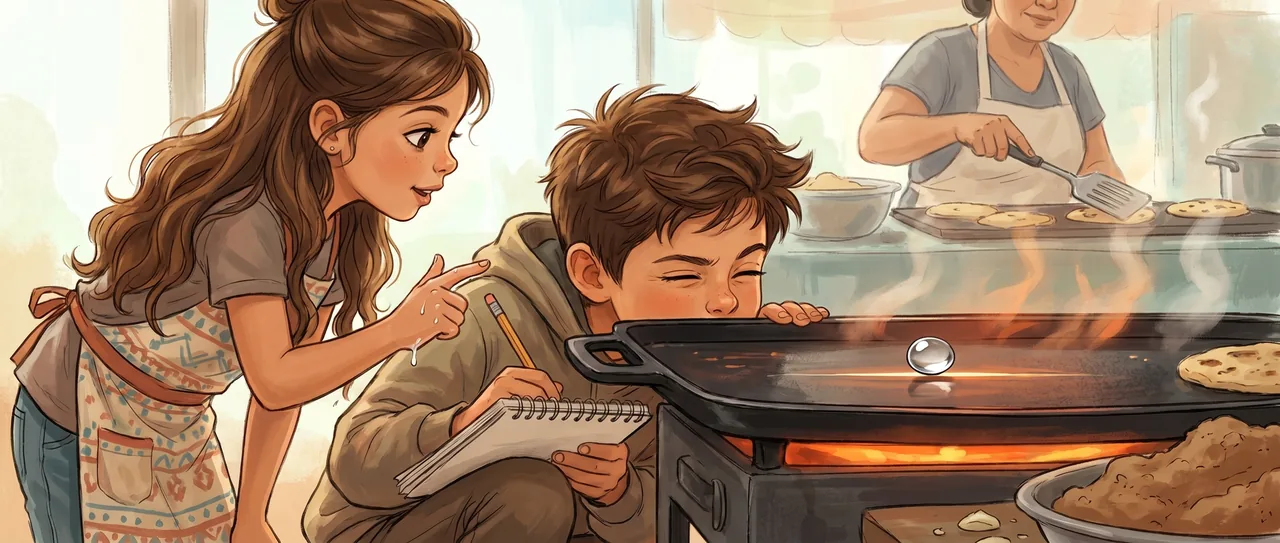
She flicked a drop onto the cooler edge of the griddle, near the rim where the heat dropped off. It splatted and steamed and was gone in less than a second. Then she flicked one into the middle, the blazing center. It balled up and skated for a full three seconds, a tiny silver marble rolling across a black desert.
Soren stared. He flicked one himself. Then another. He did it maybe ten times, leaning so close Carmen swatted him back with a spatula.
"Cooler equals dead. Hotter equals alive," he said. "Every time. That's not a fluke."
"So the cold part of the griddle is more dangerous to a drop than the hot part," Maya said. She heard how strange it sounded and liked it more for being strange.
Carmen flipped a pupusa without looking. "You two are going to burn your fingers off."
"We're not touching it," Soren said. He turned to Maya. "Why does the hot one live?"
Maya didn't answer with words. She was watching one particular drop, a fat one, and she saw it. The drop wasn't touching the iron. It was sitting up on something. It hovered, just barely, the whole bottom of it lifted off the surface, riding.
"It's floating," she said. "Soren. It's not on the griddle. It's above it."
He got down to eye level, cheek almost on the workbench, sighting along the surface. "You're right. There's a gap. There's a line of light under it."
"On what, though." Maya chewed her lip. "There's nothing there."
And then she had it, the way she sometimes got things, the answer arriving before the reason. "Steam," she said. "It's floating on its own steam."
Soren sat back on his heels. "Say that again."
"The bottom of the drop boils so fast it makes a layer of steam. And the steam holds the rest of the drop up. So the drop never actually touches the metal." She talked faster, chasing it. "On the cool part it's not hot enough to make the steam fast enough. So the drop just sits down on the iron and dies. But on the screaming hot part, it makes steam quicker than the steam can escape, so there's always a cushion under it."
Soren was writing now, fast, his tongue between his teeth. "That's why it lasts longer when it's hotter. The steam insulates it. The drop is sitting on a pillow of its own steam and the pillow keeps the heat away from the rest of it." He looked up. "It's protecting itself. By boiling."
They both went quiet. The drops kept skating, dozens of them now, a tiny silver traffic with no roads.
"Tía," Maya said slowly. "Have you ever burned your hand on the griddle?"
"A hundred times."
"But you wet your fingers first. To test it."
Carmen paused. She looked at her own hand, at the wet fingertips she touched to the iron so quickly you'd miss it if you blinked. "My mother taught me that. You touch fast, with a wet hand, you don't get burned. Dry hand, slow hand, you scream." She shrugged. "I never asked why. It just works."
Maya and Soren looked at each other.
"It's the same thing," Soren said quietly. "The water on her fingers does the same trick the drops do. It flashes into steam and the steam is the cushion. For a fraction of a second her skin is riding on steam instead of touching hot iron."
"People do it without knowing why," Maya said. "For generations. Her mom. Her mom's mom."
Soren wrote that down too. Then he stopped writing and just sat there, which for Soren was a large thing to do.
"There are people," he said, "who dip a wet hand into molten metal. Lead. Way hotter than this. And pull it out fine. Because of this exact thing. The steam comes off so fast it lifts their skin off the metal before the heat gets through." He shook his head. "I read about it and didn't believe it. I thought it had to be a trick."
"It is a trick," Maya said. "It's just a real one."
Carmen leaned in over both of them, spatula on her hip, watching the drops race that she had watched her whole life and never once stopped on. "So my mother was doing physics," she said. "With her fingers. At a tortilla griddle."
"Everybody is," Maya said. "They just don't write it down."
"He does," Carmen said, nodding at Soren.
Soren didn't answer. He had found a new question and you could see it land on him. He flicked one more drop into the hot center and got down low again, watching the line of light hold the water up off the iron, the cushion that was there and not there, made of the very thing trying to destroy the drop.
"How thin is it," he said. "The cushion. How thin can it get before it fails."
Maya wet her fingers. She held them over the screaming center of the griddle, close enough to feel the heat push back, and did not yet touch down.
Read the interactive version, listen to the narration, and earn a gold star →
A science-verified short story for curious kids · Curiosity Land