The Crack That Closed
The helmet had a crack in it, and the crack was getting shorter.
Maya was sure of it. She had set the helmet on the workbench an hour ago, dropped from the shelf when Soren's grandfather moved a box, and the crack had run a thumb's length across the white shell. Now she crouched with her nose almost touching it. The line was thinner at one end. Like ice melting backward.
"Soren. Come look. The crack shrank."
Soren was untangling a bicycle chain and did not want to lose his place. But Maya did not say things like that for no reason. He wiped his hands and crouched beside her.
"Cracks don't shrink," he said. "That's not a thing that happens."
"I'm not saying it's a thing. I'm saying look."
He looked. He found the spot where the crack ended. He pressed his fingernail there and made a tiny scratch in the workbench to mark it. Then he sat back and waited, because that was the only way to know.
"You're going to watch it," Maya said. It was not a question. She liked that about him.
"Six minutes," he said. "If it moved, it'll move again."
They waited. The garage smelled of oil and old cardboard. Grandfather was somewhere behind the shelves, humming to a radio, half listening at most.
After six minutes Soren leaned in. The crack ended before his scratch now. Not by much. By the width of a hair.
"Okay," he said quietly. "That's not nothing."
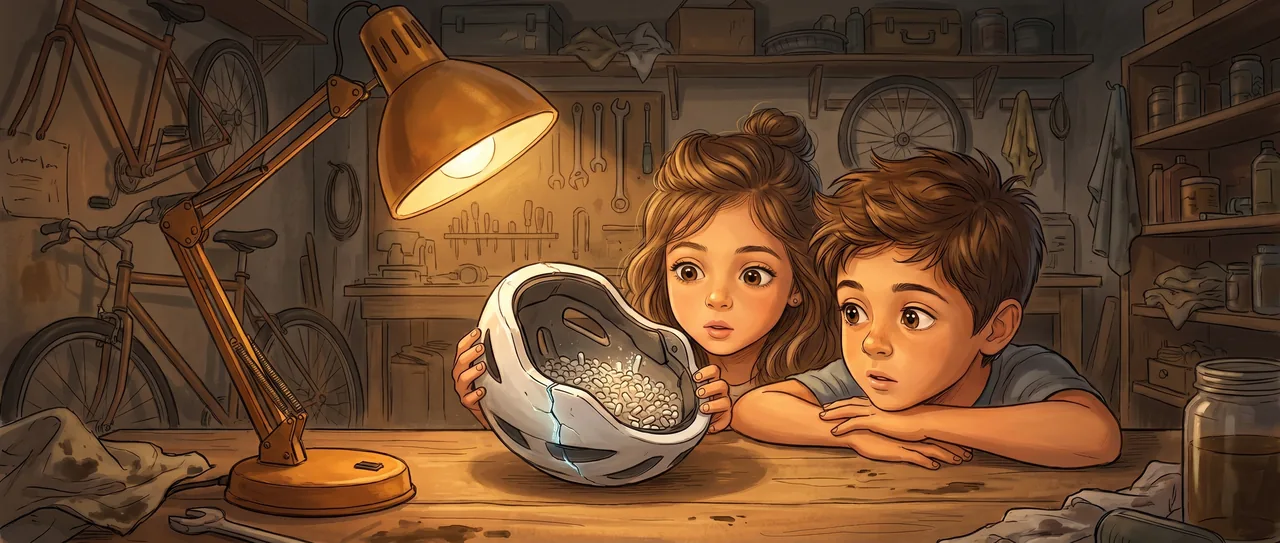
Maya picked up the helmet and turned it under the lamp. Along the crack there was the faintest shine, like a wet line drying. She touched it. It was barely tacky.
"Something came out," she said. "Something filled it."
"From where? It's solid plastic."
Maya held the helmet to the light and tilted it until the shine caught. And there, all through the white shell, she saw them. Tiny dots. Hundreds of them, smaller than salt, scattered through the plastic like seeds in bread.
"Soren. It's full of dots."
He took it and angled it the same way. The dots only showed at the right angle, when the light went sideways through the shell.
"Those aren't dirt," he said. "They're inside. They're part of it." He ran his thumb along the crack again. "And the wet stuff is along the crack. Not on the dots far away. Only where it broke."
Maya was already three steps ahead. "So the break popped them. Like stepping on a grape. The crack tears through and they spill."
"And the spill fills the crack." Soren stopped. He looked at the helmet like it had said something to him. "It's bleeding. The helmet is bleeding into its own cut."
They were both quiet.
Maya took it back and pressed gently on the shell near the crack, bending it the smallest amount. A new shine welled up along the line, then stopped. She let go. The shine settled and began, slowly, to dull.
"It only bleeds when it breaks," she said. "The rest of the time it just carries the dots around. Waiting."
"For years, maybe." Soren's voice had gone soft. "It's been waiting since the day it was made. Driving around on people's heads. Doing nothing. Holding all those little capsules full of glue, just in case."
Grandfather's voice came from behind the shelves. "You two still fussing over that old helmet? It's done. I cracked it. Toss it."
"It's not done," Maya called back. "It's fixing itself."
Grandfather laughed, the laugh of a man who had thrown away a thousand broken things. "Plastic doesn't fix itself, sweetheart."
"This one does," Soren said. Not arguing. Just reporting. "We watched it."
There was a pause from behind the shelves, and then the humming started again, because Grandfather had decided they were playing and gone back to his box. He did not come look. Maya thought that was strange and a little sad, that a person could be that close to a healing thing and choose the radio.
She set the helmet down and put her face level with the workbench so the crack was at her eye line.
"How does it know," she said.
"Know what?"
"Where to bleed. It doesn't have a brain. It doesn't decide. The crack opens and the right capsules are exactly there, in the path, because someone put them everywhere. So no matter where it breaks, there are capsules in the way."
Soren turned that over. "You can't predict where a thing will crack. So you don't try. You fill the whole thing with the cure. Every spot is ready because no spot is special."
"Like a scab that's already in you before you're cut," Maya said.
"It's not alive, though."
"No." She kept staring at the line. "That's the part. It's not alive and it heals anyway. Somebody figured out how to make not-alive things do the thing alive things do."
Soren got out his notebook then, because the inside of his head had run out of room. He wrote: helmet, dots, only bleeds where broken. Then he stopped writing and just held the pen, because there was a thought coming and he wanted to be empty for it.
"If a helmet can do this," he said slowly, "then so could a pipe. A bridge. A plane wing. A crack starts somewhere you'll never see, deep inside, where no one could ever reach to fix it. And it just. Closes. On its own. In the dark. Forever." "There are things being saved right now," she said. "All over. And nobody's watching. Like this. Cracks closing in the dark and no one knows."
They both turned back to the helmet.
Soren found his scratch mark on the workbench. The crack ended well short of it now. He pressed his fingernail into the wood a hair's width ahead of the crack's new end, making a fresh mark.
Then the two of them put their chins on the workbench, side by side, eyes on the white shell, and watched the line keep closing toward it.
Read the interactive version, listen to the narration, and earn a gold star →
A science-verified short story for curious kids · Curiosity Land