The Bird That Never Flapped
The bird had been with them since Tuesday, and Soren was certain it was cheating.
"It has to flap eventually," he said. He was leaning over the rail with his notebook braced against the wind, which kept trying to peel the pages back. "Everything flaps. Pigeons flap. Eagles flap. It's just been a while."
"It's been since breakfast," Maya said. "And yesterday. And the day before."
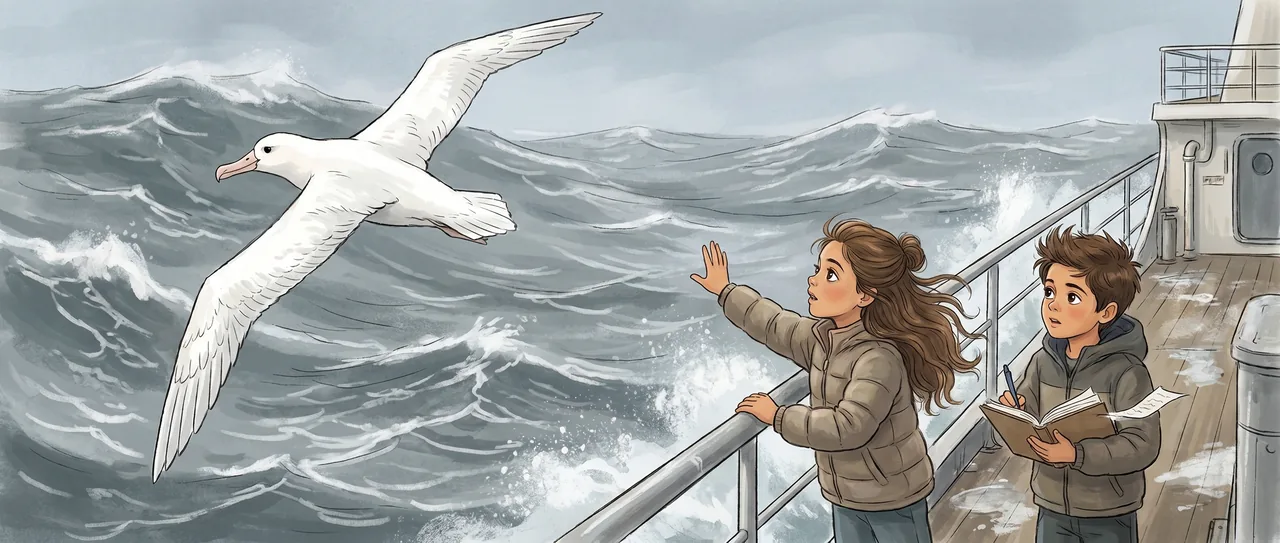
They watched. The albatross was enormous, bigger than Soren when it opened up, white as a torn sail, and it never once beat its wings. It sank low along the back of a wave, almost touching the gray water. Then it tipped, caught something invisible, and rose. High, higher, until it tilted and came sliding back down the far side of the swell. A long curve. Then another. The same shape, over and over, like a signature being written across the whole ocean.
"There," Maya said. "It did the thing again. It climbs, then it turns, then it dives. Every time. Same loop."
Soren wrote loop and then crossed it out and wrote arc. "Birds don't get free energy. It's costing it something."
"Then where's the cost?" Maya asked. She wasn't arguing. She genuinely wanted to know. That was the thing about Maya. She would chase a question right past the point where Soren wanted to stop and think.
Her mother came up the stairs with two mugs of cocoa and a thermos clamped under her arm. She worked on the engines, not the science, and she had the tired, cheerful look of someone who had been awake since four.
"Still watching your bird?" she said.
"It won't flap," Soren said. "It's been hours."
"Albatross," her mother said, the way you name a thing and then have nothing else to add. "They follow ships. Free ride." She handed over the cocoa and went back down to the noise and heat below, and that was all the help they were going to get.
Soren stared at the line where she'd written nothing. Free ride bothered him. The ship wasn't pulling the bird. The bird was nowhere near the ship's wake half the time. It was out wide, working the open swells where there was nothing but water and wind.
Wind.
"Maya," he said. "Put your hand over the rail. Low. Now lift it up slow."
She did. "It's faster up high," she said immediately. "Down by the deck it's almost calm. Up here it's pushing." She lifted her hand higher and the wind shoved it back. "Way faster up high."
Soren felt the shape of it arriving before he had the words. He looked at the bird. Low, in the slow air near the water. Then climbing. Climbing into the fast air up high.
"Watch when it climbs," he said. "Tell me what it does at the top."
They both leaned out. The albatross sank into the quiet pocket against a wave, then rose, up out of the slow air, up into the rushing layer above, and right there at the top, in the fast wind, it turned. Swung around hard. And dove back down.
"It turns into the fast wind," Maya said slowly. "It turns so the fast wind hits it from in front."
"And that's a push," Soren said. "It steals speed off the difference. Slow air down low, fast air up high. It climbs into the fast layer, turns to catch it, and the wind hands it a shove. Then it dives back down and spends that speed climbing again."
"It's not fighting the wind," Maya said. "It's, it's eating it. It's eating the edge between the slow part and the fast part."
Soren wrote: wind shear. Slow air near waves, fast air above. Bird harvests the difference. Then he stopped writing, because his hand had gone still.
"It never flaps," he said quietly, "because it doesn't have to. Ever. As long as there's wind and waves, it can just keep doing that loop. Forever."
Maya had gone very quiet too, which never happened. She was doing the thing where her eyes moved like she was watching numbers that weren't there.
"How far," she said.
"What?"
"If it never has to flap. If the wind just keeps feeding it. How far could it go?"
Neither of them knew. But Soren remembered a panel on the wall of the mess hall, by the door, that nobody ever read, and he was suddenly desperate to read it. They both went, hands on the cold rails down the stairwell, and there it was under a smear of someone's coffee.
Wandering albatross. A young one leaves the nest and does not touch land again for years. One bird had been tracked all the way around Antarctica. Forty-six days. The whole frozen continent, the whole screaming ocean, in forty-six days. In a single year, one of them might fly one hundred and twenty thousand kilometers.
Maya read it twice. "That's three times around the Earth," she said. "In a year. Without flapping."
"It's not without flapping," Soren said. "It's without ever stopping. It sleeps out here. It eats out here. The same bird up there might have already gone around the whole bottom of the world. More than once."
They went back up. The wind hit them at the top of the stairs and Maya laughed, because now the wind was not just weather. It was the thing the bird was reading, line by line, the slow part and the fast part, the edge between them that you couldn't see but could feel the second you lifted your hand.
The albatross was still out there. Low, then climbing, then the turn at the top into the fast air, then the long dive down. Writing its signature across the swells. It had not flapped once the entire time they were below.
"It doesn't even know we figured it out," Maya said.
"It doesn't need us to," Soren said. "It's been doing it for millions of years. We just stood here and watched and worked it out from a rail."
Maya put her hand back over the rail, palm flat, and lifted it slowly from the calm air near the deck up into the part that pushed, feeling for the edge the bird was riding. Out past her fingers, the albatross tipped at the top of its arc, turned into the wind, and dove.
Read the interactive version, listen to the narration, and earn a gold star →
A science-verified short story for curious kids · Curiosity Land