Twenty-Two Hours From Here
The cafeteria screen usually showed lunch menus, lost hoodies, and reminders about not flicking peas.
On Tuesday it showed a black sky with one bright speck labeled Voyager one.
Soren stopped with his tray halfway to the table.
Maya bumped into him and saved her milk with two fingers.
“Signal restored,” Soren read. “Spacecraft launched in nineteen seventy-seven. In interstellar space. Still transmitting. One-way light time about twenty-two hours.”
Maya looked at the tiny speck. “That picture is lying.”
“It is probably not a real picture,” Soren said.
“No. I mean the speck part.”
The cafeteria flowed around them. Shoes squeaked. Somebody laughed too loudly. The screen changed to chicken nuggets.
Soren carried his tray without looking away from where the speck had been.
Their science teacher, Mrs. Keene, chose that afternoon to announce the Distance Fair. Each pair had to make the class feel one enormous distance without using the words very far.
“You may use string, scale models, maps, or demonstrations,” Mrs. Keene said. She was writing while she talked, because the eighth-grade rockets had clogged the sink again and she had glitter on one sleeve. “You have two minutes each on Thursday.”
Maya raised her hand.
Mrs. Keene saw her and sighed first. “Yes, Maya.”
“Can we use waiting?”
“Waiting is not a material.”
“It is for Voyager.”
Mrs. Keene clicked the cap onto her marker. “Two minutes, please. I have thirty-one projects to hear.”
That meant no.
Maya wrote nothing down. Soren wrote Voyager one, twenty-two hours, not a speck.
After school, they sat on the curb by the bike rack. Soren had printed three pages from NASA’s website in the library. Maya had found a cracked plastic salad container in the recycling bin and was turning it over like it might become part of the answer.
“It crossed into interstellar space,” Soren said. “Not near another star. Just outside the heliosphere.”
“The what?”
“The bubble made by the Sun’s wind.”
Maya stopped turning the container.
Soren checked the page. “The Sun blows particles outward. There is a boundary where interstellar space pushes back. Voyager passed that boundary.”
Maya looked up at the afternoon Sun. It sat over the school roof, ordinary and white and too bright to stare at.
“So the Sun has weather,” she said.
“Sort of.”
“And Voyager went past the weather.”
Soren did not write that down. He just held the page flatter. But the Sun was no longer a circle in the sky. It was throwing itself outward in all directions, a storm bigger than the planets, and one human-made thing had gone through the edge of it and kept talking.
Maya stood up.
“We are not using string,” she said.
“My first calculation used string,” Soren said. “It did not go well.”
“How not well?”
“If Earth was here and Voyager was the end of the hall, the Sun would be smaller than dust. If the Sun was a basketball, Voyager would be kilometers away. The school is not big enough.”
“Good,” Maya said. “Then the school is wrong.”
They went to Soren’s apartment because his mother worked late on Tuesdays and did not mind if they used the kitchen, as long as nothing burned and no magnets went near her bank card.
Soren’s little sister had left a toy microphone on the table. It could record ten seconds and play them back with a squeal. Maya pressed the red button.
“Voyager, are you there?” she said.
The microphone squeaked the question back at once.
“Terrible,” Maya said.
“Too fast,” Soren said.
He opened the clock app on his old tablet. It had a timer, an alarm, and a cracked corner that made the number seven look like a hook.
“We can set an alarm for twenty-two hours,” he said.
“That just rings.”
“We can record the answer and make it ring tomorrow.”
Maya made a face. “Then we are faking the spacecraft.”
“We are faking the wait,” Soren said. “Not the spacecraft.”
Maya considered that. She opened the salad container and put the toy microphone inside. The plastic made her voice hollow.
“Does Voyager answer right away?” she asked.
“No. Even if it sends a signal right now, Earth receives it about twenty-two hours later. And if Earth sends a command, that takes about twenty-two hours to get there.”
“So hello takes almost two days to become hello back.”
“Yes.”
Maya pressed the microphone button again. This time she said, “We sent this yesterday.”
It played back at once.
“Still terrible,” she said.
Soren tapped his pencil against the table, three soft taps, then two. He did that when a thing was not working but was close enough to make him stubborn.
“What powers it?” Maya asked.
“Not sunlight,” Soren said. “Too far. It uses radioisotope thermoelectric generators. Heat from plutonium decay becomes electricity.”
Maya opened the kitchen junk drawer. She found foil, two rubber bands, a dead flashlight, birthday candles, and a packet of batteries.
“Decay sounds like ending,” she said.
“It is slower than ending.”
Soren said it quietly, still looking at the page.
Maya placed the batteries beside the dead flashlight, then pushed them away. “Not batteries. Not candles. Something changing by itself for decades.”
“The power gets lower over time,” Soren said. “They have turned off some instruments to save energy.”
“Like whispering because you are far away.”
“Like whispering because you are far away and old and still exact.”
The toy microphone suddenly seemed too loud.
They did not build a model that night. They built a schedule.
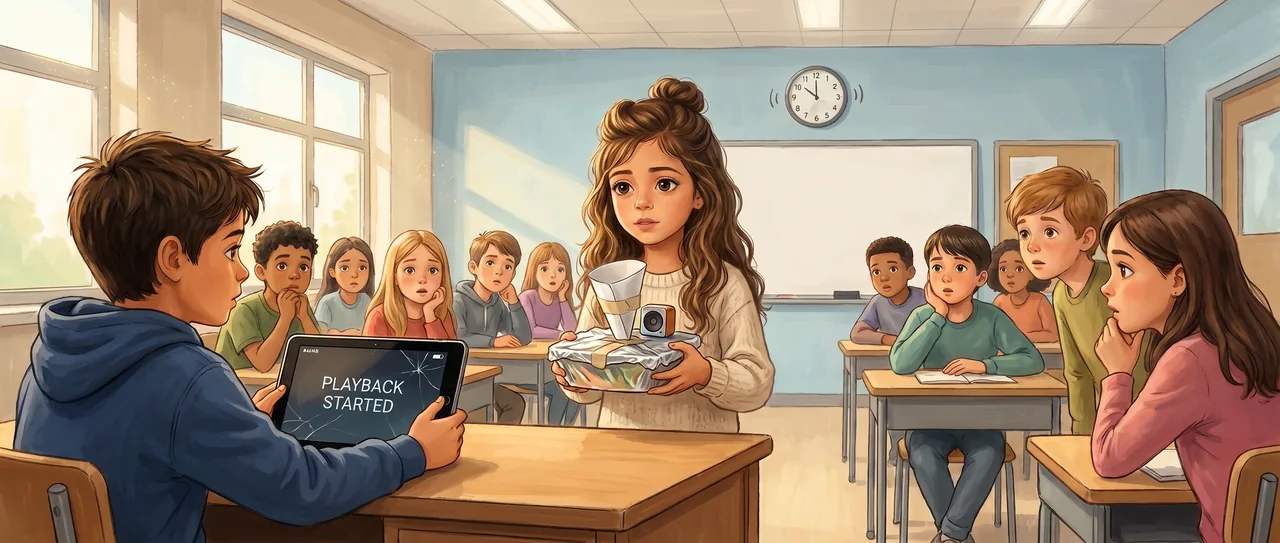
On Wednesday at exactly ten thirteen in the morning, during recess, Maya and Soren stood under the metal stairs behind the gym. Soren held the tablet. Maya held the salad container wrapped in foil, with the toy microphone inside and a paper cone taped to one end.
“This is the receiver,” Soren said.
“It is a salad container,” said Malik from their class.
“It is listening,” Maya said.
That made three people stay. Then five. Then twelve.
Maya pressed record on the toy microphone and spoke into the paper cone.
“Voyager one, are you there?”
Soren set the tablet alarm for Thursday at eight thirteen. He showed the screen to everyone who had stayed. Twenty-two hours.
“That’s tomorrow,” Malik said.
“Yes,” Soren said.
“So nothing happens now?”
Maya snapped the lid shut on the salad container. “Now is the thing that happens.”
Most of them left.
Not all.
A girl from the other class, Lina, stayed until the bell rang. She looked at the foil container and said, “My dad texts from the night shift. I get them when I wake up. It’s weird. Like he is there and not there.”
Soren nodded once. “Yes.”
He did not add anything. He did not make it smaller.
On Thursday morning, Mrs. Keene was collecting volcano posters when Maya put the foil container on the front table.
“No liquids,” Mrs. Keene said without turning around.
“No liquids,” Maya said.
“No smoke.”
“No smoke.”
“No live insects.”
Soren paused. “Also no.”
Mrs. Keene turned then. Her glitter sleeve had been washed, but one silver dot remained near her elbow. “You have two minutes.”
“We need one minute now,” Maya said. “And we used twenty-two hours already.”
Mrs. Keene looked at the clock. “Begin.”
Soren stood beside the table. He did not hold up the NASA pages. He did not draw the solar system. He only said, “Voyager one launched before our parents were born. It flew past Jupiter and Saturn. It is past the bubble of particles blown by the Sun. It is in interstellar space. It still sends radio signals to Earth.”
Maya lifted the foil container.
Soren said, “A signal from Voyager takes about twenty-two hours to get here.”
Nothing happened.
Someone coughed.
Mrs. Keene glanced at the clock again.
Maya held the container at chest height. Her arms did not shake.
The room got restless in layers. First chairs. Then shoes. Then whispers. Soren watched the tablet screen. Ten seconds. Nine. Eight.
The alarm chimed.
Maya opened the container. The toy microphone squealed, then played her voice from yesterday, small and scratchy and trapped in plastic.
“Voyager one, are you there?”
Soren pressed the play button again for the second recording, the one they had made after everyone left.
The little speaker hissed.
Then Soren’s voice came out, quieter than Maya had ever heard it.
“Still here.”
No one laughed.
The classroom clock ticked above the whiteboard. Outside, a truck backed up with three soft beeps. Inside, everyone stared at the foil container as if it had become heavier.
Mrs. Keene opened her mouth, then closed it.
Maya put the container down. “That was our distance.”
Their two minutes were over, but no one moved to set up the next project.
Lina raised her hand even though it was not her turn. “If it talked this morning, when would we hear it?”
Soren looked at the clock. Maya was already counting on her fingers, not because she needed to, but because it made time feel solid.
“Tomorrow morning,” Soren said. “Around now.”
Malik leaned forward. “And if we answered?”
“Saturday,” Maya said.
Mrs. Keene sat on the edge of her desk. “We do have class on Friday.”
It was not permission exactly. It was not a no.
At recess, Maya carried the foil container outside. Soren brought the paper cone and the tablet. Lina came too. Malik followed with half his sandwich still in his hand.
They stood under the metal stairs behind the gym, where the first question had left Earth.
Maya raised the paper cone toward the pale morning sky.
Read the interactive version, listen to the narration, and earn a gold star →
A science-verified short story for curious kids · Curiosity Land